When water comes home
In Berehale, Afar Region, PROSPECTS-supported water services are easing the burden of water collection and giving women and girls more time for learning, family care and other activities

“I was so excited. I just wanted to walk over and open the tap.”
Berehale, Afar Region, Ethiopia – “You see the mountain over there,” says Medina Musa, pointing towards one of the two stark peaks surrounding her small town of Berehale. “It used to take almost five hours to fetch water and bring it back home.”
For years, collecting water was a daily struggle for Medina and many other women in Berehale.
She would leave home early with other women from the village to search for water. The small stream running along the mountainside was unreliable, and even when they found water, the journey home was exhausting.
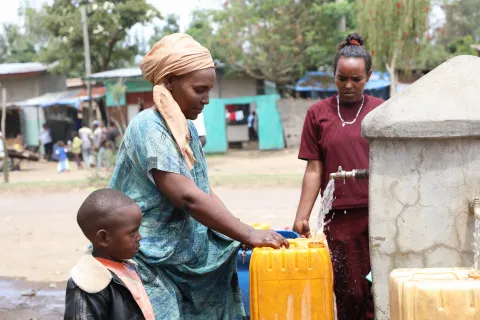
“Even when we found water, we had to carry a jerrycan strapped to our backs. Because one jerrycan was not enough, we also carried smaller five-litre containers in our hands. By the time we got home, we would feel very tired,” she recalls.
Later, a well was dug and a hand pump installed closer to the village, giving women some relief. But it was still not close enough to Medina’s home. A few years later, Berehale received an additional water supply system with government support. However, households away from the main roads still had limited access to the distribution network. Insufficient reservoir capacity and frequent power interruptions also disrupted water production and distribution, leaving host communities and refugees without reliable access to water.
“We were so happy to have water available nearer to us, even if it still took an hour or so to fetch it,” she says.
Medina never imagined that she would one day have water at her doorstep.
That changed six months ago when UNICEF, through the PROSPECTS project, supported major improvements to water supply and sanitation services in Berehale, benefiting families like Medina’s and thousands of refugees.
Two large reservoirs were constructed uphill, while existing boreholes were rehabilitated to increase the amount of water pumped into them. Water distribution networks were also expanded to neighbourhoods across the town. UNICEF installed solar panels to mitigate power disruptions and improve the reliability of the town’s water supply system.
The town’s water utility worked with the local administration and community members to identify households to prioritize for new connections. Medina registered in the utility’s customer system and waited for her turn.
Then, finally, water came to her home.
“I was so excited. I just wanted to walk over and open the tap,” she says, smiling.

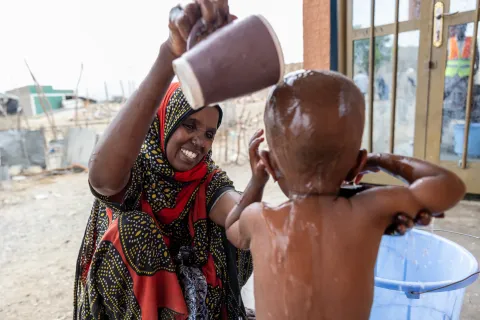
Today, Medina takes pleasure in turning on the tap inside her compound. Cooking, bathing and washing clothes have become much easier. Tasks that once required hours of walking and carrying heavy containers can now be done within the safety and comfort of her home.
Medina’s 13-year-old son, Abdulkerim, sometimes helps her fill a bucket. He may be too young to fully understand the hardship his mother endured to bring water home, but he is happy to see it flowing in their compound.

So far, around 900 families in Berehale have received household water connections, while many more await their turn as expansion work continues.
“We understand the challenges women face when collecting water,” says Mohammed, head of the town’s water utility office. “It makes me happy to see their joy when we connect their homes to the water network.”
The utility collects regular payments from customers, using most of the revenue to maintain the water network and cover the electricity needed to run the pumps. This helps sustain services for the growing number of connected households.

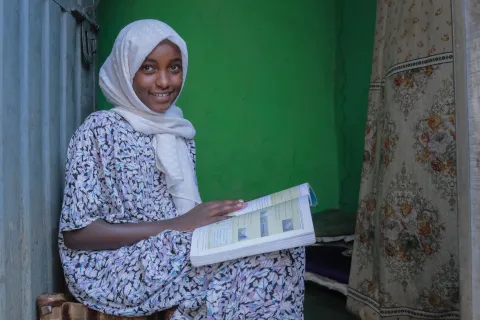
For Medina, however, the change means much more than having water at home. She is especially happy that her nine-year-old daughter, Meyrem, may be spared the hardship endured by generations of women and girls in the community.
“When I see that our daughters do not have to go through what we experienced, I feel so much happier,” Medina says.