Transforming Communities
Child Marriage Survivors Advocate against Harmful Practices
![Hanan Hussein [name changed for confidentiality] walking to her classroom.](/ethiopia/sites/unicef.org.ethiopia/files/styles/hero_extended/public/138A7131c.JPG.webp?itok=ZgHlpq3J)
Many young girls in the Oromia region are forced into marriage before they're ready. UNICEF, in partnership with the Bureau of Women and Children Affairs (BoWCA) and other partners, works to stop these harmful practices and ensure every girl stays in school, learns, and thrives.
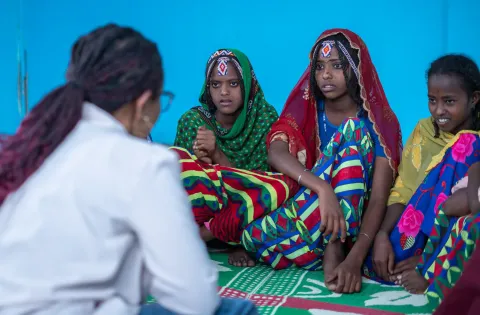
![15-year-old Hanan Hussein [name changed for confidentiality] (left) sitting with her mentor, Halima Abdulhamid (right).](/ethiopia/sites/unicef.org.ethiopia/files/styles/media_large_image/public/138A7141c.JPG.webp?itok=bJxgVNNy)
Living in Sire Woreda, Oromia region, 15-year-old Hanan Hussein [name changed for confidentiality] was abducted and forced into child marriage. After being held for a week, she managed to call her family, who quickly came to rescue her. Despite this experience, Hanan has returned to school, continuing her education in the eighth grade for four months now. Reflecting on her ordeal, Hanan credits the Out-of-School life skills training for giving her the courage to escape the forced marriage.
“Without this training, I would have felt ashamed and feared rejection from society,” says Hanan. “Now I am focused on finishing my education to become a doctor.”
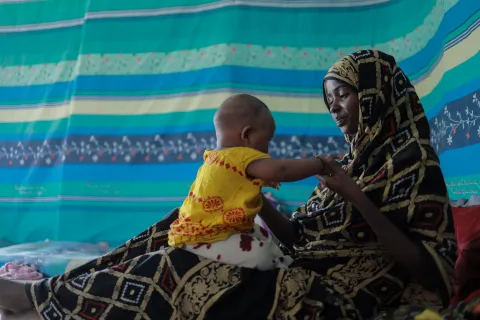
![Seniya Mohammed [name changed for confidentiality] holding her chlid.](/ethiopia/sites/unicef.org.ethiopia/files/styles/media_large_image/public/R6__6866.webp?itok=aG6bLEio)
Similarly, Seniya Mohammed [name changed for confidentiality] married at the age of 15 and gave birth to her child at 16.
“Because I married young, I feel a deep sadness. I was separated from my friends, and while they continued their education, I dropped out of school from the eighth grade.” Seniya's marriage was informally cancelled, and she has now enrolled in the Out-of-School life skills training programme. She shares her experiences to advocate against harmful practices.

Halo Haji was only 14 years old when a potential groom’s family began asking for her hand in marriage. “I was agonized,” Halo recalled. “I kept asking: ‘Why is this happening to me now?” Terrified, she fled to her sister in Adama without telling her parents. Luckily, her father opposed the marriage, wanting Halo to finish her education. Halo has now returned home and is continuing her education. “I advise young girls against child marriage. I tell them that it will hurt them.” Halo is now in the sixth grade and dreams of finishing her education to become a teacher.

Halima Abdulhamid serves as a mentor in the Out -of-School life skills training programme, guiding children who have dropped out of school to return to their education. She teaches them about the importance of returning to school and raises awareness about the dangers of harmful practices, ensuring they have a safer and brighter future.
"I encourage the girls to focus on their education and understand the dangers of child marriage. By guiding them back to school, I hope to ensure they have a safer and brighter future."
According to the Ethiopia Demographic and Health Survey conducted in 2016, 48 per cent of women and girls aged 20-24 in the Oromia region were married before turning 18. UNICEF's strategies to eliminate harmful practices include empowering both out-of-school and In-School adolescent girls and mobilizing communities to shift attitudes and practices. By engaging parents, boys, men, religious and other community leaders, UNICEF aims to create an empowering and protective social environment. It also focuses on strengthening service delivery, enhancing the enabling environment, and improving data and evidence to inform programming and policy initiatives.
The UNICEF Ethiopia End Child Marriage and FGM programme is funded by the European Union and the governments of Iceland, Italy, Belgium, Luxembourg, Austria, Netherlands, Norway, Spain, Canada, Sweden, and the United Kingdom. We are grateful to our donors who contribute to our joint efforts to end child marriage, FGM, and improve the lives of girls.