Towards a polio free Ethiopia
Fighting polio in Afar region, one child at a time
The world is closer than ever to ending polio, but outbreaks still persist in some countries. In pastoralist communities like Ethiopia’s region of Afar, where people move from one place to another with their animals looking for water and pasture, immunization activities are challenging. Children often miss out on their life saving vaccinations, including polio. A recent confirmed case of polio in the region put surveillance and vaccination teams on high alert. Determined health workers are also marching in harsh weather to make the world free from polio for every child.

Inside Semera Health Centre, Nasir Idris, an Expanded Programme on Immunization (EPI) nurse, prepares polio vaccines, carefully sorting the vials and droppers. He arrives early every day so that the campaign team can take enough supplies and start immunization on time. In early October, an integrated polio vaccination campaign is launched in Afar covering multiple districts. More than 350,000 children under five are targeted in a four-day campaign.

While Nasir makes vaccines ready for the vaccination team, his colleague Mohammed Ali walks around the outskirts of Semera town announcing the campaign. He calls on mothers and caregivers with children under five years of age to get ready. “A polio vaccination campaign is underway… health workers coming to your homes, children under five will be vaccinated…”

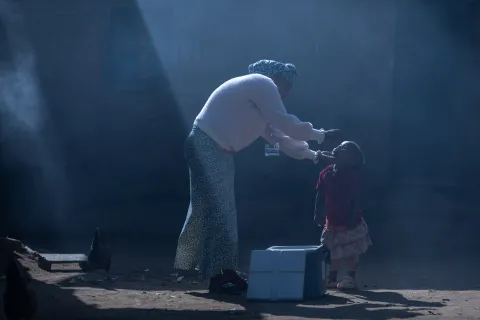
After the team covered suburbs and homes on the outskirts of Semera town, they proceeded further to remote villages crossing rough volcanic terrains. “The people here in Afar live scattered around vast areas. They also move from place to place with their cattle. So, we have to walk far to get to their homes in hot weather,” says Husein Siraj carrying a vaccine cold box. “But we are happy, the community nowadays understands the value of vaccination to their children’s health.”

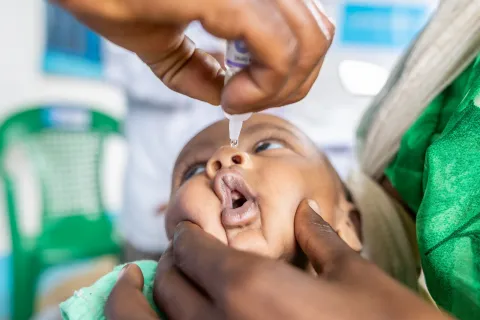
35-day-old Hamdu Asrer had to wake up from his peaceful sleep but for good reasons. He took his first vaccine, thanks to dedicated health workers like Husien and Mohammed. “I am happy that he gets the vaccination here at home. He will be healthy, and I will make sure that he takes the rest of his vaccination,” says Adma Ali, Hamdu’s mother.


The house-to-house polio vaccination campaign has a lot of meaning for the two brothers: 5-year-old Mohammed Ahmed and 3-year-old Seid. Both have never been vaccinated before, also known in technical terms as ‘zero-dose children’. The campaign creates an opportunity to track children like Mohammed and Seid and refer them to the nearest health facilities where they can receive other essential lifesaving vaccinations.
The boys' mother Ayisha is glad that her children are protected. “They [the health workers] are kind to us. They came all the way here to help our children. My children have not been vaccinated before, but they are safe now.”
“The health workers are kind to us. They came all the way here to help our children. My children have not been vaccinated before, but they are safe now.”

Before moving to the next house, Mohammed marked the boys’ house and wrote the date of the visit noting that every child aged under 5 years had received a dose of Oral Polio Vaccine (OPV) in that round.

Finally, it was 10-month-old Kedija’s turn. She remained calm and curious, observing what was going around in the comfort of her mom’s arms. While she kept staring at the little vial she wanted to play with, Husien gently opened her mouth and put two drops of the OPV. The little one is yet to know the importance of the vaccine, but polio, a debilitating childhood illness, will not come near her.
The Afar region has one of the lowest overall immunization coverages in Ethiopia, with only 53 per cent[1]. The region also has more than 67,000 unvaccinated (zero-dose) children[2]. Following a recent confirmed polio case, an integrated polio vaccination campaign was held from 7-10 October with two more days for mop-up activities. In addition, the identification and enlisting of zero-dose and under-immunized children is also carried out during the campaign. UNICEF with partners like WHO, CDC, Gates Foundation, and government counterparts, provided technical and logistics support to the campaign.
[1] Regional Health Bureau, 2023
[2] National Big Catch-up Plan to Reach Zero Dose Children, 2023