Leaving no child behind
Reaching zero-dose children with lifesaving vaccines and other essential health and nutrition services

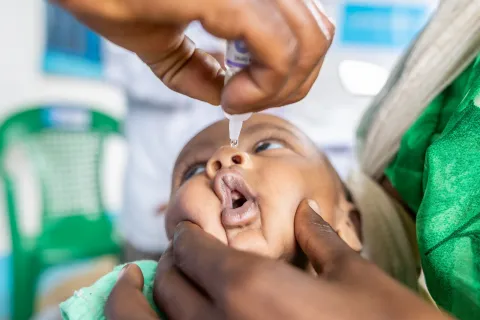
Vaccines are lifesaving. They are also the most effective and safest method to protect children from life-threatening diseases. Ethiopia has shown significant improvement over the years, increasing immunization coverage. Yet, there are still many children who have missed out on their life-saving immunization for various reasons. In the South and Central Ethiopia regions, UNICEF is working with the government to find all unvaccinated children under the age of five through house-to-house visits, including two-year-old Zinash.

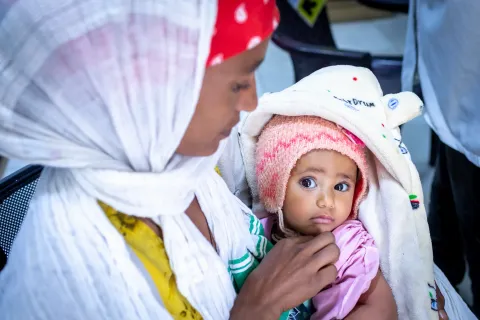
Tiringo struggles to make ends meet by selling vegetables in the local market. Every day, she leaves early, walking for nearly two hours, to Doyo Gena town to get vegetables at a good price. Then she sells it in the local market, making a small profit to support her family of six children, including her two-year-old daughter Zinash. While Tiringo keeps herself busy putting food on the table, her little girl misses out on her crucial routine immunizations. In fact, Zinash has never been vaccinated, also referred to, in technical terms, as a zero-dose child.
“I usually leave her at home with her siblings when I am gone to get the vegetables. I thought she would get a fever or a headache if she got the shots, and it would be difficult for them [her siblings] to look after her.”
Tiringo’s vaccine hesitancy and misconceptions were a wrong move. Zinash's growth was stalled, and she frequently fell ill. “She was not gaining proper weight and got sick easily. I was concerned. I kept thinking, maybe if I had taken her earlier, she would have been much better,” says Tiringo.

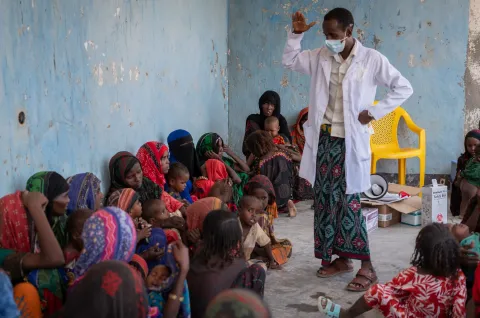
Early in the month of June, in the little village of Qosha, where little Zinash lives, and the surrounding districts, health workers began a house-to-house enumeration to identify zero-dose and under-vaccinated children. Various outreach sites were set up in hard-to-reach villages, which are far from health facilities, to provide vaccination and other integrated health and nutrition services.

“We provide immunization integrated with other services during outreach vaccination sessions,” explains Demekech Wakeltu, the Health Extension Worker in Qosha Kebele (sub-district). “We identify and vaccinate zero-dose and under-vaccinated children, screen children and pregnant or lactating women for their nutritional status, provide vitamin A supplement and deworming tablets. We also encourage mothers to get birth certificates for their children.”

It is during this house-to-house enumeration that Demekech identified Zinash. “When we found her, she was zero-dose,” Demekech recalls. “We gave her the first round of vaccines, [including Penta1, PCV1, Rota1, IPV1, Measles 1st dose] and Vitamin A supplement. We also screened her and found out that she was severely malnourished and referred her to Outpatient Therapeutic Programme (OTP) services.”

The house-to-house visits are conducted once a month and are vital to identify children who missed out on critical health services because of access or misconceptions.
“Many mothers are either too busy with everyday life or live far from the health post. They don’t always prioritize vaccination, not because they don’t care, but because of other competing priorities.”

“We educate mothers to bring their children for routine immunization,” adds Demekech. “But many mothers are either too busy with everyday life or live far from the health post. They don’t always prioritize vaccination, not because they don’t care, but because of other competing priorities.”

Zinash is now protected from debilitating childhood illnesses. She is also recovering well from severe malnutrition. Though Tiringo regrets seeing what happened to her little girl, she is now keen to advocate for vaccines.
“I know vaccines are important. They protect children from diseases like measles. I want other mothers to know this. It saves lives,” she says. “I want my daughter to grow up healthy and become a doctor one day, so that she can help others.”
The South Ethiopia and Central Ethiopia regions are among the top 10 in the country, where 10 per cent of the country's zero-dose children reside. In June this year, UNICEF, with support from the Church of Jesus Christ of Latter-day Saints (LDSC), conducted a house-to-house enumeration to identify and vaccinate zero-dose and under-vaccinated children in most underserved communities in 65 woredas (districts). Health extension and community mobilizers, along with maternal and child health coordinators from woreda health offices, managed to reach and vaccinate over 37,000 zero-dose and under-vaccinated children as of July 2025.