Reaching the Unreached
Mobile health and nutrition teams continue to serve as a lifeline for pastoralist communities in Ethiopia

In Ethiopia’s Somali region, access to healthcare is often shaped by distance and mobility. For pastoralist families who move with their livestock, reaching a permanent health facility can be difficult, particularly for women and young children.
This is where Mobile Health and Nutrition Teams, known as MHNTs, step in. By following community movement patterns, the teams bring essential health and nutrition services directly to families who would otherwise go without care.

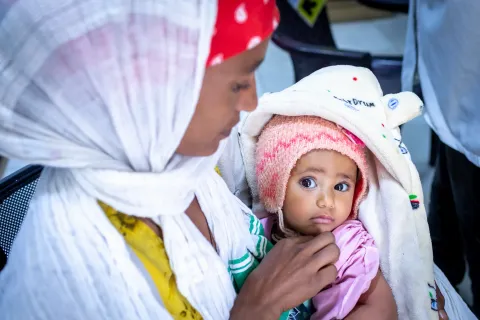
In the remote pastoralist village of Berguled, nine-month-old Amel sits calmly on her mother’s lap, watching the activity around her with quiet curiosity. Unused to seeing so many people gathered in one place, she observes everything closely. Moments later, Amel receives her routine immunization, a brief discomfort that will help protect her health for years to come.

“I brought my child for immunization today,” says Ikram, Amel’s mother. “I want my child to be healthy and strong.”
After Amel is vaccinated, Ikram is given a vaccination card that records all of her daughter’s routine immunizations. She is advised to keep the card safe, as it will be important for tracking Amel’s health and future vaccinations.

Across the Somali region, MHNTs play a crucial role in delivering life‑saving health services to pastoralist communities. These include routine immunization, antenatal care, treatment for moderate and severe acute malnutrition, and the management of common childhood illnesses.
MHNTs are also rapidly deployed during emergencies such as droughts, floods, and disease outbreaks. Teams typically include nurses, midwives, health extension workers, and drivers, and are equipped with vehicles, medicines, and other essential supplies to reach communities in need.

Ikram smiles as she watches her baby, relieved to know Amel is protected and growing healthy. For pastoralist mothers and children living in remote villages, access to care is often uncertain, making each visit from the MHNTs deeply meaningful.
“To see my baby protected, growing healthy and strong, fills my heart with joy,” says Ikram.
“For us, the mothers of the herds and the wide plains, these Mobile Health and Nutrition Teams are not just visitors. They are a lifeline. They bring care to our remote doorsteps and restore hope, not only for our children, but for our entire community.”
Core UNICEF funding is essential to overcoming the systemic barriers faced by MHNTs. It helps address operational instability, strengthens emergency preparedness, and enables more effective health and nutrition services. In pastoralist regions where mobility defines daily life, this support makes MHNTs indispensable for delivering maternal and child healthcare to hard-to-reach communities.
Core and flexible funding that UNICEF receives from partners is essential to overcoming the systemic barriers faced by MHNTs.