Nyanding’s Voice Against Child Marriage
Defying the Odds to Reclaim Her Dreams

Jikawo Woreda (District), Gambella Region: In the small, close-knit community of Kebele (sub-district) 01, Nyanding (16) carried big dreams in her heart. A 9th-grade student, Nyanding loved school and dreamed of becoming a teacher one day. She spent her days studying, helping her mother at home, and playing with her younger siblings. However, behind the walls of their modest home, a storm was brewing—one that threatened to shatter her dreams.
One evening, Nyanding’s parents sat her down to deliver life-changing news. They had arranged for her to marry a 58-year-old man from the United States of America (USA). “It’s for her best interest,” her father said, as her mother nodded in agreement silently beside him. The family had been promised a good dowry, and the man assured them he would financially support both Nyanding and her family. Little did they know that the man already had a wife in the USA.
The parents further informed Nyanding that the marriage was set to take place on 25 October 2024, giving her just weeks to prepare herself for the new life that they decided for her. Nyanding’s world tilted. She couldn’t believe what she was hearing. At that moment, an inner voice screamed, “How could they take away my dreams, and my life, like this?”
According to the Ethiopia Demographic and Health Survey (EDHS) 2016, one in three child brides in Ethiopia are married off to men who are at least 10 years older[1], with the age difference in Gambella being 7 years.[2] The child marriage prevalence in Gambella is 47 per cent among women aged 20 to 24 years, implying nearly 1 in 2 girls are subjected to child marriage. The situation in Jikawo Woreda is particularly alarming, with the highest prevalence among woredas in Gambella for child marriage at 43.8 per cent among girls aged 10-17, as per further analysis by Overseas Development Institute (ODI) in 2016 based on the 2007 Census. This is significantly higher than the national average of 12.9 per cent. Due to the high magnitude and severity of the problem, UNICEF targeted the woreda as part of the Global Programme on Ending Child Marriage, focusing on girls and those who influence their lives.
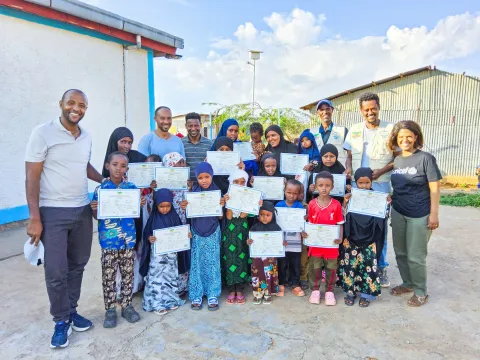
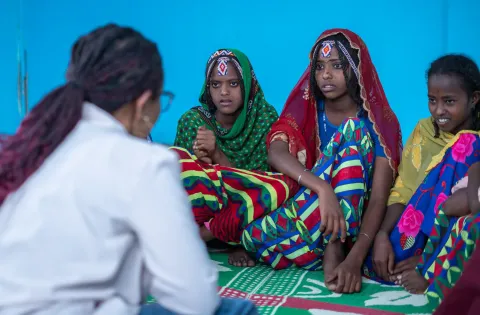
But Nyanding wasn’t the same happy girl again after the proposed arranged marriage incident. Through a life skills programme conducted by Gambella Regional Bureau of Women and Social Affairs in collaboration with UNICEF, she attended in her Kebele, she learned about the dangers of child marriage—the risks to her health, education, and future. She had also learned her rights, and the power to stand up for herself.

With newfound knowledge, confidence, and understanding of child marriage dangers, Nyanding refused the marriage. “No,” she said firmly, her voice trembling but resolute. However, her parents did not agree with her. “You’re just a child,” her father said angrily. “We know what’s best for you.”
The days that followed were filled with relentless pressure. Her parents threatened her, scolded her, and eventually resorted to physical violence to force her compliance.
Frightened and desperate, Nyanding confided in her best friend Ayana. They sat together on a quiet afternoon under the shade of a large tree, and Nyanding poured out her heart. “I cannot marry this man, I don’t want to sacrifice my education and career dream,” she said, tears streaming down her face. Her friend, also a participant in the life skills programme, listened carefully and then spoke with determination. “Remember what we learned in the life skills sessions? We need to tell someone who can help. Let us report this to the social workers.”
Together, they made the brave decision to act. Nyanding and her friend approached a social worker and shared everything about the incident. The social worker immediately took action by informing his supervisor and coordinating with local authorities to prevent the impending child marriage.

Meanwhile, as the social worker coordinated efforts for her rescue, Nyanding's parents forced her to travel from Jikawo to Gambella, a distance of 92 kilometres, to hand her over to the man they had chosen for her. This journey highlights the lengths Nyanding's parents were willing to go to marry her off.
The response was swift. The police, acting on the social worker’s report, intercepted the family in Gambella. Nyanding was rescued and returned to Jikawo, where social workers were waiting to provide her with care and support. They listened to her story, reassured her, and helped her begin to heal.
With the social worker's help, Nyanding was able to return to school and resume her education. She also continued attending the life skills programme, which became a lifeline for her. The sessions not only deepened her understanding of her rights but also gave her a sense of strength and self-worth. She learned how to manage her emotions, make decisions, and build resilience for the challenges ahead.
The experience also changed her family. Her mother, moved by the intervention and its impact, began attending community conversations in her area. There, she listened to other parents, learned about the harm caused by child marriage, and began to see things from Nyanding’s perspective. Over time, her mother became a strong advocate for protecting children’s rights in their community. However, Nyanding’s father is still currently being engaged in dialogue about the multi-dimensional impact of child marriage on his daughter and the legal consequences for the family by the Bureau of Women and Social Affairs and selected influential community members participating in the local community conversation intervention.

Nyanding’s journey is one of courage and transformation—not just for her but for her family and community. It is a story of how knowledge, support, and determination can light the way in even the darkest of times. Today, Nyanding continues to pursue her education, her dreams intact, with the hope that no other child in her community will have to face what she did.
Her story serves as a powerful reminder of why life skills programmes and community engagement are so vital. They don’t just teach; they empower. They don’t just inform; they transform. And they don’t just protect dreams; they make them possible.
UNICEF, as part of the Global Programme to End Child Marriage continues to implement comprehensive prevention and response interventions. These includes building the capacity of adolescent girls through life skills education and strengthening their platforms. By engaging the community with evidence-based and tested social and behavioural change interventions, UNICEF aims to shift attitudes and practices to delay marriage and support girls' aspirations and dreams. Additionally, efforts are focused on strengthening service delivery, creating an enabling environment, and tracking cases and evidence to contribute to a protective and empowering environment.
On behalf of the girls, women, their families, and communities served, UNICEF expresses its sincere appreciation for the generous contributions of the Governments of Belgium, Canada, Italy, the Netherlands, Norway, the United Kingdom, the European Union, and Zonta International. These contributions are instrumental in creating a brighter future and empowering girls to achieve their dreams.