Menstrual Hygiene and Health implementation in schools improved girls’ performance and family income
Bambasi primary school is one of the seven schools supported by UNICEF budget from CIDA fund since 2020 in Benishangul-Gumuz region.

Rahel Sima, 15, is a grade 7 student in Bambasi primary school, Bambasi Woreda (district) in Benishangul-Gumuz region. Her father died 5 years ago. As a result, her mother got sick, and she can’t do physical activities. Rahel has an elder sister, Shume Sima, in grade 8, who has physical disabilities on her hand. As a result, earning most of the household income depends on Rahel.
After school, Rahel works as a daily laborer, assistant to the masons to cover the family expenses and educational materials. Due to the social taboo, menstruation issue is not widely spoken among the society. Like most adolescent schoolgirls in Ethiopia, Rahel had poor knowledge regarding menstrual hygiene management and doesn’t have money to buy sanitary pads. As a result, she used to absent from class and the daily laborer work at least for 2 -3 days per month.
As parts of eliminating inequalities in WASH services access, UNICEF Ethiopia’s Water, Sanitation and Hygiene (WASH) Programme, supported the menstrual hygiene management (MHM) implementation that contributes to reducing child marriage through improving girls’ school attendance, performance, and school completion.
Bambasi primary school is one of the seven schools supported by UNICEF budget from CIDA fund since 2020 in Benishangul-Gumuz region.
To Break the silence on MHM, trainings were given for woreda health experts, teachers, and Health Extension workers (HEWs) to support the Social and Behavioral Change Communication (SBCC) campaign in the schools and school’s catchment. Accordingly, SBCC campaigns were done in the school and school catchment using audio vans, information, education, and communication materials distribution. Advocacy meetings were held with the community representatives, religious leaders, and elders to increase the awareness about the natural process of menstruation and how to properly manage it in school and at home.
For girls to manage their menstruation effectively, safe space (one block with four rooms) was constructed: one lockable room with water and soap for washing, shower, private space for drying wet cloths, bins, and incinerator for disposing off used pads; one room for taking rest during their menstrual periods; one room for counseling and one room for waiting area either for counselling or washing or to change the used pads. Through the implementation of MHM, the adolescent girls in the school are provided with access to sanitary pads to absorb or collect menstrual blood, soap, and clean water supply (for bathing, handwashing and washing clothes) as well as sanitation facilities that allow privacy to change sanitary pads and for safely disposing of used materials.

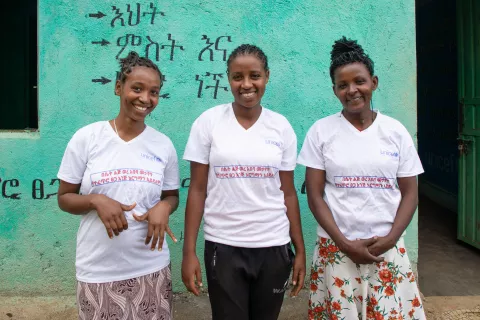
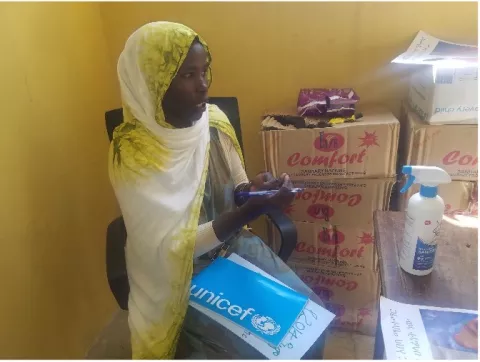
School MHH clubs were established composed of both girls and boys with a focal person from female teachers, through which awareness raising is conducted using microphones at flag ceremonies and school mini media. The MHH focal teacher teaches adolescent girls about the natural process of menstruation and how to properly manage it in school and at home. After orientation, the focal person distributes hygienic and sanitary materials including soaps, underwear, sanitary pads, and sanitizers to poor girls who can’t afford to buy the sanitary materials. Rahel is one the active MHH club members and the beneficiaries from UNICEF supported MHH programme in Bambasi primary school.
Rahel is confidently saying that through the MHH club in the school, she has acquired enough knowledge about the physiological process associated with sexual maturity and biological facts as well as practices of managing menstruation. She is not afraid to ask advice from a teacher or other staff member at school if she needs sanitary pads to manage her menstruation.
“The MHH programme is a blessing for me because I can’t afford to buy the sanitary pads with the current high cost of living. I would have totally quit class.”
"Through the support of the programme, I don’t have shortage of hygienic material. I am regularly attending the class as a result, last year, I scored high in grade 6 and ranked 3rd from the class. Moreover, after the class I am working as a daily laborer which has helped me to have additional income for the family and contributed to withstand the current high living cost,” said Rahel.
The MHH coordinator also witnessed that the MHH programme implementation in the school has ensured the safety and dignity of adolescent girls and empowered them. It has also improved their absenteeism from school during critical time of menstruation and improved their academic performance.
However, additional, and continued support is critically important to expedite the Regional Education Bureau’s plan to increase girls’ enrolment, retention, and gender parity index at primary education (1-6 grades) from 0.87 in 2020 to 0.96 in 2024.
Considering the emphasis given in UNICEF global Gender Action Plan II (2018-2022), the UNICEF Ethiopia New Country Programme (2020-2025) has made a commitment to shift towards a more gender transformative programming approaches.