I don’t have words to express how happy I am with this water scheme
Basoliben Woreda of East Gojjam Zone

Abesha Goshu (40) is a mother living in Yelem Gej community, Basoliben Woreda of East Gojjam Zone. She is a single mom living with her 15 years old son and 9- and 6-years old daughters. Abesha makes her living by making and selling ‘tella’ (a local beer). Making the tella makes her household consume a large amount of water. They consume more than 30 jerrycans of water per day on Fridays and more than 10 jerrycans of water per day from Monday to Thursday.
Abesha remembers the situation in the past.
“Since the queue at the water source became very long during the day, we used to fetch water during the night using a torch. On Fridays, it used to get worse. We were not able to do other activities but only fetch water. Excluding the travel time, we had to wait at least 2 hours to fetch one jar of water.”
“I have been carrying water till a bruise happened on the back to my waist,” she continued, “my son’s waist was bent since he has been carrying water on his shoulder all the time. I have been making him fetch water even by making him absent from school.”
In addition to her own and her son’s hard labour, Abesha previously has been hiring additional 3-4 people to fetch water. She also shares her frustration with the water quality.
“I have been fetching water while cattle were also drinking from the same source. Due to this, the water was not clean, and we have been using that water as it is without boiling it even for drinking. Since I was afraid to get sick, I have never drunk water unless it is ‘tella’ before this water scheme was constructed.”
“Since there was a water shortage, there were times that I couldn’t make and sell ‘tella’. I had to do what I could do and made my earnings. We couldn’t wash our clothes and utensils. We used to wear our clothes even three times without washing them. I have been sparing water when they (my family) want to wash their hands before eating food.”

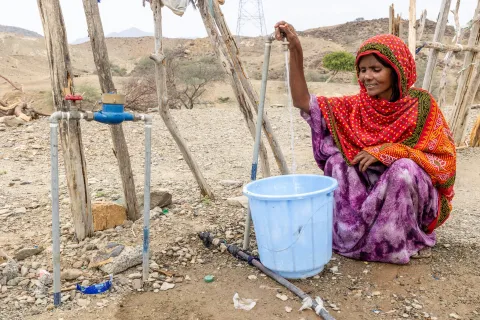
Thanks to the Yelem Gej rural drinking water system, Abesha, and her household have now a waterpoint in their compound. This gave her more time for other activities. Since the problem has been solved related to water, domestic activities like cooking, cleaning, bathing, and washing clothes are all easier too. Alike Abesha and her household, the project has solved the issue of water shortage in Yelem Gej community permanently.
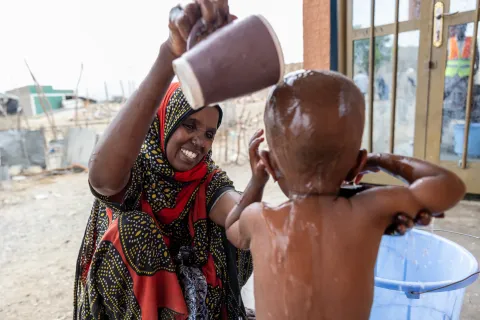
Abesha said all these things have become a history of the past since she is now fetching water in her compound. “Now we eat the food keeping our hands clean. I am drinking water in addition to tella. We are washing our clothes two times a week. Also, my son is not absent from school anymore. He is attending school.”
“I don’t want this water to be taken from us. I can’t withstand that. We saw a world that we have never seen, and have never thought about. Now, I am even worried when the water is interrupted for a single hour and a single day.”
“This water made me save hard labour and time. If there is time, we can do different activities. Nowadays, time is everything and it can be transformed to money.”
Recognizing the strong need by the community and the burden it imposed on the public in general, and on women and children in particular, UNICEF, with the generous funding from Les Mills and the New Zealand National committee for UNICEF, worked together with Amhara regional water bureau, East Gojjam zone water department, Basoliben Water office and with the community to construct a new water scheme called Yelem Gej Rural drinking water supply system.
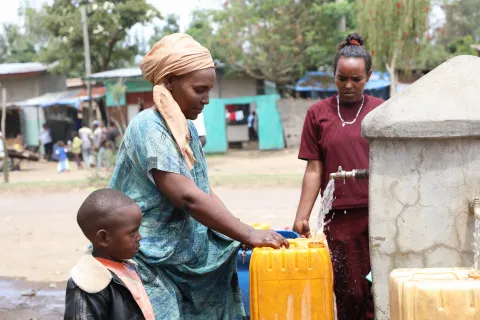
Currently, Yelem Gej rural drinking water supply system is serving an estimated 10,000 population through 8 communal water points and 180 household water points. All three public institutions in the community (2 schools and 1 health centre), have access to water.
The water scheme is managed through a WASH committee and managing the water scheme provides employment to one water technician and one manager. The committee is strong, and they have saved more than 750, 000 ETB (US$14,000) which empowers them to cover the costs of breakdowns or other expenses when they need that.
Currently, the system is working through a diesel generator. They are waiting and asking for an electrical grid connection. The cost of diesel makes the cost of water higher as diesel is more costly than other energy sources in the area and it also must be transported from urban areas.