Humanitarian cash grant help families rebuild their lives in Ethiopia
Ataye, Amhara region

“I was making an income higher than that of my husband’s,” says Merima Hassen a mother of three children in the town of Ataye, Amhara region “I ran a small restaurant near the bus terminal. People love to dine there, and I was happy.”
Perhaps Merima has another reason to be grateful for. Her first-born twins are performing well in high school - ready to take the national exam - while her youngest child, only six years old, is about to graduate from kindergarten. And she is a mother who provides everything to make her children successful.
Life was good before it took a sudden sad twist.
In March this year, something terrible happened; her town Ataye and the surrounding woredas (districts) were engulfed by violence. Sadly, Merima lost her husband to the conflict and her restaurant was burnt to the ground.
“I was so devastated. I didn’t know what to do or to think,” says Merima.

Despite her ordeal, Merima had no alternative but to stand strong. At least for the sake of her children. “I worry that what happened to us will jeopardize their future. They have been working so hard for the national exam. I pray that they succeed,” she says.
Like Merima, 25-year-old Tizibt Mulugeta tells a similar story. Tizibt attended school up to grade 9. When her mother died, she quit her studies and began supporting herself by selling roasted peanuts on the streets. But the conflict changed all that.
“When it started, we ran for our lives. My house was burnt down, I lost everything,” she says. Tizibt is now staying at her neighbour’s house.
Merima and Tizibt are struggling to get their lives back on track. And help has come at a time when they need it the most.
UNICEF with support from Swedish International Development Cooperation Agency (SIDA), started providing small humanitarian cash grants to families most affected by the conflict.

The selection of beneficiaries follows a two-part process. First, families who have lost their main source of income were screened. Then priority was given to pregnant and lactating mothers; to families headed by women, children, or the elderly; and to those who have chronically ill members and people with disabilities.
Next, members of the community validate the selection process and anyone who feels they should have been selected can file a complaint to the appeals committee which is established at a local level.
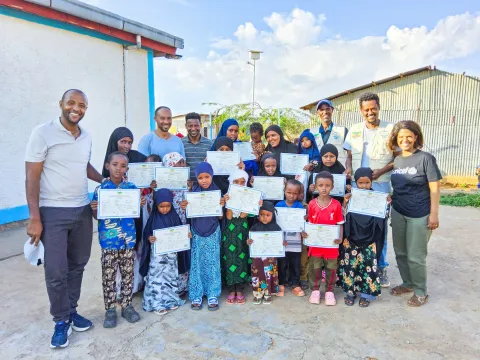
“We work closely with the local administration and community members to identify families whose livelihood is affected by the conflict, especially those headed by women,” says Yeshi Negash, head of the woreda Women and Children Affairs Office.
“Many families lost their livelihoods due to this conflict. We are glad that this cash grant is helping them to start over,” adds Seyoum Assefa, Head of the Ataye Town Administration Office.
So far 336 families, including Merima’s and Tizibt’s have been selected and a three months’ grant is transferred to their bank accounts as a lump sum, based on the agreement reached with the community. The amount of transfer depends on family size and each family member is entitled to 1,560 Ethiopian Birr (USD$35).
A total of 1.8 million Ethiopian Birr (USD$41,000) has been distributed to the families so that they can start rebuilding their livelihoods.
“The main objective of the humanitarian cash transfer programme is to improve food security amongst poor households affected by the conflict,” says Worku Berhe, UNICEF’s Planning and Monitoring Specialist. “It helps the families to not only meet their daily needs but also start their small businesses.”
Merima is now back in business. She rented a small place and opened a restaurant though it is not as busy as the previous one. She also sells tea and coffee to supplement her income. “Business is yet to pick up,” she says. “But I am glad to be back to work.”
Tizibt on the other hand bought a sack of peanuts with her cash grant. She soaks some of it in salted water overnight. Then it will be slightly roasted on the next day. After small portions are wrapped with used paper, the crunchy salted nuts will be ready to sell at the local market.
“I am making preparations to sell my peanuts tomorrow,” she says smiling proudly. “I am grateful for the support given to me. The cash grant helps me to start over.”