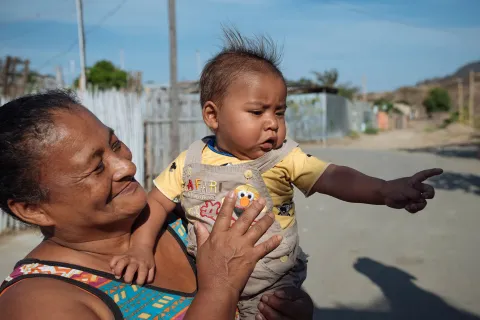
"I went from reporting COVID-19 cases in my neighborhood to living it first hand in my family"
Magdalena came face-to-face with COVID-19 when her daughter Brithany contracted Multisystem Inflammatory Syndrome, but her experience as a community health monitor helped them overcome the disease together.

- Español
- English
Magdalena Zambrano, 47, is a woman living in Guayaquil, Ecuador who does not give up; not even in the toughest times. Inspired to help, she visits her neighbors’ homes in Monte Sinaí, checking on their health status.
"I work every day with the kids here in my sector. I visit every home and make sure they have been vaccinated. Many children are missing two or three vaccines, in those cases I do the paperwork and report the cases so the kids can get their vaccines. I also identify the cases of pregnant teenage girls and do check-ups on them," says Magdalena.
For the past five years, she has been part of a group of 80 leaders who have become community health monitors and whose goal is to watch over the well-being of the Monte Sinaí inhabitants, one of the most vulnerable areas in Guayaquil, where the impact of the pandemic adds to the poverty, lack of basic services, drug addiction problems , violence and illiteracy, among others.
There in Monte Sinaí, where health services are limited, the work of community health monitors like Magdalena is critical. They concern themselves with finding out who has diabetes, asthma, hypertension or other health conditions.

The community health monitors also encourage families to complete their vaccine schedules according to age and they help with the registration of live births and the identification of children with malnutrition, anemia, tuberculosis, HIV, or other health problems. They even check whether children are studying or not. As cases are identified, community health monitors refer them to the NGO Development and Self-management (DyA), UNICEF's implementation partner, which has been present in this area for 10 years and who takes charge of addressing and managing each case, as well as coordinating with the Ministry of Public Health and other local institutions.
Magdalena comments that during the months of March and April of this year, when the number of COVID-19 cases in Guayaquil was at its high point, in Monte Sinaí the community health monitors had a lot of work but also went through a lot of pain.

"On this block where I live, everyone got infected with COVID-19. I went from house to house asking how my neighbors were doing," says the community health monitor, who during that time checked up on people in her sector, advising them to stay home while reporting any cases to DyA so that they would receive medical care and get the PCR test.
What Magdalena never imagined was that the virus would come to her home and infect all members of her family, including her 8-year-old daughter Brithany, who has 76% physical and intellectual disability.
"First my husband got infected, then me, then my son Allan and finally Brithany. I was shocked when Brithany’s test came out positive. I even cried, because I wasn’t expecting my daughter to get COVID," says Magdalena becoming teary eyed again upon remembering.
As a result of COVID-19, Brithany was affected by Multisystem Inflammatory Syndrome, which caused high fevers, body rashes and lesions in her mouth, among other symptoms.
When Brithany's fever continued for several days, concern overwhelmed Magdalena. Without hesitation, she contacted Carmen Vasquez, DyA's community organizer, for help. Assistance soon arrived at her home. Thanks to this timely action, Brithany received medical attention including blood and PCR tests as well as treatment and accompaniment to overcome the disease.
"Mrs. Magdalena's case is very special, because she is a community leader who has become an active health monitor referring cases of COVID-19. Also, she came face-to-face with the pandemic because her family got sick with the virus, but the all of the training she received with DyA helped her better cope with the disease," Carmen says.
After a few weeks of treatment, Brithany and the other members of her family defeated COVID-19. Magdalena resumed her work as a community health monitor and now continues to walk the dirt roads of Mount Sinaí, where every day the laughter, noise and games of hundreds of children and adolescents are heard.
"I'm happy that I can get help when I need it and to help others when they need it. I feel happy helping people to the extent that I can," Magdalena concludes.

Thanks to this initiative, 1,700 children, adolescents and pregnant women in Monte Sinaí in Guayaquil have been able to access comprehensive health services during the emergency.
UNICEF and DyA, in coordination with the Ministry of Public Health and the active participation of men and women in Mount Sinaí, implement the Community-Based Epidemiological Surveillance Strategy for the early detection of COVID-19 cases. As a result of this initiative, vulnerable children, adolescents and pregnant women are identified and given comprehensive health care with support and follow-up for each case leading them to health and well-being individually while in a larger framework guaranteeing and fulfilling people’s rights.