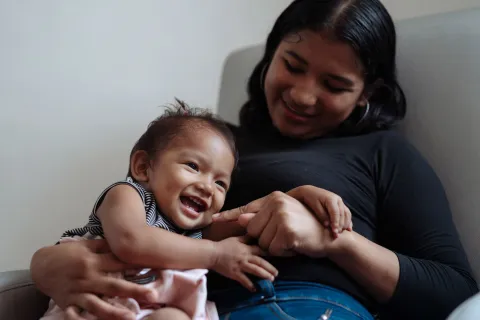
Fabiana focuses on her studies for better opportunities in Ecuador
She dreams of becoming a doctor and attends school every day with her son in her arms.
- Español
- English
It is 6 am in the Martha de Roldós neighborhood in the north of Guayaquil, Ecuador. Fabiana Ortega (18) hurries breakfast and finishes preparing her backpack with books, snacks, and diapers. At the same time her partner, Ángel Bravo (28), dresses their son Miguelito, 11 months old. The three of them walk to the bus stop. Fabiana and Miguelito have an almost two-hour noisy ride to school ahead of them.
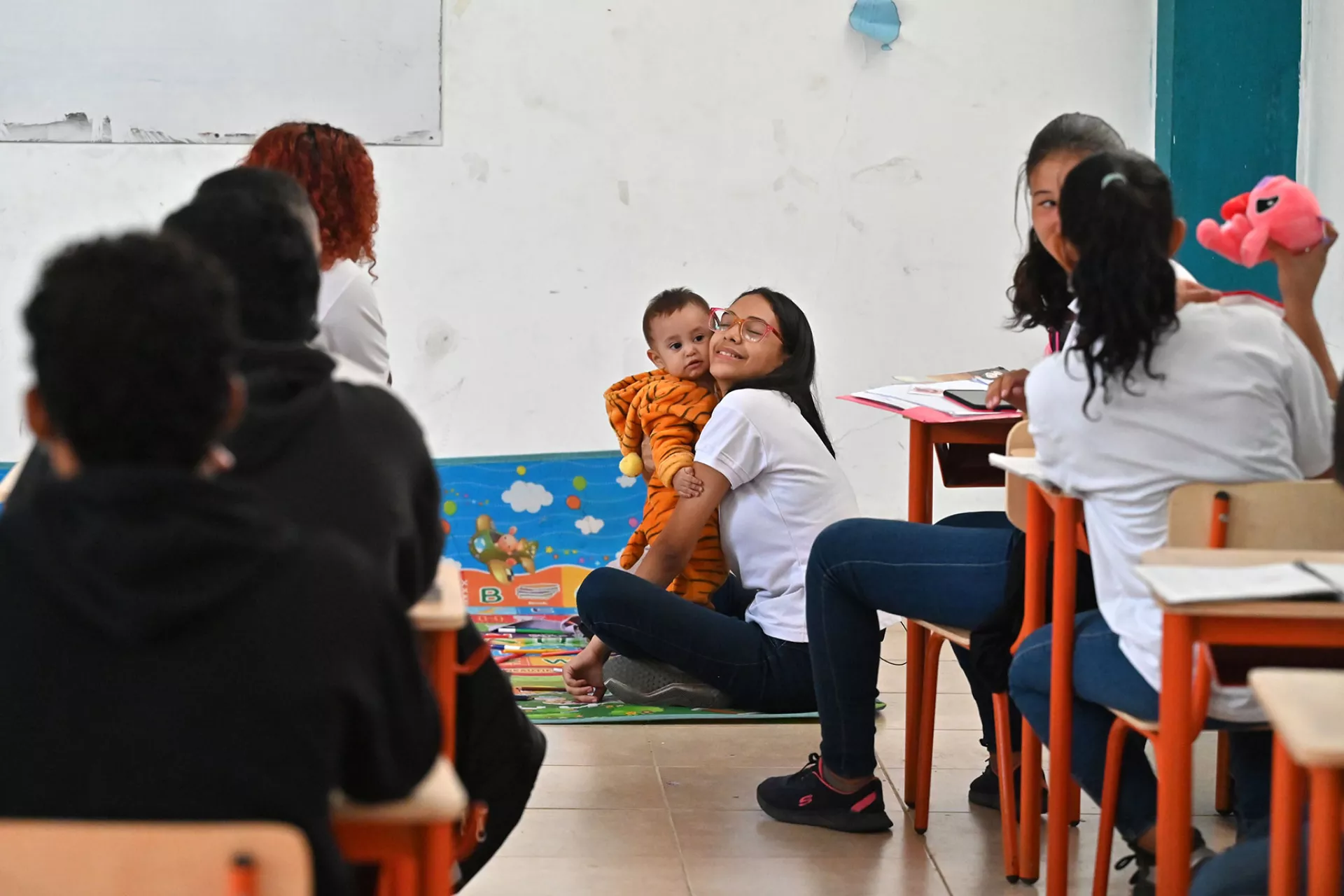
Every day, Fabiana walks into the classroom with her baby in her arms. Leaving him at home is not an option as her partner works long hours in a cosmetics factory and they do not have enough resources to hire a babysitter. Despite this, Fabiana never missed a day of school.
The young mother is one of the 722 teenagers that make up the UNICEF Integral Protection Program (PPI) for migrant and refugee families from Venezuela with children and adolescents.
“The primary goal of the intervention is to be able to articulate with public services, to which the migrant and refugee population are entitled in Ecuador, such as comprehensive care. And that implies having access to education, health, and child protection public services, provided by the State and recognized in our Constitution”, explains Alexandra Escobar, UNICEF Ecuador Social Policy officer.
A difficult journey
Fabiana was born in Táchira, Venezuela, and at the age of 11 migrated for the first time to Colombia. She lived there for five years, but the family's economic situation led them to migrate again in 2019. Their destination was Chile; however, the pandemic changed their plans and they decided to settle in Guayaquil in search of better opportunities.
“It was quite hard to leave Venezuela. I said goodbye to my grandmother, I remember that I asked for her blessing, and I hugged her so tightly that I couldn't help crying. Also said goodbye to my dad, and it was a bitter moment”, recalls Fabiana. Life in Colombia was not easy, but she never gave up her studies: “When I was in Bogotá I studied, and my mother worked. I tried to get good grades and I was always one of the best. My mom was proud of me, and I was of her because we were together.”
The trip to Ecuador lasted four days. Parts of it were done on foot and others, by bus. They crossed the border in the middle of the night through the Rumichaca bridge and then ran out of food.
Fabiana has a story of resilience and struggle, like millions of Venezuelans who left their country because of the political and economic crisis. According to data from the Interagency Coordination Platform for Refugees and Migrants from Venezuela (R4V), there are more than 500,000 migrants of Venezuelan nationality in Ecuador. Only in Guayaquil, there are more than 20,000 Venezuelan families. At a national level, the UNICEF program reached more than 1,400 households in five cities: Quito, Guayaquil, Tulcán, Lago Agrio, and Manta. Around 6% of these families are headed by an adolescent.

Fabiana's life changed when she met Ángel. Shortly after they started dating, she found out she was pregnant. Her vulnerable situation was never more evident than during childbirth. No hospital wanted to care for her because she was an adolescent, a migrant, and without a direct family member to answer for her. Her mother had resumed the trip to Chile.
"My mother told me: 'Daughter, are you staying with your partner or are you coming with us?' And I decided to stay. It was hard because the love that my mother gives me is not the same as that of my husband. I spent my pregnancy alone with my partner, at my mother-in-law's house, and with my mother, it was only through video calls or text messages," says Fabiana.
After the baby was born, she was contacted by the HIAS organization, an implementing partner for the UNICEF program in Guayaquil. Fabiana and her baby could not leave the hospital without the signed consent of an adult relative.
“When there is the case of an unaccompanied adolescent in early union with an adult, there may be a risk of violence,” explains Sabrina Galeas, HIAS Child Protection Social Worker. The organization contacted her mother in Chile and got the authorization. Fabiana and the baby were able to leave the hospital after four days. After that, HIAS visited every week or arranged follow-up calls.
A life plan in a backpack
The UNICEF program has been in place since 2018 in Ecuador and includes unconditional cash transfers for the participants. The amount varies according to the reality of each family and can be extended up to nine months. “The migrant and refugee population allocate the money for rent or to buy food. In the case of households with children and adolescents, we also provide economic support to boost school attendance”, points out the UNICEF Social Policy officer.
In addition to an early childhood kit and a monthly aid voucher, Fabiana receives an education voucher, which she invests in study materials and transportation to the school. The program also provides psychosocial support and assistance for drawing up a life plan.
With social workers' support, Fabiana prepared a document called the Life Project, which is a plan written in a notebook that she keeps in her backpack and that has helped her establish a list of the skills and knowledge she needs to meet her goals. “It's like teaching a baby to take the first steps until it fends for itself,” says Galeas.

As part of her life plan, Fabiana advances in her studies under the accelerated learning modality, which allows the completion of three courses in one year.
When she arrives at the “Réplica 28 de Mayo” school, her friends welcome her with laughter and hugs, like a family. They all want to hold Miguelito and they take care of him in the classroom as Fabiana arranges a colorful rug on the floor for the baby to crawl and rest.
“I see a lot of hope in Fabiana, she wants to get ahead. She has the goal of graduating and knows what she wants for her life”, says Joselyn Fernández (16), her best friend and classmate, full of pride.
David Valle is Fabiana's teacher and comments that at first, the young woman was reluctant to return to class. “Now she is the first to arrive at school and her homework is excellent”. He admits that it was strange teaching with a baby in the classroom because he cried or the noise bothered him: “Over time, Miguel adapted to the dynamics of the class, and we adapted to him. The child has generated a unity atmosphere”.


The vice-rector of the educational institution, Liliana Mota Contreras, always motivates Fabiana to pursue her dreams. “She is a very committed girl; I think she will go a long way. She is very responsible, a good classmate and is very accomplished with all her tasks. What I admire most about her is her predisposition to come to the institution with her baby in her arms. She is an excellent student.”
The UNICEF program and the support of HIAS also allowed Fabiana to start a small business selling cosmetics online, and she has already managed to take part in two entrepreneur fairs in Guayaquil.
But there are bigger dreams. She wants to pursue a university career: “I would like to start as a nurse and then a doctor.” She is well aware that although her migratory journey may have ended; her personal growth journey is just beginning.
This is possible thanks to the support of the European Union, Humanitarian Aid and Civil Protection.