
A haven of peace for children in Esmeraldas
At UNICEF's Comprehensive Support Space, children and adolescents can play, learn and be protected.
- Español
- English
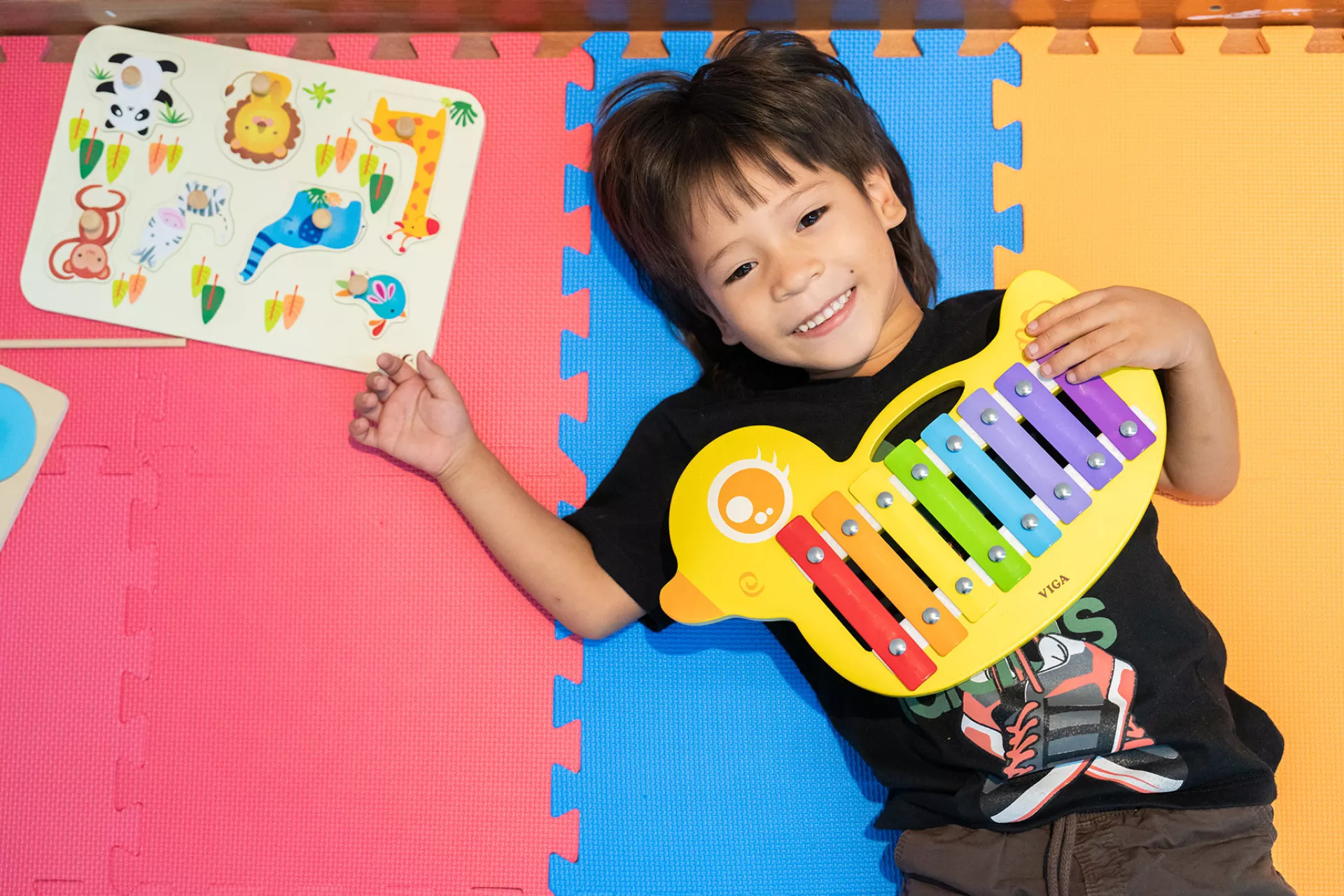
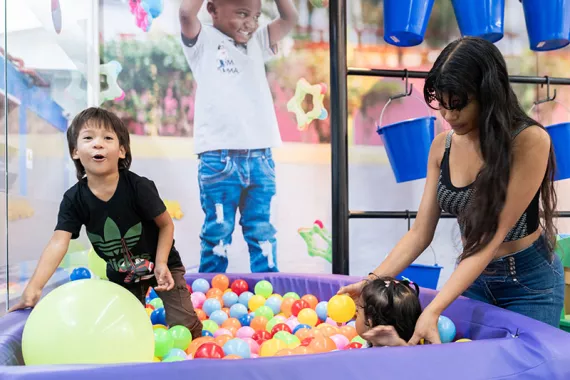
Janel, a 3-month-old girl, sleeps undisturbed despite the noise and humidity of Esmeraldas, a city in the province of the same name on the Pacific Coast of Ecuador, where temperatures reach 32°C (90°F). Nearby, her brother Gabriel, 4, jumps on the foam mat and bursts out laughing. Next to him, one-year-old Nayeli plays with a puzzle. They are under the care of Ruth Peña, a kindergarten teacher at the Comprehensive Support Space in Esmeraldas (EAI for its acronym in Spanish from Espacio de Apoyo Integral), where children and adolescents can play, learn and receive care.
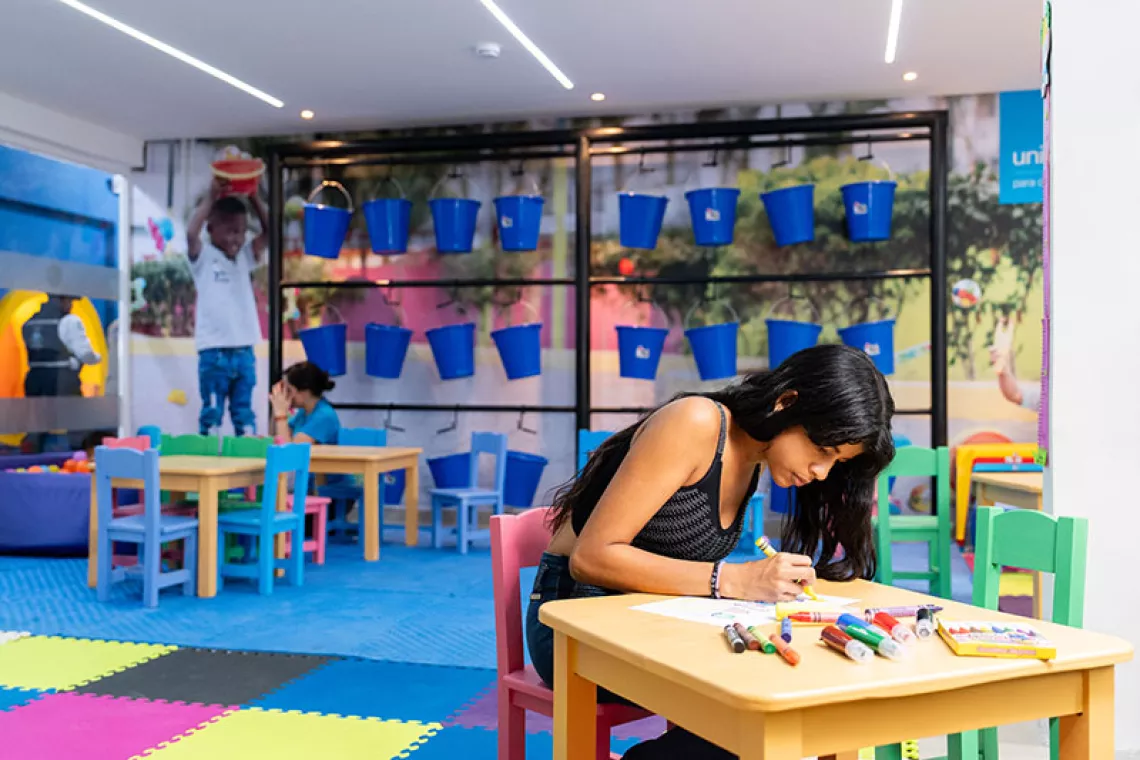
The EAI is a UNICEF initiative implemented through several organizations in collaboration at the site. The Space has the capacity to receive 120 people at a time, with areas designed for children, adolescents and their families. While mothers can attend to their children in the breastfeeding room, children can discover a book in the reading areas and others enjoy the playroom. In addition, there are educational workshops on music, dance, plastic arts, sexual and reproductive rights, psychological counseling and legal advice for migrant families.
As you walk through the door of the EAI, the sound of traffic, music and voices from the street are left behind. Inside, there is calm. When children and adolescents are asked what they like most about the Space, most of them emphasize the feeling of "protection".
Such a response is critically significant in Ecuador, where the perception of insecurity has risen and today the country is considered the least safe in Latin America. Here, the homicide rate for children and adolescents increased sevenfold in the last four years1. In Esmeraldas, murders quadrupled in the last three years.
"We want the children to be here, safe physically and mentally, safe in their emotions, so that they can be calm, so that they can live and dream," says José Luis Guerra, UNICEF Child Protection Officer in Ecuador.
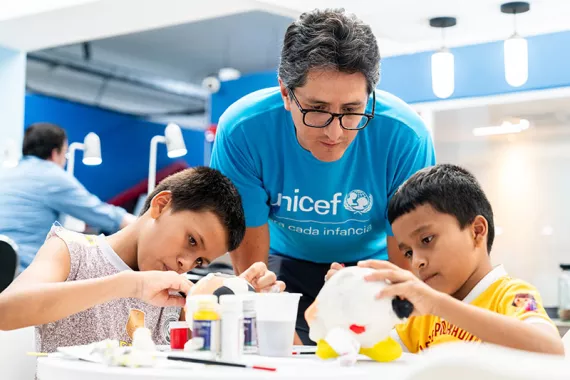
Psychologists, social workers, lawyers, artists and a variety of community professionals work here. In the EAI, UNICEF seeks to weave child protection networks utilizing different societal actors, hence it works in synergy with the Municipality of Esmeraldas, the Ministry of Economic and Social Inclusion, the Ministry of Women and Human Rights, the Ombudsman's Office, UNHCR and other institutions that it brings together to provide services to vulnerable children and adolescents in one place.
Make friends, create, dance ... Be kids!
Jamileth, 10, sits next to other children in a room with tables, a ball pool, hula hoops, storybooks and other toys. This is the Child Friendly Space. She draws hearts, stars and colorful waves. Jamileth lives near the beach but rarely goes there. Nor does she go to the park, "because of the situation," she whispers as she writes with a red crayon the word "friends."
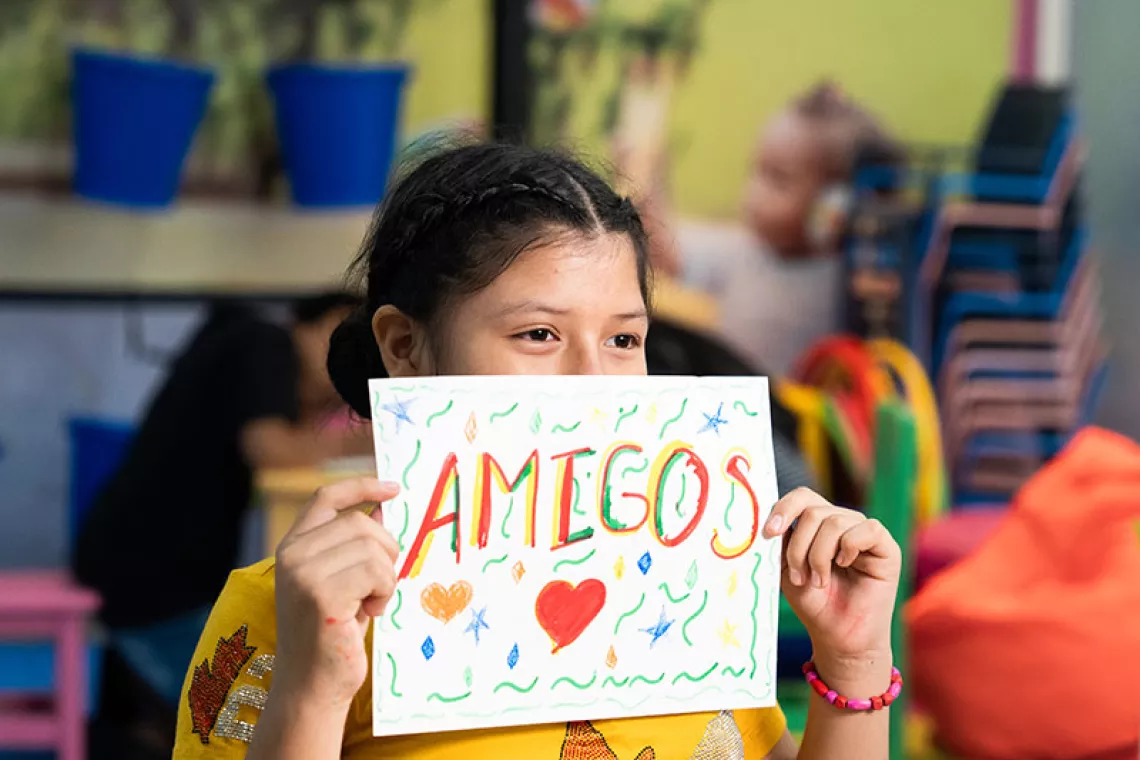
Since the EAI opened its doors in September 2023, Jamileth has made several friends, among them are the siblings Santiago, 12, and Kristen, 10. They have quiet voices and watchful eyes. He plays the saxophone and she dances. Both take every opportunity to proudly mention their musician grandfather. Their artistic streak motivates them to come to the Space.
Kristen, nonetheless, would like the EAI to have slides like those at an outdoor playground, "to have recess," she says. In the areas hardest hit by violence, fewer and fewer children are in the spaces where they should be playing, and some schools remain closed. Because of this, families are looking for alternatives for recreation and learning.
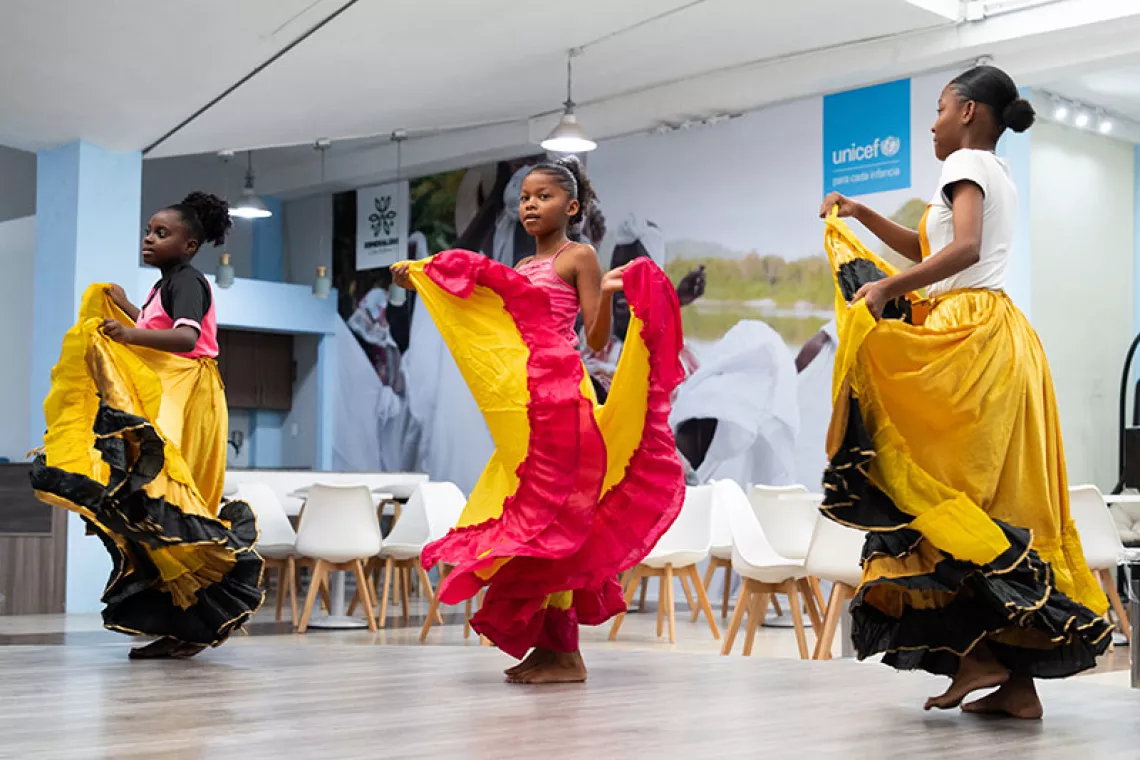
This afternoon at the EAI, marimba, the traditional rhythm of Afro-Ecuadorians, can be heard. A group of six girls, between 10 and 12 years old, practice an Esmeraldan choreography barefoot, waving long, colorful skirts which cool them off. Diana Cuero, the teacher, claps her hands and stomps her feet, accentuating the rhythm. She shouts "lift up your heads" and the girls rise to the sky.
A place to rekindle dreams
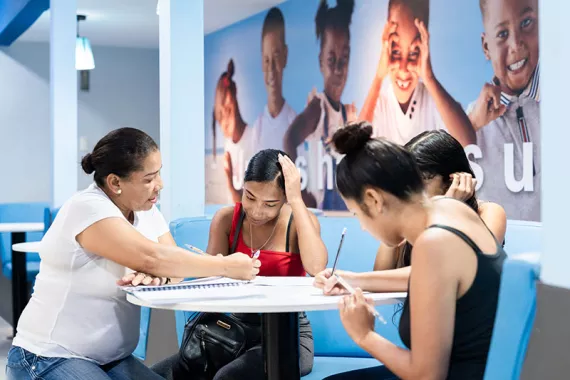
In the study hall, Alejandra, 19, and Mary, 15, with pen in hand, are taking a test. They attend the educational inclusion program for pregnant and parenting teens, a project which enables girls who had to drop out of school to take care their children, to return to classes.
The teacher from the Comprehensive Support Space waits patiently for the girls, who tap their feet under the tables and rub their hands together. One of them looks up, attentive to what is happening at the other end of the building. Minutes ago, the teenagers left their children, Janel, Gabriel and Nayeli, in the care of the kindergarten teacher, freeing themselves up for their studies.
"Here they take very good care of her (my daughter), they make sure she eats, check her diaper. They are experienced. Now the girl is more sociable," says Mary, a young Venezuelan girl who dropped out of school after becoming pregnant at the age of 13. Since attending the UNICEF program, her dream of becoming a lawyer and owning a bakery no longer seems impossible.
"When I came to the Space I was afraid of being judged, because they judge me everywhere," says Mary, who is now 15 years old. Prejudice is one of the challenges faced by teenage mothers in Esmeraldas. In 2022 alone, 161 girls under 15 became mothers in this province, while 2,408 adolescents between the ages of 15 and 19 gave birth in that year2.
Discrimination against teenage mothers often occurs in the classroom as well. Francisco Salazar, national program coordinator at DYA, a UNICEF implementing partner, recalls the case of a teacher who closed her classroom door to a student who showed up with her baby in her arms.
Francisco came to Esmeraldas to replicate the UNICEF program for pregnant and parenting teens, also being implemented in the cities of Guayaquil, Machala, Lago Agrio and Tulcán. As part of its methodology, social workers and teachers, guided by community leaders, visit the most vulnerable neighborhoods to identify girls who have dropped out of school.
43.6 percent of all school dropouts among students between the ages of 12 and 17 are due to lack of economic resources3. For women, one of the main causes is pregnancy at an early age. In other cases, school dropout results from opposition by the woman´s partner, who may be twice the age of the adolescent and may be exercising power over her, according to Salazar. For this reason, the approach is comprehensive and the work is complex.
The teens finish their test. Mary tucks her curly bangs behind her ear, grabs her backpack and crosses the hallway in search of her baby. In the early childhood room she is reunited with her daughter Nayeli, who is crawling after a ball. There also are the tireless Gabriel and his little sister Janel, who has woken up hungry and is already on her mother Alejandra's lap.
Mary says goodbye, it is already noon and she has to cook. With the baby in her arms, she walks out the door to the street and her figure evaporates in the heat of Esmeraldas. The joyful click of her sandals echoes as she walks uphill with the seeds for a better future.
In Ecuador, UNICEF operates three Comprehensive Support Spaces, one in each of the following cities: Tulcán, Manta and Esmeraldas. The latter is managed in coordination with the Municipality of Esmeraldas and is possible thanks to the support of donors in Ecuador and the Bureau of Population, Refugees and Migration of the U.S. Department of State (BPRM).
1Ministerio del Interior del Ecuador. Indicadores de Seguridad Ciudadana. Homicidios Dolosos
2Sources: NATIONAL INSTITUTE OF STATISTICS AND CENSUS (INEC), Population projections, 2023. INEC, Cumulative National Survey on Employment, Unemployment and Underemployment (ENEMDU), 2022. INEC, Live Birth Registry, 2022.
3Sources: NATIONAL INSTITUTE OF STATISTICS AND CENSUS (INEC), Annual National Survey on Employment, Unemployment and Underemployment (ENEMDU), 2022. Ministry of Economic and Social Inclusion (MIES) and Ministry of Education (MINEDUC), Administrative Records, 2023.