Girls across Central Asia lead the way in STEM
Girls across Central Asia are helping solve complex global problems through building satellites, programming early warning systems and engineering software
- English
- русский
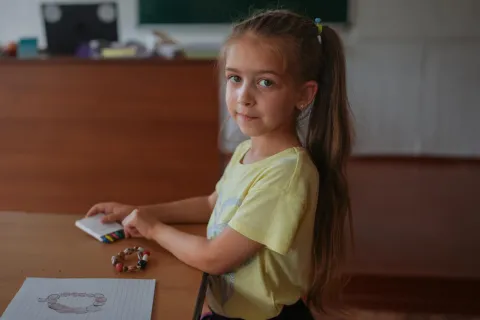
Girls in Kazakhstan, Kyrgyzstan, Tajikistan, Turkmenistan and Uzbekistan are advancing in male-dominated fields by creating innovations in science, technology, engineering and mathematics (STEM) through building satellites, programming early warning systems and engineering software.
Bringing solutions in STEM, girls across Central Asia are helping to solve complex global problems from measuring air pollution to coding systems that warn of incoming natural disasters to children and families.
UNICEF works to strategically and efficiently address some of the greatest and most pressing challenges facing children and young people and continues to work, applaud and amplify girls in the lead as role models in their communities.

UNICEF

UNICEF
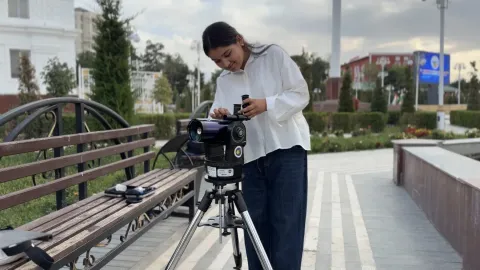
Young female students from Kazakhstan, Kyrgyzstan and Uzbekistan create and launch seven nanosatellites into the stratosphere to study air pollution.

UNICEF
Amina from Kazakhstan found herself in the company of more than 150 girls from Kazakhstan, Kyrgyzstan, and Uzbekistan. All of them came to Almaty to take part in a 10-day marathon of engineering, design, programming, and spacecraft assembly.
“Some girls want to work in this field but don’t know where to start. I think this program is perfect for them,” says Amina. She emphasizes that gender inequality is a relic of the past and appealed to the next generation of girls to “be active and dream.”

UNICEF
Only 1 out of 3 girls aged 15-19 have computer literacy in Kyrgyzstan.
In 2020, UNICEF launched the “Girls in Science” program to help young girls expand their professional horizons, overcome gender stereotypes, and make their career choices. Since then, more than 10,000 girls have joined the initiative every year and more girls are gaining confidence in developing a scientific career.

UNICEF
In Uzbekistan, there is still a significant gap between boys and girls in computer literacy, technical education and technical careers. The UniSat program gives girls the opportunity to take part in analyzing meteorological data collected with the nanosatellites with support from specialists from UzHydromet.
“UniSat is more than just a project. It is knowledge. It is people. It is motivation,” says Diyora.

UNICEF
Mahri challenges gender stereotypes in Information Communication and Technology (ITC) in Turkmenistan. She is a young IT specialist who helps educates and empowers women and girls by teaching digital skills at her university.
“When I had to choose the field for my university degree, I applied to the Faculty of Programming for Computers without any doubt in my mind,” she says.

UNICEF
Mohjabin, a Tajik teenager, is part of the UNICEF-supported social entrepreneurship programme developing a wireless early warning system for disasters. The system is a wireless device that alerts residents to impeding natural disasters immediately reporting avalanches, mudslides and floods.
“I want everyone in the world to have free energy through a global, wireless communication system. In the future I will be engaged in science to make people's lives more comfortable and safer.”