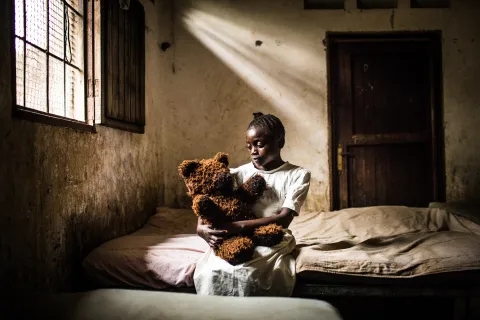
From forest to blackboard: the story of Mavala
Forcibly recruited by an armed group at the age of 15, Mavala is now a role model for her primary school pupils.

- Français
- English
When you attend a maths lesson taught by Mavala* at one of Goma’s primary schools, you immediately notice that the 25-year-old teacher is patient, caring and works passionately to help her pupils.
"Education is very important because the future of the country is in the hands of the children," Mavala says.
A teacher for four years, Mavala's life has been shaped by the violence that has ravaged the east of the Democratic Republic of the Congo (DRC). She was recruited by an armed group at the age of 15 when she went to fetch water in the forest.
"We met these rebels who took us by force to their camp," Mavala recalls. "They took us as their wives, they raped us and we were beaten if we resisted."

UNICEF estimates that between 30 per cent and 40 per cent of children associated with armed groups are girls, who are exploited, raped and forced into marriage.
Mavala suffered these abuses for two years. Because of what they go through, girls are particularly stigmatised when they return home. When Mavala managed to escape at the age of 17, she thought she could get on with her life – but her return was not welcome at first.
A UNICEF partner organization then successfully facilitated Mavala's return to her family, and her reintegration into her community.

The young girl was supported by psychologists and re-enrolled back into school so that she could continue her education and relearn how to live a normal life.
"This helped me to forget the past," Mavala says.
UNICEF and partners assist around 3,000 children formerly associated with armed groups each year with support from USAID's Bureau for Humanitarian Assistance (BHA), the European Union Humanitarian Office (ECHO), the Swedish International Development Cooperation Agency (Sida) and the Japanese Government.

Comprehensive medical, psychosocial, legal and socio-economic support is provided to survivors of sexual violence to avoid stigma and social exclusion.
Convinced that education can transform the lives of children like herself, Mavala decided to become a teacher.
In her third year of secondary school, she specialised in teaching and obtained her diploma, which enabled her to enter the job market successfully. She is now married and teaches a class of first-year primary school pupils.
"After life in an armed group, a normal life is possible," says Mavala, who is expecting her first child.
* The name has been changed to protect Mavala’s identity