

Improving girls’ access to education in Kasai
With the support of the British Embassy in DRC, UNICEF is implementing a pilot project for girls’ education in Kasai, where only 12 girls out of 100 boys attend lower secondary school.

- Français
- English
In Kamonia, Ekado is one of the few 16-year-old girls who are still in school. In this mining town in the province of Kasai in the Democratic Republic of Congo (DRC), young girls are often married off early and only boys are sent to school. “I have a friend who dropped out of school to get married, but she is not happy in her home,” explains the young student dressed in her blue and white uniform.
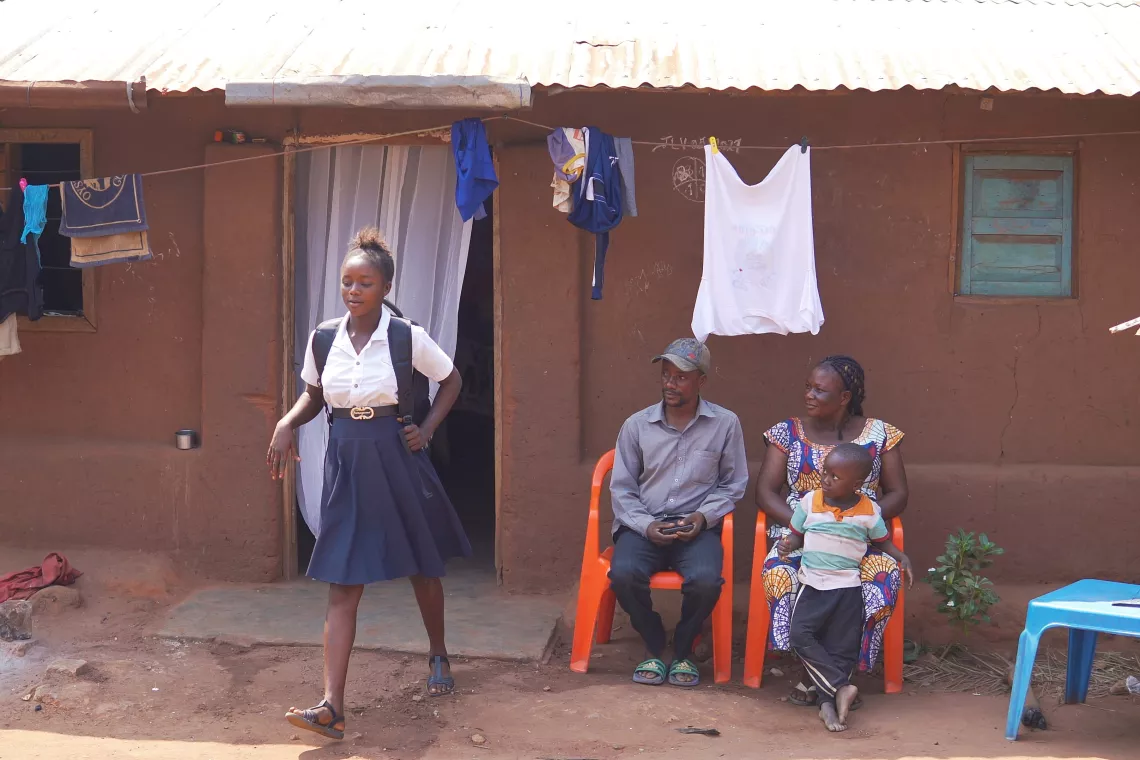
Early marriage is one of the main causes of school dropout among young girls, as evidenced by Tanga, Ekado’s mother. “I was married off very early because my parents couldn’t afford to send me to school,” says Tanga sadly, who is determined to send all her children to school, girls and boys alike. “Times have changed, I want all my daughters to be able to study,” says the mother.

The Lycée Maman Lembe where Ekado studies is committed to promoting the education of young girls with the support of the Foreign, Commonwealth and Development Office (FCDO). “We have received training on adolescent and youth reproductive health, the national curriculum, menstrual hygiene and school-related gender-based violence,” explains Marie, Ekado’s teacher.

UNICEF is working to improve access to education in 75 primary and secondary schools in the Kamonia territory. New classrooms will be built in 26 schools, with sanitation facilities to facilitate menstrual hygiene management among young girls. In these schools, boreholes will guarantee access to drinking water for students but also for neighbouring communities.

“My parents encourage me to go to school,” says Ekado with a wide smile on her lips. The student wants to see as many girls as possible by her side on the school benches. “I ask girls not to be in a hurry to get married but rather to complete their education,” continues Ekado, specifying that girls and boys will be able to access the same opportunities as adults.
Ekado has a very specific goal in mind. “I go to school to become a teacher and teach other girls,” she says.
Thanks to the generous support of the British Embassy in DRC, UNICEF is implementing a pilot project in the Kamonia territory to improve access to quality education for vulnerable children, in particular girls. This project responds to all the issues related to girls’ schooling and reinforces teachers’ capacities, empowers young women and girls, and fights against gender-based sexual violence.


