Digital Education Strategy 2025-2030
Beyond digital as usual: An equity-driven, human-centered digital and AI strategy for learning

Accelerating learning in the 21st century
The purpose of the new Digital Education Strategy is to dramatically accelerate results for learning and the global impact of UNICEF’s work on learning gains and skills acquisition. To achieve major global progress, all the digital education work of UNICEF will move to a focus on improving learning outcomes through evidence-based approaches, in alignment with UNICEF’s education strategy – Every Child Learns. It will have a particular focus on bridging digital divides, including gender, disability and linguistic digital divides, and on children both in and out of school. Multiple transformative shifts are required to address these challenges and close the learning and skills gap. It is imperative to implement innovative and cost-effective approaches to expand access to quality education and ensure equitable learning opportunities.
Responding to the global learning crisis
- 273 million children are out of school
- 600 million children are not achieving minimum proficiency levels in reading and mathematics, even though two-thirds of them are in school
- 44 million additional teachers are needed globally across primary and secondary education to fill the present shortage – and 6 million more if we include early childhood educators.
- 1.3 billion children, or approximately two-thirds of the world’s school-age population, do not have internet connection in their homes, limiting their access to digital learning or skilling opportunities.
The urgency and promise of digital transformation in education
We are living in an era of cutting-edge digital technologies with immense potential to accelerate progress in addressing the multiple educational crises. These technologies offer much needed solutions in reshaping the future of learning. The world is experiencing a seismic shift, with disruptive innovations like artificial intelligence, automation, and increased access to smartphones opening up new possibilities but also placing new demands for employability skills. There is a strategic need to strengthen the government education system through the appropriate use of technology. Embracing new approaches to improve teaching and learning is also crucial for unlocking the full potential of education in today’s rapidly changing digital world and to support the alignment between skills gained at school and those needed in the 21st century workplace. Teachers and school leaders need to be central to this process, supported in it, and part of the co-design and decision making around products and their usage.
However, despite good intentions, education technology is too often misapplied – converting traditional materials to digital formats without addressing the deeper barriers to learning. There is also often an expectation that distribution of devices in and of themselves will improve learning outcomes. This misalignment squanders billions of dollars in education technology investments each year. To truly improve learning outcomes, we must prioritise solutions and approaches backed by robust evidence of impact and ensure holistic integration into teaching and learning practices.
The time is now for UNICEF to take a global leadership role within the education community, acting as a positive disruptor and championing a holistic vision for digital transformation in education. This vision unites UNICEF’s diverse expertise, leverages its unique strengths, and capitalizes on its comparative advantages. By aligning efforts across global, regional and country levels, UNICEF can foster a more coordinated, impactful, sustainable and scalable approach to unlocking the full potential of digital technology in every facet of education.
Five focus areas
- Empowering teachers
- Teacher shortages and low teacher motivation and retention – Insufficient numbers of qualified teachers, especially in rural and marginalized areas, coupled with high turnover rates, challenges in recruitment and uneven teacher deployment, disrupt the continuity and quality of education. In addition, teachers have overly heavy workloads with too much time spent on administration and management, significantly reducing teaching time.
- Low teacher capacity – Many teachers lack adequate training and professional development opportunities (pre-service and in-service), leading to gaps in subject knowledge and pedagogical skills and challenges in delivery of effective lessons.
- Foundational learning
- Instruction not at the right level or language for the child – Mismatches between teaching instruction and content, and students’ learning levels or language proficiencies, which impedes effective learning. This is especially critical at early stages of literacy.
- Lack of effective learning approaches for children outside the formal school system – Children who are out of school, in non-formal education settings, experiencing disrupted education, and more broadly children who lack opportunities for appropriate and effective learning.
- Competencies and skills development
- Disconnect between the skills acquired in schools and those required in the job market – Many children leave school without the skills and competencies, for example digital and AI skills, needed to thrive in an ever evolving and increasingly digitized future.
- Lack of accessible accreditation opportunities – Out-of-school children lack options to acquire recognized competencies for employment and as a complementary pathway to reintegration into formal schooling.
- Strengthening systems
- Inadequate government capacity and lack of robust ICT in education master plans – Challenges include limited government capacity on ICT in education, lack of long-term planning and financing, and infrastructure gaps.
- Weak monitoring systems and strategic planning – Ineffective data collection and analysis hinders the ability to track out-of-school children, monitor learning outcomes, and make evidence-based decisions. Additionally, a lack of long-term, holistic and strategic planning by governments results in fragmented efforts and inefficient use of resources.
- Barriers for children with disabilities and adolescent girls – Physical, societal and cultural obstacles limit access to education for children with disabilities and adolescent girls.
- Fragmented and ill-suited digital platforms – Multiple platforms and solutions for monitoring, management, and learning often operate in isolation, lacking interoperability and duplicating functions. At the same time, decisionmakers, including those at the school level, lack clear guidance to identify the most appropriate, context-relevant, impactful (based on evidence), inclusive and safe solutions. This leads to inefficiencies, siloed approaches and limited or even negative impacts on learning outcomes.
- Thought leadership
- Lack of evidence-based decision-making in digital education – Insufficient use of data and research-based insights leads to misallocated investments, ineffective strategies, and potentially detrimental impacts on both learning outcomes and child wellbeing.
- Lack of standards regarding safe and effective use of digital in education – Absence of clear standards leads to inconsistent practices, mixed messaging, insufficient attention to online safety and privacy risks, and missed opportunities to fully realize the benefits of technology.
8 strategic shifts
- From standalone digital learning to integrated digital transformation: There will be a shift from digital learning as a standalone domain to a more integrated and cross sectoral approach to digital transformation. This reflects the interconnected realities of today’s digital age, where technology impacts not just how children learn but how education systems are designed, managed and improved.
- From tech-driven to human-centred approaches, with teachers and learners at the centre: UNICEF will shift from technology-driven approaches towards human-centred and culturally appropriate digital education, empowering and supporting teachers, strengthening their capacity to effectively use and shape technology, and prioritising inclusive, personalised, and adaptive solutions that address the diverse needs and contexts of both educators and learners.
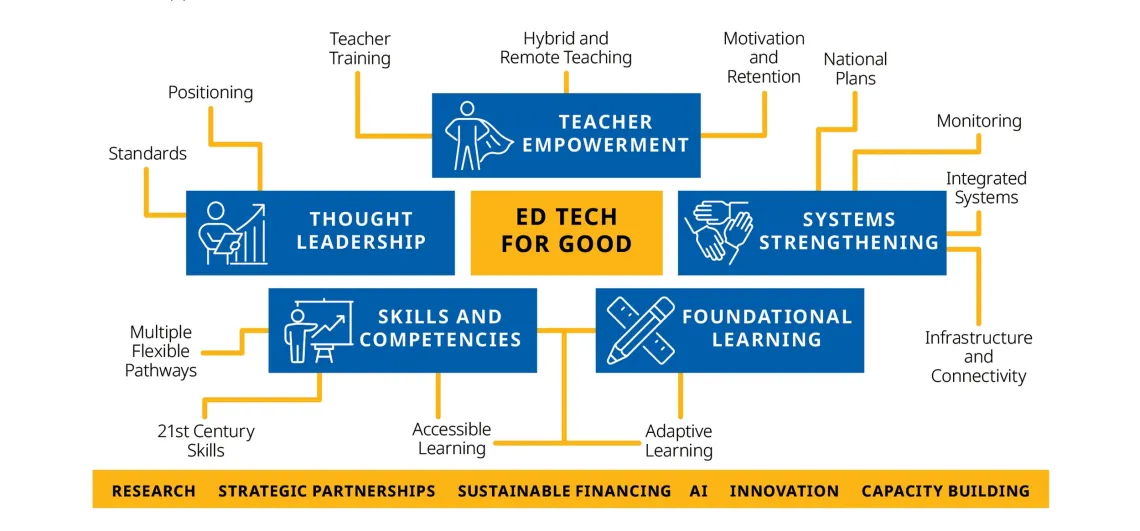
- From initiatives to strategy-driven scaling: To maximize impact and coherence, the Strategy represents a major shift from an initiative- and opportunity driven approach to a centralised, criteria-based approach. This will be anchored in the five priority areas and guided by the EdTech for Good Framework – which ensures human-centred, inclusive, and evidence-informed design. UNICEF will also move from initiative-focused fundraising, implementation and posts to strategic fundraising, implementation and posts, and centralised coordination of donor engagement.
- From scattered approaches to big bets: While recognizing the importance of local partnerships, at the global level, a small number of high profile (centrally managed) global partnerships will be launched that are ‘big bets’ in digital education intended to have significant global impact on learning (+100 million beneficiaries). At country level, they will directly respond to key identified challenges, ensuring relevance and alignment with national priorities.
- From outputs to outcomes: UNICEF digital education will shift from an outputs-based logic to an outcomes-based logic (this means ‘did children learn?’ is more important than ‘did children take part?’). As part of this strategic shift, all digital education initiatives will be underpinned by robust research and based on the best of the existing evidence of what works, while also contributing to new evidence to help shape the global education sector. Impact measurement will include a clear equity dimension, using disaggregated indicators and research designs that assess whether digital approaches are reducing or widening learning gaps.
- From ad hoc approaches to context-sensitive models anchored in global standards: UNICEF will shift from inconsistent approaches in digital education to setting clear global minimum standards. All digital education activities will go through the EdTech for Good review process, and include a clearly articulated sustainability and cost-effectiveness strategy covering government ownership and an exit plan. UNICEF’s frameworks and guidance will be field-tested and adapted to realities on the ground, with models for acceleration and scale tailored to country typologies and contexts.
- From “one child, one device” to dynamic, shared, collaborative learning: While personalized, one-to-one device programs unlock adaptive learning pathways, UNICEF will broaden its focus to champion social, playful, creative and hands-on engagement. This will include technology-enabled approaches that foster collaborative problem solving, peer-to-peer learning, and gender empowerment. UNICEF will also develop and test cost-effective, context-sensitive device-sharing models, making optimal use of limited resources while maximizing learning impact.
- Championing a balanced and ethical approach to digital education: UNICEF will prioritize digital well-being, online safety, data protection, and ethical engagement, while equipping children with the skills to navigate the digital world safely, critically and confidently. Digital approaches must not displace essential non-digital activities such as unstructured play, physical activity, in-person social interaction, and foundational skills like handwriting; instead, they should enhance—not replace—meaningful human connection and social interaction, all of which are essential for children’s holistic development.
EdTech for Good
The Strategy will transition UNICEF to focus on a smaller number of high-profile and scalable initiatives, all focused on the five priority areas. Fundraising efforts will focus on broader strategic focus areas in line with or encompassing the key areas of the Strategy. There will be centralized coordination of donor engagements to ensure alignment with the Strategy. Engagements through Private Fundraising and Partnerships (PFP), Public Partnerships Division (PPD), National Commissions (Natcoms) and others will prioritise more flexible funding for implementation of the broader Strategy, rather than specific initiatives or areas within the strategy, especially with bigger donors. This greater flexibility will empower regional and country offices to undertake more holistic and strategic activities tailored to their specific contexts and needs. The EdTech for Good Framework – which aligns with the Principles for Digital Development – serves as a unifying element of the strategy, ensuring it is human-centred and inclusive, and guiding and integrating its various components while highlighting UNICEF’s distinctive contributions and value.