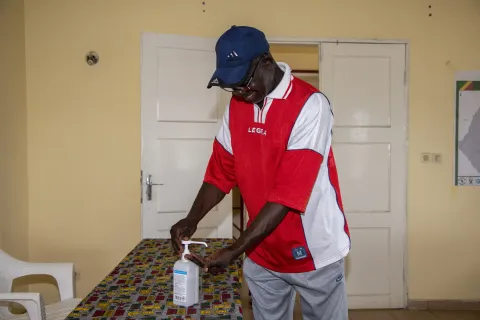
Flomy, on the front line against cholera in Mbamou
On the isolated island of Mbamou, Flomy and his team fight cholera every day to protect their community

- Français
- English
A fight in isolation
At the heart of M'bamou Island is the Mbamou Center Integrated Health Center (CSI), which Flomy has managed since February 2025. Its area of action covers three villages – Moutou ya Ngombe, Likouala and Mbamou – where more than 3,000 people live depending on the center for their care. The island, which has around 15,000 inhabitants, is difficult to access. It is not connected to the electricity network or the roads.
To reach Lissanga, the capital of the health district, you have to sail for an hour in a motorized canoe, then another two and a half hours before arriving at Mbamou Centre.
“Here, every medical procedure is a challenge,” explains Flomy. The center operates using a single solar panel, which often breaks down, and has only three beds, a consultation room, a delivery suite and a small pharmacy.
Faced with the cholera epidemic
On July 2, 2025, the first case of cholera was reported on the island. Less than a month later, the Government declared an epidemic in the health district. Since then, Flomy and his team have been on the front line.

“We treated 173 cases, with only one death that was not directly linked to cholera,” he says. “We are seeing a lull, but the risk remains present. » With the support of the NGO Water and Sanitation for Africa (EAA) and UNICEF, an area of the center was completely redeveloped to accommodate cholera patients. Secure circuits have been set up for care, hand washing and disinfection of equipment.
Community mobilization, key to the response
Flomy’s days begin at dawn. With their colleagues, they provide care, epidemiological surveillance and awareness activities. “Thanks to the support of the EAA and UNICEF, we are going door to door to inform the population,” he explains. “Wherever we see people gathered, we spread the message: wash your hands, treat the water, report cases. » Their mission also carries risks. “My hands felt like they were burned from being immersed in chlorine,” says Flomy. “We must protect others, but also protect ourselves. Being a role model for the community is essential. »
A coordinated and sustainable response
Thanks to funding from UNICEF (via CERF and EPF), partner EAA strengthened the response in Mbamou and Mossaka:
- 5,216 households received hygiene kits and water treatment tablets.
- 152 water points were disinfected and 9 boreholes rehabilitated. - 28,205 people were made aware of hygiene and preventive actions.
- 60 community relays were trained to relay information and collect feedback.
- 6 focus groups made it possible to express the needs of the communities, in particular the lack of latrines adapted to sandy soils.
These community mechanisms promote direct listening to populations and continuous adaptation of interventions, essential to the sustainability of the response.
Courage in the service of life
Despite the isolation, lack of resources and the health threat, Flomy continues to serve with determination. His dedication illustrates the silent courage of hundreds of Congolese health workers mobilized against cholera. “We cannot give up,” he concludes. “As long as there is a risk, we will be there to protect our community. »
Thanks to the commitment of Flomy, his team and the joint support of the Government, UNICEF and its partners, thousands of lives are protected on the island of Mbamou.