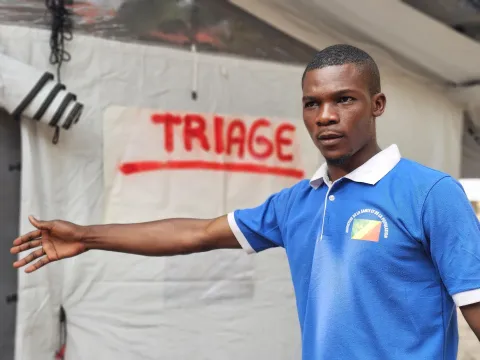
Detecting cholera early to save Lives
In Gamboma, the vigilance of a disease surveillance officer helped ensure the early detection of the first cholera cases.

- Français
- English
Martin Ossokoué still remembers the day a young woman in her twenties arrived at Gamboma Hospital suffering from unusually severe diarrhoea.
For many, it might have appeared to be just another case. But for the district health surveillance officer, something seemed different.
“It caught our attention,” he recalls. While speaking with the young woman, Martin learned that another member of her family, an elderly woman, was experiencing the same symptoms at home. Faced with this unusual situation, he and his colleagues decided to investigate further.
A few weeks earlier, as part of its support to the efforts of the Government of the Republic of the Congo to prevent and respond to cholera in the Nkéni-Alima department, UNICEF had provided the Ministry of Health and Population with essential supplies, including rapid diagnostic tests.

These tests enabled health teams to act quickly and without delay.
The first test result came back positive. A second test conducted at the family home confirmed the suspicion. Samples were then sent to Brazzaville, where laboratory analysis officially confirmed the presence of cholera.
For Martin, this rapid detection marked the beginning of a race against time.
“Among the four people who were sick in that household, two tested positive,” he explains.
The patients were quickly treated thanks to the medicines and medical supplies already available. Isolation areas were set up, and health teams strengthened prevention measures to reduce the risk of further transmission.
Sadly, the elderly woman did not survive the disease. Her daughter and the other family members, however, recovered.
“ Without the support of the Government and its partners, this would be a disaster.”
In a region where many families live far from health centres and have limited resources, Martin knows that every hour saved can make a difference.
“Without the support of the Government and its partners, this would be a disaster” he says.
Beyond medical supplies, health facilities also received personal protective equipment. Thanks to these measures, no cases of infection were recorded among healthcare workers.
Today, Martin continues his surveillance and community awareness work. Although no new cholera cases have recently been detected in Gamboma, the risk remains in some neighbouring areas.
“We are doing everything we can to inform communities and remind people about preventive measures,” he explains.
For him, this experience reinforced a fundamental conviction: preparedness saves lives.
In Gamboma, rapid diagnostic tests were available even before the first cholera cases appeared. Health teams had been trained. Essential supplies were already in place.
When cholera struck, the response could begin immediately.