Construction interventions to meet the needs of children
Denise, a Construction Manager at UNICEF, works in construction and rehabilitation projects to build better learning spaces for children

Denise Venturini
Construction Manager, UNICEF Lebanon
As a Construction Manager at UNICEF, Denise oversees the construction or rehabilitation projects including planning, support to procurement, as well as monitoring of construction works on site. She collaborates closely with the Programme and Operations teams in UNICEF Lebanon in construction interventions to meet the needs and achieve results for children in the country.
Denise, how did you first hear about UNICEF?
I still remember as a child, the UNICEF fundraising stands in the streets of my city. I never thought then that one day I would join this incredible organization.
How would you describe to a child what you do every day at work?
Together with my colleagues from all over the world, we work to build better spaces for children, such as schools, where every student, even the most disadvantaged, can move freely and safely, and where there is light, electricity, and water all day. A place where joy reigns and where even the teachers are happier.
“We should have more women in the construction sector - they bring a different perspective and are key contributors to a child-centered approach, particularly during the project design.”
Denise Venturini, Construction Manager

What is your professional and education background?
I have a master’s degree in Architecture and one in Urban and Territorial Planning in Developing Countries. I am currently pursuing a postgraduate diploma in Humanitarian WASH. Before working with UNICEF, I worked with several INGOs in humanitarian contexts. At the beginning of my career, I worked as a freelance architect between Italy and Portugal.
What is the best part of your workday?
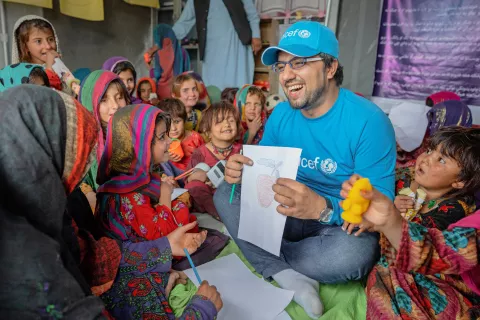
The best part of my work is when I visit a school built or rehabilitated by UNICEF and hundreds of students run towards me with a big smile. You can feel their joy. This is one of my greatest achievements, giving children hope, and providing them with a safer place where they can learn and express their full potential. Schools should be a place of hope, inclusion, and empowerment. Building better learning environments has an impact on the quality of children's lives as well as on their education.
What is the least favorite part or a challenge you often face at work?
When I visit contexts of extreme deprivation, where children and families have nothing to live on and the most basic rights are denied.
What is your career advice to young professionals interested in UNICEF?
Inform yourself beforehand about UNICEF’s mandate and work worldwide. Follow our page, document as much as you can, and try making an informed decision. Also, if possible, get some field experience with organizations in your country or abroad, in development or humanitarian contexts. It's important to understand if this work and life are what you really want.
Delivering Results While Living our Core Values
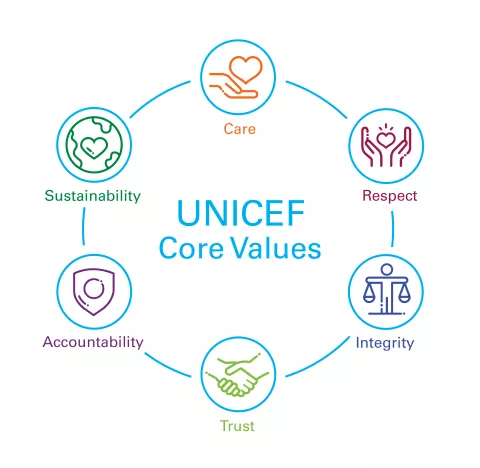
If you could highlight just one, which of the six UNICEF Core Values (Care, Respect, Integrity, Trust, Accountability, and Sustainability) would that be?
Sustainability is a word rich in meaning. International professionals come and go. What matters is what remains, what we manage to achieve together. Our contribution cannot last if we do not include everyone, especially those who will benefit from the interventions.


My mother is a teacher, and my father is a doctor, they have worked in the public sector all of their lives; they both love traveling. I was raised with a strong sense of duty, fairness, and social awareness, but also filled with curiosity and with a backpack always ready to go. This is why as an Architect and Urban Planner I have always been more interested in the social and environmental aspects of the human habitat. So, after a few years in the private sector, I started working with humanitarian organizations. I learned about deprivation, vulnerabilities, and needs, but I also saw how strong, determined, and innovative people can be especially during challenging times. Joining UNICEF has been one of my greatest dreams. Improving the lives of children is fulfilling and inspiring. There is no better reason for waking up and going to work every morning.
As a woman, working in a male-dominated environment has not been easy. Gender bias and challenges are everywhere, not only in the building sites but also in the working environment. As women, we think that the only way to manage construction teams and building sites is to behave as a man, which doesn't come easily to me. Fortunately, things are changing slowly. Still, technical advice provided by a woman has a different impact than when it is made by a man. I have learned not to take this personally and have also learned how to convey my messages through men, not only because it is often easier and faster, but also because in the end it is not about me, but who we serve. There is an interesting anecdote from when I was working in Haiti. I supervised a construction project entirely managed by women. Women, as well as I, were the project managers for the construction company and the consulting firm. It has so far been one of my most positive experiences. It moved on so smoothly, especially in terms of budget management, timeframe, transparency, and communication. We should have more women in the construction sector - they bring a different perspective and are key contributors to a child-centered approach, particularly during the project design.
Supply Management and Constructions

Learn more about UNICEF's Functional Area of Supply Management and Constructions or click here to explore relevant vacancies advertised currently.