The AFDSA women’s association in the heart of an isolated camp
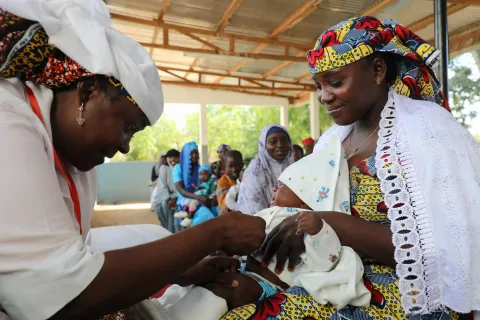
Among the actions carried out for the vaccination of children aged between 0 and 11 months, the Ngaoundéré urban health district has decided to combine the services of women's associations

Among the actions carried out for the vaccination of children aged between 0 and 11 months, the Ngaoundéré urban health district has decided to combine the services of women's associations. The AFDSA (Association des femmes dynamiques de Sabongari-America) is one of them.
The role of AFDSA is to find the so-called ‘lost to view’; in other words, children and pregnant women who have stopped their vaccinations, as well as to carry out community monitoring of diseases preventable by vaccination. When they find unvaccinated children, the women of the association, in the interests of the welfare of the whole community, explain, sensitize and persuade on the necessity for vaccination. Then they give the families a card for the parents to take to the health centre. This process thus quantifies the work and contribution of these women’s associationsin lowering dropout rates in the health area and at the district health level.

Hadidjatou, the president of AFDSA, is motivated by this mission. As she explains, “Immunization is the way to protect children from disease. It's not possible for some diseases, but when the vaccine exists, it is very important to do it.” To achieve this she must also persuade parents, and especially fathers, still often reluctant in this predominantly Muslim community. However, Hadidjatou notes that the situation is changing and that men are more and more convinced once they understand the challenges.
But, according to Hadidjatou, there is one particular factor that explains the abandonment of vaccination: distance. Many of the families who live in the health areas she and her team cover are semi-nomadic, live long distances from centres and have to travel on difficult, long and dusty roads. They must have not only the time, but also a means of transport. Most of the time the trip is done on motor bikes, but few people have the means to pay for transportation.
To illustrate this issue, Hadidjatou, accompanied by an AFDSA member, Yasmine, and a community health worker, Mouhamadou, take us to meet the family of two babies lost to view, whose father accepts that his children must be vaccinated, even though it will be a struggle…

An isolated family
We reach the health centre of Bamyanga Hamadjangui in the Adamawa region, 8 km away from Ngaoundéré. From there, we go to the village of Malaou Beka. After more than an hour and a half of travelling along a chaotic, winding, sandy track, strewn with ruts, we meet the father of the family, Osama, who has come to welcome us and guide us for the last quarter of an hour of the journey. We arrive at the family camp. The man is a herder and the first thing we see is his herd of cows. Then, he presents his two wives: Aya and his baby Souaïbou, and Doudou
with his granddaughter Aïchatou. Both babies are just a few months old. When Hadidjatou asks the two mothers why they did not come to last month’s immunization appointments, they say they have recently moved to this site and now live too far away from the health centre; they not have the time or money to continue the vaccination of their babies. Osama has a total of nine children, none of whom have followed the complete vaccination protocol, and four of whom have not even received the first dose of BCG.
Today he understands that vaccination is important but is still struggling to keep up with the children’s vaccinations, especially as the precariousness of his existence has forced him to move to this isolated place where he can cultivate a piece of land to feed his family. The distance to the health facilities is a major barrier.
Before, I was afraid to vaccinate my children. I thought that if we started the process, but had to stop along the way, my children would get sick.

Convinced mothers
A member of the team addresses the mothers, and both listen carefully. Yet not everything is assimilated and awareness needs to be further deepened; Thus, although Aya, one of the wives, has never been afraid to vaccinate her children, she did not understand that if her baby receives only one dose of vaccine when it needs more than one, the child is not protected against the disease.
She is surprised and the community worker sits next to her to explain. Doudou rushes up, very interested and attentive. The mothers demand information, eager to understand how to protect their children, and the father is convinced too. It’s unanimously decided that the two babies will be taken to the health centre for their next vaccination the following Friday. And when it happens, Hadidjatou will be informed by phone. This exchange reinforces the importance of both information and awareness in spreading the vaccination message.
These populations are poor and lack information. The work done by women’s associations, with the vital support of community health workers, is therefore essential and fruitful. However, the two members of AFDSA emphasize that they could do much more if they had greater means to increase access to these populations. The women use their own money to pay for motorbike rides to remote villages and camps like that of Oussama and his family.