Young people take over World Children’s Day
Celebration in Mondulkiri embraces the potential and promise of young people and gets youth speaking up about child rights in one of Cambodia’s most vulnerable and hard-to-reach provinces

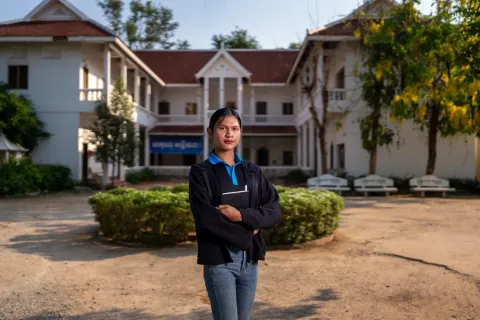
23 November 2024, Mondulkiri – When up-and-coming Cambodian rapper Roxy visited UNICEF’s World Children’s Day’s celebration in Mondulkiri, 19-year-old Mengneang wasn’t shy about putting herself in front of other photographers to get the shot she wanted.
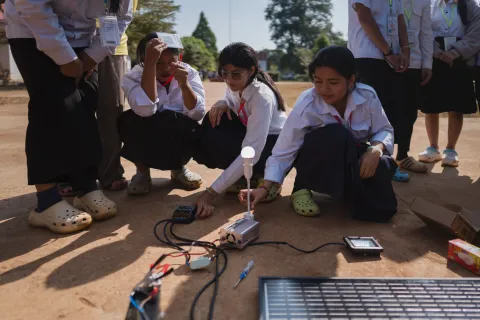
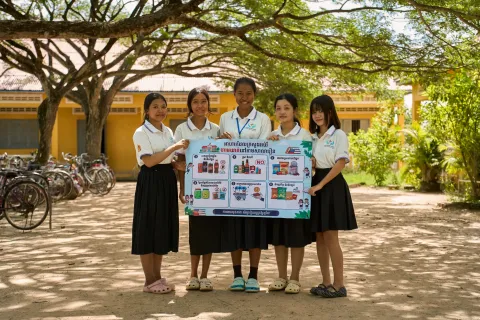
But it’s not just because she’s a fan. She’s one of 45 youth volunteers recruited to take the lead at Bonn Phum on the Move’s UNICEF Village (“Phum UNICEF”). Today her job is to capture on video the best moments from the World Children’s Day celebration in her home province, to be used across UNICEF Cambodia’s social media platforms. With more than 12,000 children, caregivers and other local visitors in attendance attending workshops and games on anything from nutrition and education to climate and the environment – all run by young people from youth networks like World Vision Cambodia, Volunteer for my Community (VMC), Adolescent and Youth Reference Group (AYRG), and high school students – she has her hands full.
“I’m very happy to do the content because I get to capture the moment of the kids smiling and having fun,” she says. “They’re happy, so I’m happy too.”
As the first of its kind in Mondulkiri, Mengneang knows how special it is that children in one of the most remote and vulnerable provinces in Cambodia get to engage in activities that help them learn about their rights and celebrate their indigenous culture.
“I’m very happy that Bonn Phum on the Move chose Mondulkiri because this is one of the provinces that is very far from the capital city,” she says of the event, which was co-organised by UNICEF and partner Plerng Kob. “I think that the event is important because this is also part of us showing love to children, allowing them to engage in a lot of activities. I know that children have the right to get protection from us as adults. So we have to protect them, love them.”
Building on the success of last year’s celebration in Kratie province, this year UNICEF Cambodia continued amplifying the voices of children and young people as advocates for their own rights by reaching even harder-to-reach populations in the country’s far northeast, where children face significant inequalities and multiple deprivations. Almost one-third of children under five are stunted, and approximately one in ten children have not received any vaccines, which is 3 per cent above the national average. According to the recent Children’s Climate and Environmental Risk Index (CCRI) for Cambodia, 92 per cent of the population under 18 is highly or very highly vulnerable to climate and environmental hazards, shocks, and stresses because they have limited access to essential social services.
Over two days, over 179 young volunteers, including youth from ethnic minorities, led the organization of the Bonn Phum on the Move at the Bunong Indigenous village in Mondulkiri, conducting workshops on child rights, climate adaptation, mental health, nutrition, and other essential life skills.
“As a young person, I’m responsible for the development of the country, to make the community a better place,” says Mengneang, who is herself an active advocate for children’s voices and rights in Mondulkiri, including by raising awareness and speaking out against issues like child marriage, which continues to strip the potential and promise of young people from indigenous communities. One-third of women aged 20–24 in the province were married before they turned 18, the second highest rate in the country.
“It affects young people a lot,” she says. “We’re going to lose a lot of human resources if this continues to occur because children who marry early won’t receive education. Their opportunity will be cut off.”
In Mondulkiri and across Cambodia, limited space for participation and deeply rooted social norms continue to restrict young people’s ability to assert their rights and engage in meaningful dialogue on issues that affect them. Girls, adolescents with disabilities, and ethnic minorities are the most marginalized due to their limited resources, opportunities, and social norms that condone discrimination and violence.
“This kind of event helps raise awareness on issues especially stopping discrimination against ethnic minorities. Parents who come to the events with their kids get to have an idea about these kinds of problems as well,” says another Phum UNICEF volunteer, 19-year-old Sreypov, who is ethnic Bunong. She got involved with the event through Mengneang, a former classmate.
UNICEF works with the Royal Government of Cambodia to increase investment in adolescents and support their civic participation, especially adolescent girls. Through engagement with youth networks and encouraging active participation in events like World Children’s Day, UNICEF aims to empower young people to step up as leaders, become agents of progress, and exercise their right to self-expression and influence on matters affecting them.
Mengneang, surrounded by hundreds of happy children, agrees that the key to young people driving change in their communities is to build a network.
“I alone cannot make a change.”
Her final message for UNICEF: “I want UNICEF to reach out to more places that are hard to reach, like Mondulkiri. Bring more programmes like this here. Educate young people, and let them know that education is not just about going to school, you can also learn and have fun at the same time.”