A voice for every young person
Some minority groups have to raise their voice even louder than their peers to be heard. In Siem Reap, 27-year-old Gech is helping open doors for more inclusive youth participation in local governance.

- English
- Khmer
1 April 2026, Siem Reap – “My message for the younger generation: have the courage to participate and the courage to live as yourself.”
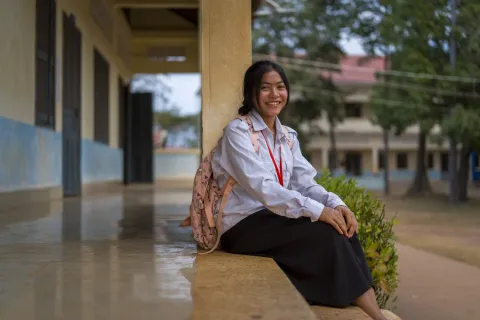
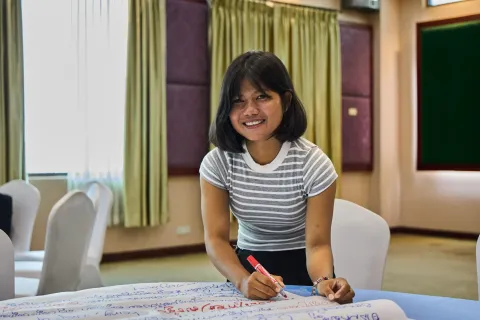
This is 27-year-old Gech’s message to youth all around Cambodia. As a transgender woman, she knows what it’s like to have to raise her voice even louder than her peers to be heard. So even before she became youth representative in her Sangkat1 in Siem Reap town, she was used to speaking up for herself, for young people, and the challenges they face every day.
“Don’t consider yourself as someone society overlooks,” she encourages. “I want them to be united in participating, struggling, and seeking support to exercise their rights. If they don’t participate and don’t raise their issues, there will be no results. I want them to understand that point clearly.”
In Cambodia, young people have limited opportunities to meaningfully exercise their right to participation and influence decisions that affect their lives. Some face even greater barriers to inclusion, including vulnerable groups like adolescent girls, sexual and ethnic minorities, and adolescents with disabilities.
Despite existing platforms for youth civic engagement across the country, many officials may not see the value of or understand their responsibility to include young people’s voices and opinions in local governance, while many may also be unable to use the appropriate tools and platforms to engage them. At the same time, young people lack the skills and confidence to engage local authorities and meaningfully contribute to their communities.

But this is changing. Since 2023, UNICEF has been working closely with the Ministry of Interior to institutionalize youth civic engagement in sub-national decision making. Youth representatives are now an official requirement for Commune Councils for Women and Children (CCWCs) across the country, giving them the chance to directly influence commune planning and budgeting and have their priorities reflected in development plans. The programme is funded by the Australian Government through the Australian NGO Cooperation Program (ANCP).
Since 2023, Gech has been working closely with her commune to identify priorities for the Sangkat that help address the challenges she sees in her community, including those facing the most vulnerable and marginalised. After being appointed as official youth representative, her role now involves seeking feedback from young people in her Sangkat and bringing their concerns directly to the CCWC. With support from UNICEF, 2,000 youth representatives like her across Siem Reap, Preah Vihear, and Ratanakiri received training on how to identify and present their priority issues and solutions, while building soft skills like leadership and confidence.
Her list of achievements is impressive, says close friend and CCWC member, 32-year-old Path Marina. Together, they’ve helped young people who dropped out of school access vocational training, they’ve mobilised resources to fix drainage and sewage issues, leading to a newly constructed concrete road, they’ve addressed traffic congestion outside schools, and they’ve installed solar-powered lights on dark streets, making it safer for students who need to travel at night. In the past year, they’ve also launched a 24-hour platform for citizens from each village in the Sangkat to communicate and raise their concerns directly with the local authorities.
Today, they’re currently working on a campaign to help vulnerable people, including youth who are migrants or informal workers, access free healthcare through a government social protection programme. Through the years, Marina has seen Gech grow as a person, going from being too shy to access basic services at the commune hall to a woman who can stand up for herself and be a leader among young people, especially by encouraging others to get involved in their own communes.
“She can give presentations on our behalf at the city level, the provincial level, and even in other provinces,” says Marina. “She has been successful beyond the commune administration. Before, she wasn't brave, but now she is. She raises problems we didn’t even think of.”
Marina is one of 1,900 local officials who received UNICEF-supported capacity development on how to work better with young people and the role of youth representatives in commune/Sangkat budgeting and planning. Trainings also aimed to spark a mindset shift for authorities to understand the right of youth to participate and have their opinions heard.
“It is absolutely necessary and important,” says Marina. “Their perspectives are fresh and modern. In truth, some people think that because youth are young, their ideas are ‘shallow’ or ‘immature,’ or that the issue isn’t important. But their voices matter because they experience that issue directly.”

As an example, she worries that many of the serious risks affecting young people, including trafficking, exploitation, and violence, may be missed because decision makers are less active online than young people.
“They might know things that we cannot see on the ground, things we only see on social media.”
But Gech is encouraged by the change in mindsets she’s seen towards young people.
“In Sangkat Sala Kamreuk, one thing they value most is youth,” she says. “Especially the Sangkat chief. For every problem we’ve discussed together in the community, he always takes time to think about it and respond to us.”
She also sees further positive shifts in authorities’ attitudes towards minority groups.
“Compared to before, it’s different,” she says. “Now, I feel the government pays very close attention to social inclusion. It’s not just us—the LGBTQ+ community—but people with disabilities or others also receive opportunities to participate. From the bottom level to the top—when our voices join, they are happy. Especially during meetings or forums, they make sure there is social inclusion. No matter what, there must be a representative to participate.”
“When she participates, people see her capacity,” adds Marina. “Old derogatory terms aren’t used anymore. No one dares to discriminate against them now.”
Gech also participated in UNICEF’s pilot initiative giving youth the opportunity to bring their concerns directly to the district level administration, which is a step above the commune level administration. Since 2025, 30 UNICEF-supported youth-governor dialogues have taken place across Ratanakiri, Siem Reap, and Preah Vihear provinces, bringing together 534 youth representatives (395 females) across 201 communes to engage with the district governor and officials. It’s the first time ever such a platform has been established in Cambodia.
“I was a bit nervous, but once I held the mic, I took a breath and just spoke as it came,” she says. The issues she chose to raise with the district – blocked sewage systems, trash, dark roads – were taken from her ongoing work with the CCWC.
She says she was encouraged by the feedback from the district officials. “I felt that our voices and efforts were not left behind. It means our hard work was not useless. It’s not like we just went there to talk for the sake of talking—they always listen and pay attention.”
“Youth participation is vital so we know their needs and can respond,” says Deputy Governor of Siem Reap municipality, Doeun Ratha, who was on the panel during the dialogue. “If they don't join, they won’t understand how government institutions work. If they join us in building a plan, they know what the city intends to do in 5 or 10 years. We are old people. We don’t always know what youth want. If they raise their concern, we can help.”
Youth participation is an investment in the country’s future, he says. “We all believe youth are bamboo shoots. To have strong bamboo, we must cultivate them while they are small.”
At 27, Gech knows that there’s a whole new generation getting ready to take over the work she’s set in motion: to transform mindsets, overcome stigma, and lay the foundation for every young person from every background, minority group, and community to meaningfully participate in decisions that affect their lives, advocate for the issues that matter to them, and build more inclusive communities.
“Please don’t be afraid,” she says. “Don’t be afraid and don’t hesitate on what you want to do and achieve.”


1A Sangkat is an administrative subdivision in Cambodia, roughly equivalent to a commune