Girls choose school over marriage
In Ratanakiri, half of girls are married before 18. Supported by UNICEF and DFAT, youth advocates are speaking out against child marriage, empowering girls to stay in school and determine their own futures

- English
- Khmer
23 January 2026, Ratanakiri – A cool January sun beats down on the challenging, unpaved roads of Cambodia’s Ratanakiri province, where passing motorbikes kick up blinding clouds of red dust that settle over remote indigenous villages. Here, schoolchildren pass the days playing volleyball, sharing their favourite snacks under the shade, or connecting with new friends online.
Last year, 17-year-old Theda started chatting with a boy she met on Facebook. He was 19 at the time, and she was 16. After a couple of months, growing closer day by day, they wanted to meet in person.
The next step felt natural. With permission from their parents, they decided to get married.
“At that time, we thought that since we loved each other, we should get married because our families lacked manpower,” says Theda, now 17 years old. “That’s why I thought I would start a family, to help ease the family’s burden.”
She had planned to drop out of school, like many adolescent girls in her community who want to get married. But as time went on, her relationship strained, and her eager hopes for the future became uncertain.
“We argued,” she says. “We weren’t getting along because we were too young, hot-tempered, and we didn’t have any money yet.”
In Ratanakiri, a northeastern province with a high population of indigenous communities, everyone has a story of child marriage. Driven by cultural norms, limited educational opportunities, and poverty, almost half (48%) of women aged 20–24 were married or in a union before the age of 18, the highest rate in the country.1
Today, many of these girls are meeting their future husbands online.
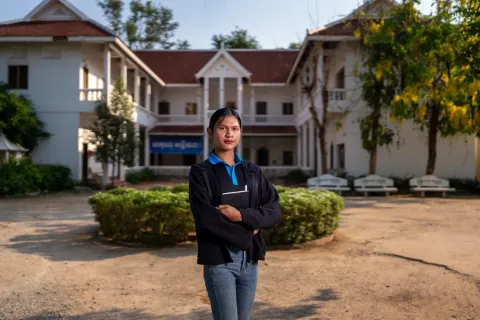
Soon after deciding to marry, Theda met 24-year-old Yoeurn Nich. She’s a member of the local Adolescent and Youth Reference Group (AYRG), a national youth network supported by UNICEF that empowers young people to become advocates for their rights. Nich has been trained to raise awareness of the risks of early marriage around her village and the surrounding communities.


Nich told Theda that getting married before 18 takes away a girl’s right to make decisions about her own life, traps families in poverty rather than helping to release a burden, and isolates girls from their friends and communities. She said early marriage increases her risk of violence, especially when financial stress causes tension in the relationship, and that teenage pregnancy can cause health complications for both her and the baby.
The message made her reconsider the decision to get married so soon, finally deciding to focus on her studies. It was a difficult choice in a community where getting married so young is ingrained in the culture.
“I thought about it many, many times, and I decided that I would continue studying without caring about what the villagers or anyone else would say to me,” says Theda, now in Grade 10. “Her words that made me reconsider were about the impacts on the future. Because when a girl isn’t well-educated, once she has a family, she faces oppression from the family and can’t connect deeply with outside society. Our future is very important. If we have no life goals and aren’t well-educated, we also have no knowledge.”
The rate of child marriage in Cambodia has not declined significantly over the past two decades, reducing from 25 per cent in 2000 to 18 per cent in 2022. In some provinces with high populations of ethnic minorities—including Ratanakiri (48%), Stung Treng (41%), Mondulkiri (33%), Preah Vihear (33%)—the practice remains widespread, with serious consequences for girls and ripple effects across society.2
“The mindset in our community is that you don’t need to study to a high level. Just knowing letters, numbers, or how to write your name is enough, because you’ll end up having a family anyway,” says Nich. Supported by UNICEF with funding from the Australian Department of Foreign Affairs and Trade (DFAT), she leads awareness sessions for adolescent girls, boys, and villagers to help change these beliefs and offer the youngest generation an alternative future.
Nich’s own cousin married a man she met on Facebook at 16. She dropped out of school, fell pregnant, and later separated from him, leaving her to raise her young son on her own.
“We felt very regretful because when she was at school, she spoke about what she loved to do,” she says. “She had dreams... We expected her to continue following her dreams.”
“This story isn’t just one or two cases. This is what happens most often.”
Nich has also felt this pressure firsthand, she says. But for herself, she wanted a different life.

“People used to joke with me that, at my age, I should just get married to help relieve the family burden because my parents are getting old,” she recalls. “At that time, I also thought that if I had a family, maybe it would be good. But I asked my mother and she said it was up to me. If I wanted to learn, then continue learning. So I decided to keep studying and joined AYRG. If I had married then, people probably wouldn’t trust me now to disseminate information about this issue of early marriage.”
To protect children from child marriage, UNICEF is working closely with local administrations, religious leaders, partners including the Child Rights Coalition Cambodia (CRC-Cambodia), and young people themselves from youth networks like AYRG. In parallel, UNICEF and partners are supporting the Ministry of Women’s Affairs to develop a national action plan to prevent Child Early and Forced Marriage (2025–2030), and supports strengthening the capacity of social workers and preventive and care services for survivors, ensuring that adolescent girls receive the support they need to rebuild their lives and reclaim their future.
“I want to tell the younger ones: please choose education over marriage,” says Nich. “Education is very important for children in the community. When we have knowledge, we have job options, clear skills for the future, and we know how to think carefully before deciding to marry.”
For Theda, the future feels hopeful and full of possibilities.
“If I have the means, I want to continue to university,” she says. “I feel very excited and happy. My dream is to graduate so that I have knowledge and know more about outside society, and to have my own job so our family’s livelihood can prosper.”
1 Cambodia Demographic and Health Survey (CDHS), 2021–2022
2 CDHS, 2021–2022