Solar energy powers future careers
Practical education on solar power is giving students skills to lead Cambodia’s transition to renewable energy while challenging stereotypes about who can lead climate action

- English
- Khmer
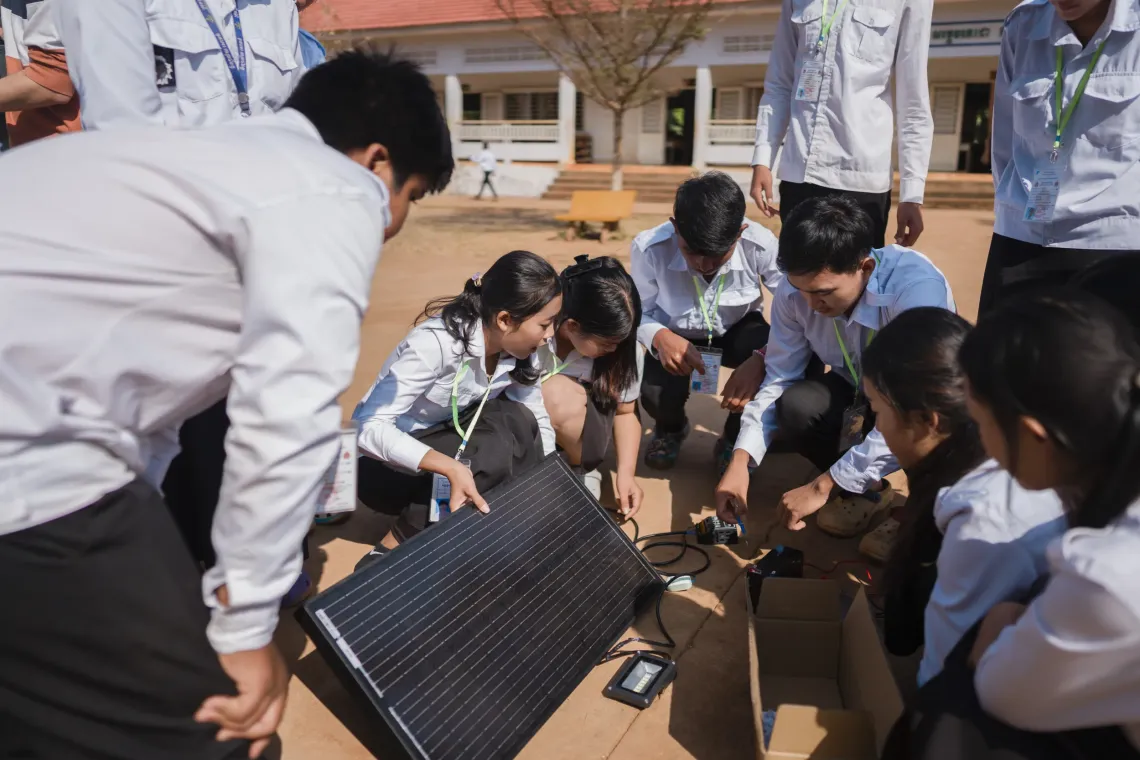
20 January 2026, Ratanakiri – Under the bright, dusty sunshine of Ratanakiri province, a group of Grade 11 students are huddled together around a tangle of wires, a battery, and a small solar panel in their school’s courtyard. Working together, they carefully connect each terminal, hoping to see a single lightbulb flicker to life.
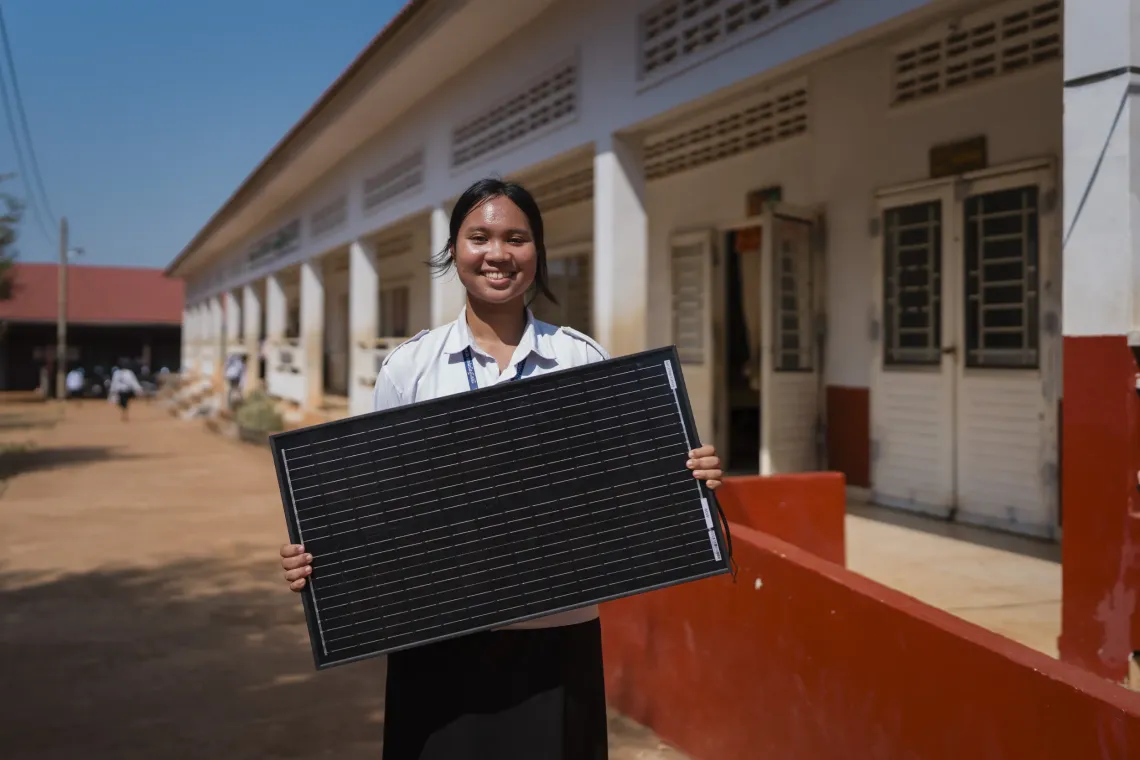
“It’s amazing,” says 15-year-old Snet, who comes from the indigenous Jarai community. “Now I know electricity can be generated from sunlight, and we can use it in our daily lives. This is the first time we've learned about this, so it's very special.”
Being a solar technician is not a career that many indigenous students from rural Ratanakiri, especially girls like Snet, would’ve had in mind for their future. In this remote corner of Cambodia, limited educational opportunities and social and gender norms continue to restrict young people's choices. Many girls drop out of school early and get married – in Ratanakiri, almost half of girls are married before 18, the highest rate of child marriage in the country – and many parents don’t see the value in their children pursuing higher education. 1
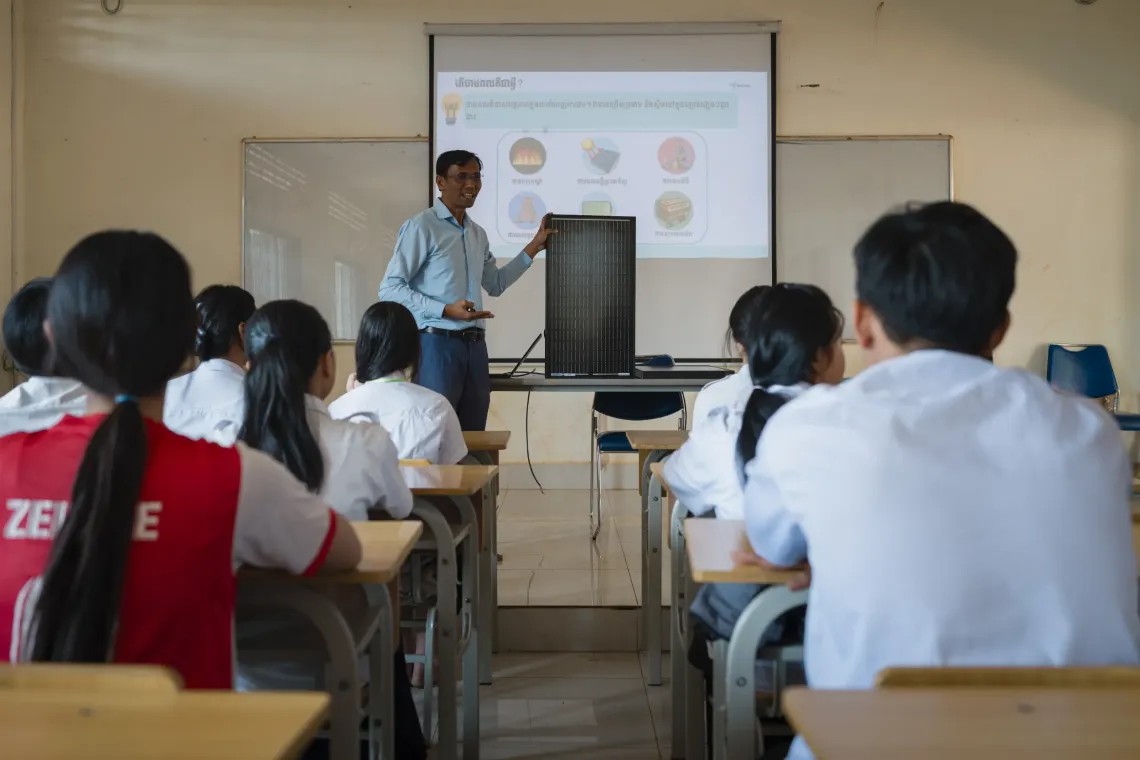
ICT teacher Heang Sokchea says his students aspire to be accountants or work in a bank. Others become farmers. “They didn’t know they could also pursue technology skills,” he says.
This is the kind of mindset that hands-on sessions on solar power are designed to change. With support from UNICEF, the Youth Solar (YOSO) initiative aims to give students, especially girls, access to a growing marketplace of green jobs through practical skills in solar installation and maintenance. YOSO recognizes that Cambodia faces urgent environmental challenges and a growing need for renewable energy, which requires both the adoption of solar power and youth engagement in climate action. It gets students thinking about how these skills connect to challenges they see in their daily lives, and their role in supporting their communities to adapt to the growing impacts of climate change.
“I want them to understand that opportunities don’t only exist in cities,” says Sokchea, who runs the YOSO sessions at his school. “If they use their solar knowledge to support their communities, work opportunities will also be created.”
Ratanakiri is one of Cambodia’s most vulnerable provinces and has a large population of indigenous communities. Many villages are still not connected to the national electricity grid, and while a growing number of communities have access to off-grid solar energy, many households and essential services still rely on rechargeable car batteries and diesel generators, which are costly, inconvenient, and polluting. Batteries often have to be transported long distances just to be recharged.
The province is also one of the country’s most vulnerable to climate change: 89 per cent of children in Ratanakiri, equivalent to around 80,000 children, are extremely vulnerable to climate impacts and environmental hazards because they lack access to essential services to cope, according to UNICEF’s Children’s Climate Risk Index (CCRI) for Cambodia.
YOSO gets students to understand that climate change is not an abstract concept, but an everyday reality for children and families.
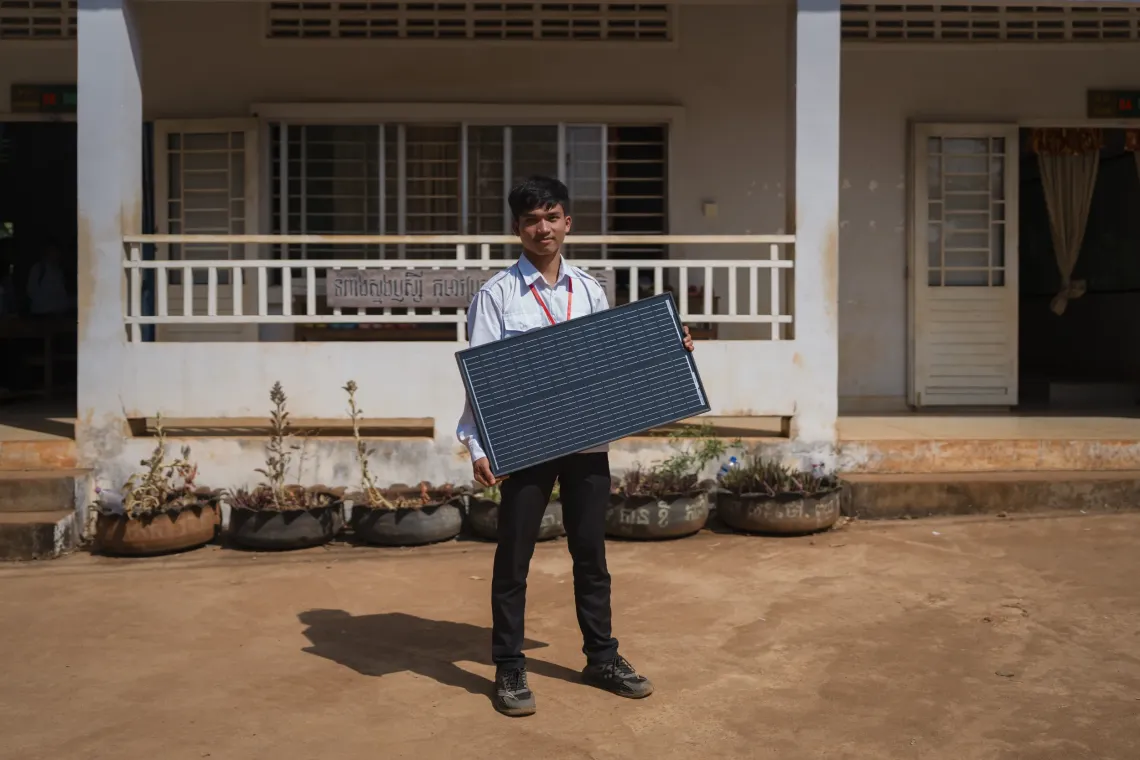
“The climate is changing intensely now—hot to cold, cold to hot, and unpredictable rain,” says 17-year-old Hao. “This makes it difficult for farmers and the Cambodian people as a whole, because we rely heavily on agriculture. If we continue to destroy natural resources, our world and our country will keep losing resources, and life will become even harder than before.”
Hao understands these challenges first-hand. Every day, he travels an hour by motorbike to school from his village, where a small solar panel powers a few appliances in his family’s home. He hopes to help more children and communities understand the transformative power of solar.
“I want to take some equipment and provide training in other villages or schools,” he says. “Most of the people studying there come from very remote areas where electricity doesn’t reach. Most of them use batteries. They have to transport the batteries a long way from the village to charge them.”
Hao already has an idea for his future career.
“I really love learning about the ’green’ solar sector. If possible, I would even love to go to the factory where they produce these and work there.”
With support from UNICEF and the Australian Government through the Australian NGO Cooperation Program (ANCP), 2,600 students across Ratanakiri and Preah Vihear provinces will benefit from climate and solar education through YOSO in 2026. Another 60 teachers have been trained as Climate Fresk facilitators, equipping them to bring engaging and inclusive climate education into their classrooms. Using Climate Fresk’s interactive card game, teachers can help students understand the causes and impacts of climate change and inspire the next generation to take action for their communities and the planet.
The next phase of the programme will integrate and expand YOSO into ongoing climate and renewable energy education delivered through the local life skills education (LLSE) and Volunteer for My Community (VMC) programme and get students out in the community to deliver their own solar solutions.
“We noticed a change in students’ attitudes,” says Sokchea. “They once thought they had no power to create change, but the training changed their way of thinking.”
By making renewable energy practical and accessible, the programme is helping students see that careers in science, technology, engineering and mathematics (STEM) are within reach—regardless of gender, ethnicity, or how far they live from the city.
“We found that the materials and equipment were very easy for students to understand,” says Sokchea. “They were able to use the materials to practice on their own and express their ideas in their own way. It helps them believe in themselves and realize they can do what others can do. It doesn’t matter if they live in a rural area.”
“Most of this work is usually pushed toward men,” adds Snet. “But as women, we can do this work as well. It’s not just for men.”
Now she wants to make sure the knowledge she has gained does not stop with her.
“I feel excited. I will tell the next generation about it. I'll tell my siblings, uncles, aunts, and many more people.”