Girls lead healthier futures
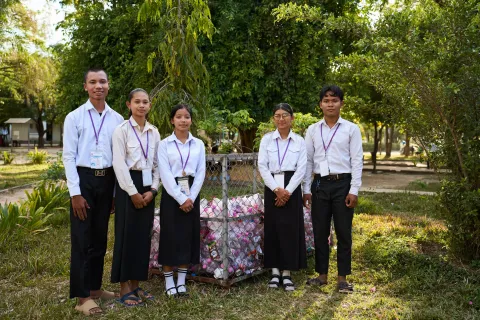
Through Volunteering for My Community, these five girls are turning their passion into action by helping primary school children make healthier choices.

- English
- Khmer
14 August 2026, Prey Veng – Shelves of ultra-processed sugary treats, energy drinks, and colourful packaged snacks that have long since passed their expiration dates: every day, schoolchildren around Cambodia are surrounded by unhealthy, addictive, and sometimes even unsafe food and drink choices. So when a group of five girls from Prey Veng were asked to choose an issue they care about, they didn’t have to look far.
“Nowadays, we see children getting sick from eating poor-quality food,” says 16-year-old Chanrotha, Grade 11.
“I want to help all children develop and stay healthy,” says her best friend and teammate, 16-year-old Sina.
The two are part of a team of five teenage girls on a mission to help children make healthier food choices. Over the past four months, they’ve been out in primary schools around their district leading sessions with children on healthy nutrition, the risks of junk food, and how the food choices they make today matter for their future. Their achievements are already impressive – they’ve stood in front of hundreds of children at morning assemblies, led lessons in classrooms, and advocated with food stall sellers to remove harmful products from their shelves. By their estimate, they've reached around 1,300 primary schoolchildren so far – and they have no plans to stop anytime soon.
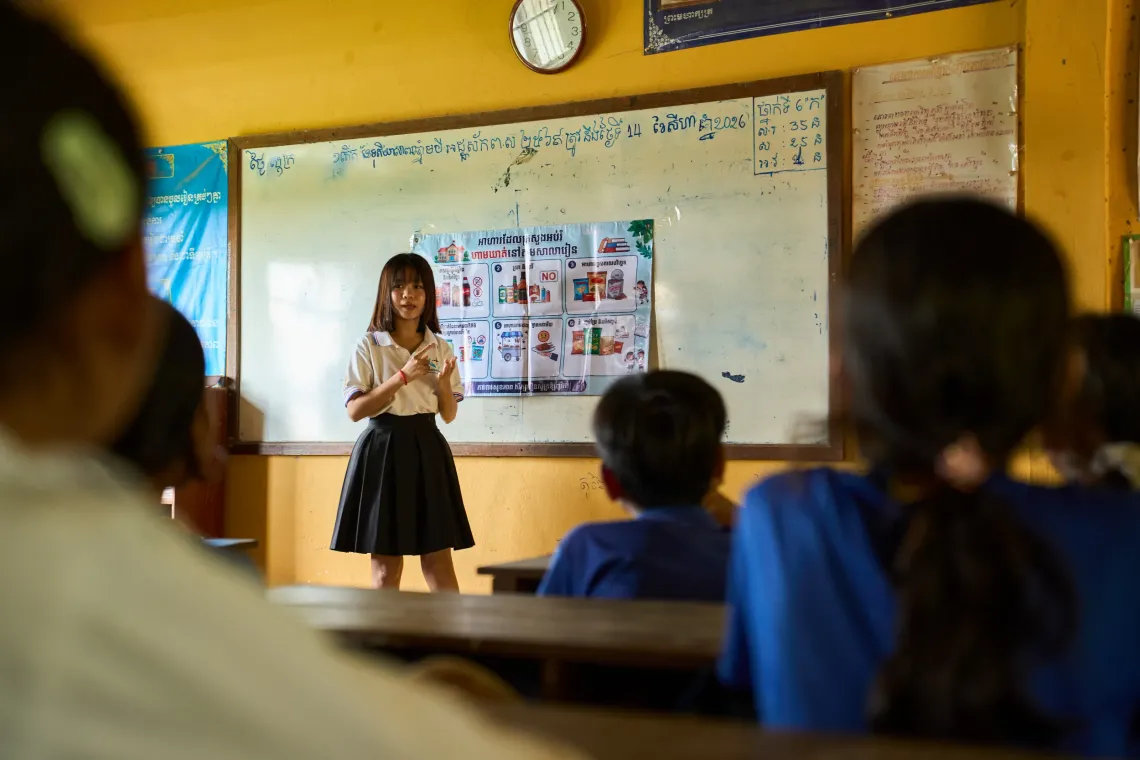
“I’m not tired,” says Sina. “I think it’s still not enough. I still want the children to go and spread the message in their villages too and tell their brothers or sisters.”
The girls are taking part in Volunteer for My Community (VMC), a UNICEF-supported initiative that equips students with skills they can’t learn in the classroom. Together with their teammates, participants learn how to identify, design, and roll-out solutions to community issues, picking up essential 21st-century skills like online research, other digital competencies including artificial intelligence (AI), fundraising, problem solving, and public speaking.
It’s been quite the journey, the group says. They started off only doing classroom sessions at nearby primary schools, but once teachers better understood what they were trying to do, they were given opportunities to speak at morning assemblies so they could reach even more students. They designed educational posters, which they printed using money fundraised among their classmates, and set up a Facebook page to post videos of their activities. Through their research, they also learned that the Ministry of Education, Youth and Sport has issued several directives banning the sale of unhealthy and unsafe products in and around schools, giving their advocacy among food stall vendors a clear call to action. Even when some vendors didn’t comply straight away, they were invited back again and again by the schoolteachers until the message stuck.
“I see that our efforts are making a difference,” says Sina. “When we went to check, they didn't have as much harmful food. They promised that once what’s left is gone, they will stop selling it.”


In Cambodia, young people still have limited opportunities to participate in their communities and develop skills to ready them for the future. Some face even greater barriers, including girls, children with disabilities, ethnic minorities, or those living in remote areas. UNICEF is working with the Ministry of Education, Youth and Sport to give every young person, especially the most vulnerable, the voice, platform, and ability to become leaders in their community. With support from the Australian Government through the Australian NGO Cooperation Programme (ANCP), more than 50,000 upper secondary children (25,000 girls) across three provinces have designed and implemented youth-led projects on climate change, healthy environments, mental health, nutrition, child marriage prevention, and more through VMC.
For Chanrotha, overcoming gender norms meant changing mindsets at home. When she told her parents she wanted to sign up for VMC, they were hesitant at first, fearing for her safety outside of school hours.
“My family didn’t really encourage it,” she says. “They said a girl shouldn’t travel far. I told them that I want to improve my own capacity, which could help me when I study at university and maybe even help me get a small scholarship. After that, they agreed.”
Sina’s parents were more open-minded, encouraging her to step beyond the familiar. For both girls, having the freedom and support to volunteer has helped them gain the confidence to do things they never would’ve done before, as well as challenge expectations about what girls can do and where they can go.
“They opened up and let me travel far, let me communicate with others, because they want us to do things for ourselves and be able to decide for ourselves,” says Sina. “I’m proud and happy that I’ve done this volunteer work. When the teacher shared what I posted after the session, my dad saw it and then he praised us. We are braver than before, so he pushed me, he really pushed me.”
“I’ve changed a lot!” adds Chanrotha. “At first, I never dared to talk. I was really scared of children. But now, I dare to talk with them. I used to be nervous around teachers, too. I didn’t dare to walk near them. But once I joined, I dared to talk to them and communicate.”
It’s the first time that their school has offered VMC for its upper secondary students. For facilitator Pon Visoth, this year has been a good indication for what the school can achieve in the years ahead.
“Now we have some experience from VMC, we can do more,” he says. It’s impact that’ll extend beyond the students who sign up, reaching the wider school and community.
Chanrotha and Sina are also looking towards the future. They say they’ll continue their project until they graduate, finding new ways to connect with children and following up with the students and vendors they’ve already visited so far.
But their passion for health doesn’t end with VMC – they both want to be doctors, so they can keep using what they learn to help others.
“When I study to become a doctor, if I have free time, I’ll do sessions like this again,” says Sina. “Right now, I can’t always explain what causes each disease, so I can’t give as clear an explanation as I would like. Once I have studied, I’ll be able to explain clearly, and people will have more confidence in what I’m telling them.”
“I want to be a doctor too, but in orthopedic surgery,” says Chanrotha. “In our society today, there are many traffic accidents, so I want to help them to heal quickly.”