Sabin hears the heartbeat of hope
UNICEF is helping improve maternal and newborn health in Cambodia, with funding from China

- English
- Khmer
March is the dry season in Cambodia. The Mekong River winds quietly through Kratie Province. As the floodwaters recede, broad stretches of riverbank emerge, while trees along the banks remain lush and green. In Kor Loab village, a newly built health centre stands quietly among the greenery. Small and modest, the two-storey building provides essential care for pregnant women and newborns from several surrounding villages.
Inside the health centre, bright orange ixora flowers sway gently in the morning breeze as a motorcycle pulls into the courtyard. Nine months pregnant, Sabin Sreyphors steps off with the support of her cousin and walks towards the examination room for her final antenatal check-up before giving birth. Today, travelling to the health centre is much easier than it once was, making it easier for her to attend every recommended antenatal check-up.
“Thump, thump, thump...”
Midwife Cheng Malen gently moves a Doppler monitor across Sabin's rounded belly, searching for the clearest signal. As the strong, steady heartbeat echoes through the room, the tension on Sabin's face begins to soften, replaced by a smile. "The moment I heard my baby's heartbeat, I felt reassured," she says. "It gave me strength and motivation."
That reassurance had not come easily. Just a few months earlier, during a routine antenatal visit, Sabin had been diagnosed with anaemia. "When I first found out, I was very worried that it might affect my baby. I had trouble sleeping. I was tired and weak," she recalls. "But the midwives said it would be okay if I took Iron Folic Acid supplements and followed the recommended diet.”
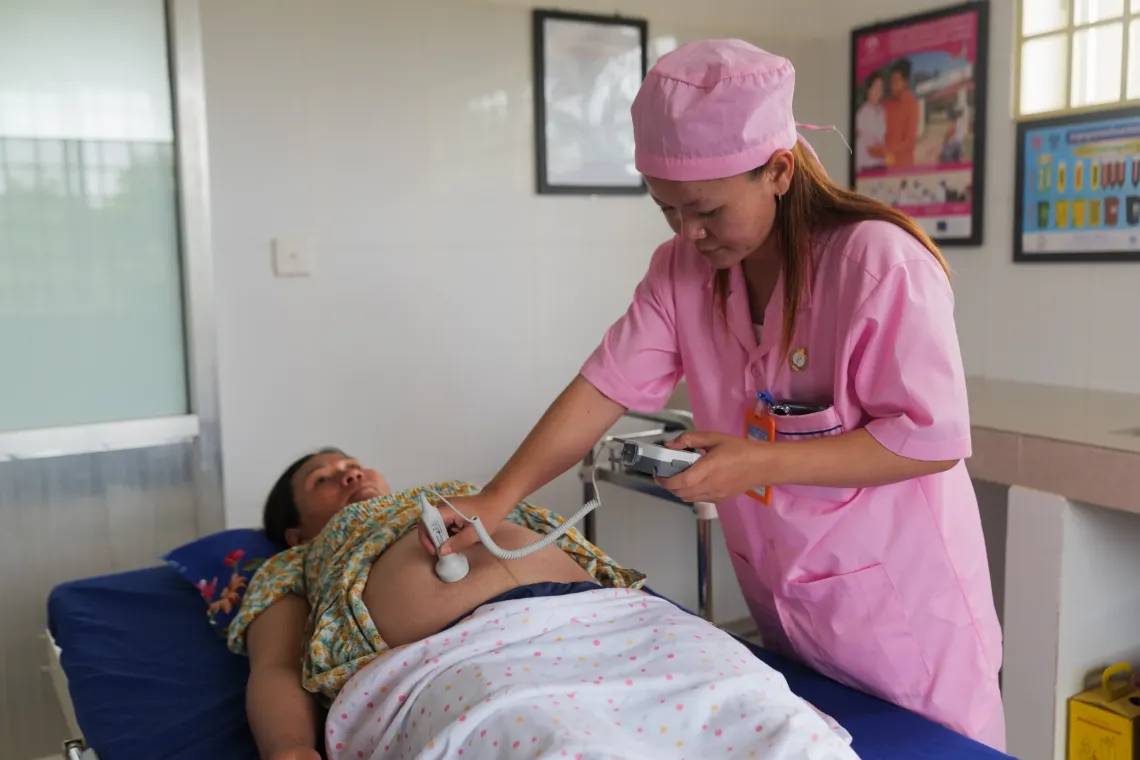
Malen has worked at Kor Loab Health Centre for years and has witnessed its transformation. "When the health centre first opened, we had very limited equipment. Sometimes we even had to use our own money to buy basic medical supplies," she says. "It was difficult to monitor a baby's heartbeat clearly. If complications arose, mothers often had to be referred to a hospital much further away."
With support from the Government of China, UNICEF has equipped the health centre with Doppler foetal monitors, neonatal resuscitation bags, and other essential maternal and newborn care equipment.
"Today, our ability to care for mothers and newborns has improved significantly," Maren says. "We can monitor a baby’s heartbeat more clearly and provide timely newborn resuscitation when needed. More pregnant women are coming for antenatal care, and more are keeping their scheduled appointments."
Bringing quality care closer to families
Cambodia has made significant progress in improving maternal and newborn health in recent years, however, every year, around 500 women still die from complications related to pregnancy and childbirth. In remote and rural areas, shortages of medical equipment, limited training opportunities for frontline health workers, and gaps in maternal health knowledge, continue to put mothers and newborns at risk.
To address these challenges, with support from China, UNICEF is equipping health centres with life-saving maternal and newborn care equipment, providing health education materials, and strengthening the skills of frontline health workers and community volunteers. Funding was provided by the China International Development Cooperation Agency (CIDCA) through the Global Development and South-South Cooperation Fund.
"China is supporting a community-led cooperation model in Cambodia. This aligns with the realities of limited rural infrastructure in areas such as education and health," says Wang Wenbin, Ambassador of China to Cambodia. "By combining China's resources and experience with UNICEF's extensive community network, we are able to ensure that support reaches communities efficiently and where it is needed most."
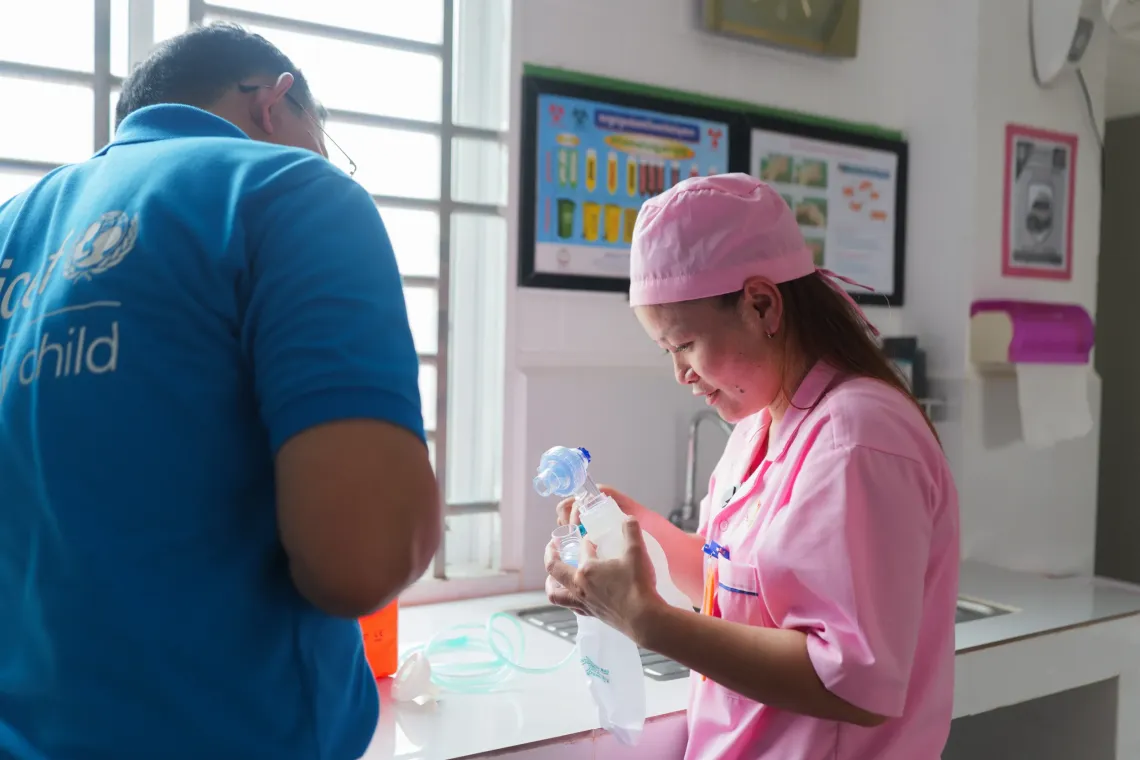
Wathna Chhuon, Nutrition Officer at UNICEF Cambodia, says all health centres across Cambodia’s five most vulnerable northeastern provinces have now been equipped with essential maternal and newborn care equipment, while health workers have received continuous training to strengthen their skills. "These efforts are helping more mothers and babies access timely, quality care close to home," he says. “We thank the Chinese Government for their assistance through the project.”
Learning together for healthier pregnancies
The village's community gathering place is a traditional wooden stilt house with two miniature spirit houses with offerings to ancestors or local spirits. Hammocks sway beneath the raised floor while free-range chickens wander between the wooden posts.
After the check-up, Sabin and her cousin ride there by motorcycle, joining other expectant mothers from nearby villages for a pregnancy education session led by Malen and community health volunteers known as the Village Health Support Group. Using illustrated counselling cards and maternal health booklets provided by UNICEF, the volunteers guide the discussion through questions and conversation.
"What changes during pregnancy are normal?"
"When should you go to the health centre immediately?"
The mothers listen attentively, nodding, and sharing their answers, with laughter bursting out from time to time.
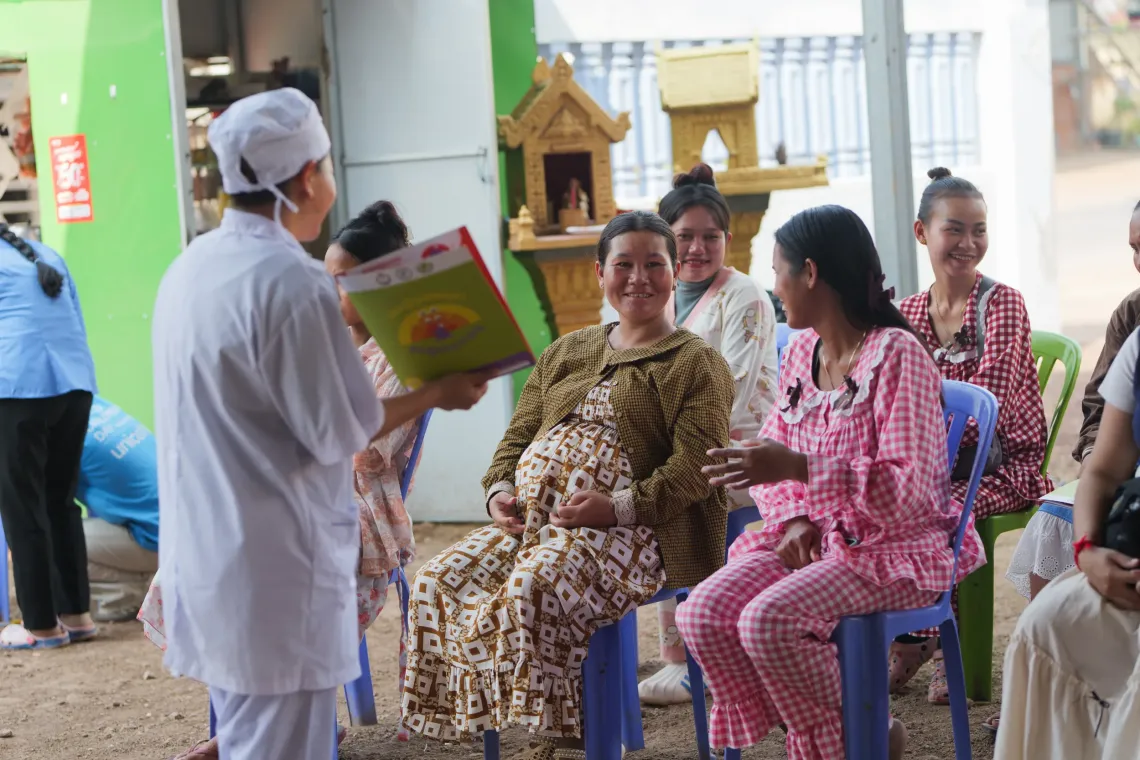
"These educational materials provided by UNICEF are very easy to understand, which encourages them to attend these sessions," says Cheng Malen. "More women now understand how to care for themselves during pregnancy and give their babies the healthiest possible start in life."
Sabin agrees. "The Village Health Support Group teaches us about danger signs during pregnancy, and about nutrition and breastfeeding." she says. "After receiving this information, I felt well prepared."
She gently places a hand on her belly. "I hope my child will grow up healthy and strong and receive a good education." Then she looks down, smiles, and adds, “I want them to have a good future.”
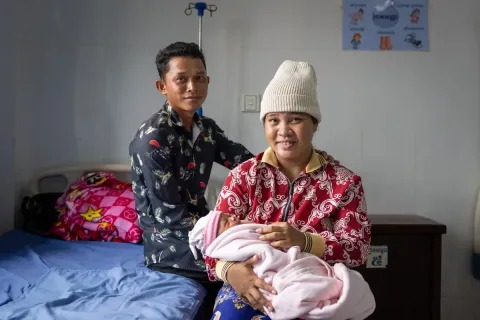
Three days later, Sabin gave birth to a healthy baby boy, Voety.