Newborns in rural Cambodia given chance to breathe
Lifesaving oxygen therapy reaches district hospitals in remote areas, transforming newborn care and giving every baby a fighting chance at survival

August 2024, Takeo – In a newborn care unit, tiny breaths matter, and every second counts.
When newborns struggle to breathe on their own, getting them the oxygen they need in time can mean the difference between life and death.
Until last month, Kirivong Referral Hospital in rural Takeo province, which sits on the Cambodian border with Vietnam, struggled to provide adequate oxygen therapy to newborns suffering from critical respiratory distress. Many staff were not able to use the equipment, and in some cases their machines could not provide enough oxygen to reach all the newborns who needed it.
When they weren’t able to provide the necessary care, Dr Socheat Heng, a doctor at the hospital, would refer the patients to the nearest facility that could – a national hospital in the capital Phnom Penh, more than 100 kilometres away.
Some families could not afford the trip, says Dr Socheat, leaving them with unthinkable decisions.
“One family said it’s up to the baby if they can live,” says Dr Socheat. “If he has good luck with life, he can live. If he has bad luck, he can die.”
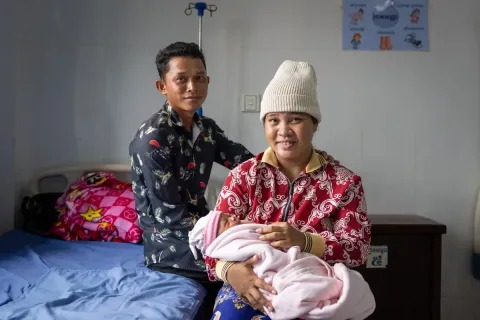
Today, every newborn at the hospital is getting a fighting chance at survival. Equipped with new oxygen therapy equipment supported by UNICEF, the hospital can now provide newborns with the immediate attention they need without having to send them to another facility.
“Some parents don’t have money to go far from the district,” says Dr Socheat. “I was really happy when I got the support from UNICEF because I can help the babies that live in poor families.”
In Cambodia, pneumonia is a leading cause of death for children under five, with nearly half of these deaths taking place during the neonatal period. Simple lifesaving interventions such as oxygen therapy, along with adequate WASH facilities, can help to prevent newborn deaths caused by preterm birth complications, birth asphyxia, and neonatal infections, however basic services like these are not widely available in remote regions.

UNICEF's innovative support to district hospitals tackles this stark divide in accessibility and quality of newborn care between urban and rural areas in Cambodia. The support, funded by the Republic of Korea, equips rural hospitals with advanced medical technology, including equipment to support oxygen therapy such as CPAP machines and pulse oximeters, and provides training on intensive newborn care for local healthcare workers. UNICEF has also been supporting the Ministry of Health and Provincial Health Departments to assess and improve WASH conditions in rural healthcare settings.
The CPAP devices supplied to three district referral hospitals – Kirivong Referral Hospital in Takeo, Snoul Referral Hospital in Kratie, and Borkeo Referral Hospital in Ratanakiri provinces – offer a simple, affordable, and life-saving breathing solution for premature babies, newborns, and children suffering from severe pneumonia and other respiratory diseases. The machines use a safe and easy-to-control bubble CPAP system and are specially designed for places where traditional CPAP machines are too expensive and complicated to operate by district hospital staff.
“My first time using it, I was scared,” jokes Dr Socheat.
But her fears have quickly subsided – in only one month, five babies have successfully received oxygen therapy treatment using the new equipment. Across the three hospitals, around 750 newborns at risk of hypoxemia, a condition characterized by low levels of oxygen in the blood, are expected to benefit from access to oxygen therapy using the CPAP machine every year. Doctors can also use the newly supplied pulse oximeters as a routine screening tool for early detection of hypoxemia in newborns.
With support from UNICEF and the Republic of Korea, these efforts are making a major difference by enhancing newborn care even in the most remote areas, bringing quality healthcare services closer to communities and giving newborn babies a chance to breathe.
“I’m really happy to help all Cambodian babies have a good life,” says Dr Socheat.