For every child, a healthy environment
In Cambodia, unhealthy environments are causing lifelong damage to children’s development. UNICEF is working with rural health facilities to help children live safer childhoods

28 November 2024, Takeo – Climate change is changing children.
Children’s minds and bodies are shaped by the environment they grow up in, from the air they breathe to the food they eat, the water they drink and even the toys they play with. The impacts of a childhood lived in an unhealthy environment can last a lifetime—the global rise in cancer, diabetes, neurodevelopmental disorders and asthma has been linked to the surge in air pollution, e-waste and the use of harmful chemicals in everyday products like plastics, food, electronics, toys and skin creams.
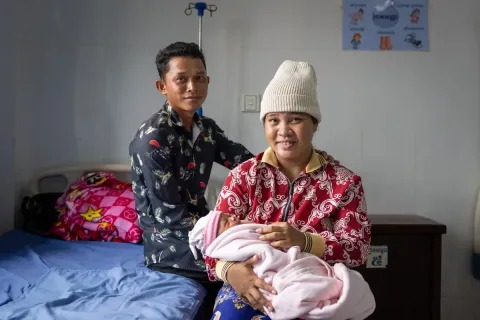
For one mother in Cambodia’s Takeo province, her own diabetes diagnosis likely caused the pre-term birth of her first daughter, leaving the baby suffering life-threatening complications. Immediate oxygen therapy was required to prevent brain damage or even death.
“I’m so happy,” says 24-year-old Chhen Sreynich through tears. Her newborn received oxygen therapy through UNICEF-supported medical equipment at Kirivong Referral Hospital, a facility that serves remote populations near the Cambodian border with Vietnam. “Without this help, my baby could’ve died.”

In Cambodia, it’s not just newborns that are having trouble breathing on their own. Unhealthy environments are putting the most vulnerable populations—including pregnant women, newborns and children—at increased risk of deadly diseases, including severe respiratory illnesses. At home, children are exposed to harmful air pollution caused by cooking with traditional wood burning stoves in an unventilated environment. Outside, they inhale the toxic fumes of motor vehicles and burning piles of household trash.
“Many overlook the problems caused by cooking with wood,” says Dr Heng Socheat, an obstetrician and gynecologist (OB-GYN) who oversees Kirivong Referral Hospital’s new UNICEF-supported neonatal care unit. “The symptoms we often notice in children include dizziness, headaches and convulsions.”
With support from UNICEF, the hospital is now stocked with state-of-the-art oxygen therapy equipment, which can treat patients suffering from illnesses caused by exposure to environmental hazards like air pollution.
“Before receiving support from UNICEF, almost all of the children and infants who had respiratory problems were sent to the provincial hospital,” says Dr Socheat. “We could only provide first aid. However, if it was severe, we had to transfer them.”
The provincial hospital is more than 40 kilometers away, a trip not all patients could afford. And for the hospital’s tiniest patients, the long journey could mean help would come too late.

In Cambodia, a first-of-its-kind assessment on children’s environmental health (CEH)— conducted by the Ministry of Health in collaboration with UNICEF—reveals the scope of environmental health risks facing children in the country, including air pollution, water and food contamination, toxic metals, pesticides and hazardous waste.
Based on global estimates, Cambodia is among the countries in Southeast Asia region that ranks the highest on outdoor air pollution, indoor pollution and lead exposure. It’s estimated that nearly one in five deaths among children under five is attributable to both indoor and outdoor air pollution and that over half of children under the age of 18 have elevated blood lead levels due to lead exposure.
To help children live in healthier and safer environments, UNICEF equips healthcare facilities in hard-to-reach areas with both innovative medical equipment and climate-resilient facilities. 30 health centres have been connected to solar power, four hospitals have been equipped with green technology to treat medical waste, three district referral hospitals and eight health centres have been equipped with nature-based constructed wetlands to treat wastewater, and two health centres have been equipped with climate-resilient water supply systems.
UNICEF also promotes awareness of safe practices to help families better protect their children, including by supporting the Ministry of Health to conduct trainings and awareness-raising activities on environmental risks for healthcare workers in remote health centres.
Dr Sim Sithorn, Deputy Director of Beoung Treng Health Centre in Takeo, received training on the devastating and permanent damage that lead exposure can have on children.
“What I have learned through the trainings is that toxic metals can severely impact our health, especially children, pregnant women and babies,” he says. “This is new information because I never knew that toxic metals could be harmful. This is important for health centres like mine to share.”

Through the trainings, the aim is for health workers to raise awareness among communities about how they can better protect their children from exposure to toxic metals like lead and the dangers of toxic smoke—including by cooking outside or in a well-ventilated environment, keeping children away from the fire, and using alternative fuels for cooking. To protect children from lead, the training encourages health workers and communities to keep children away from lead-acid batteries, battery recycling sites, and peeling paint from old buildings.
At Kirivong Referral Hospital, the occasional cry of a days-old newborn pierces the otherwise pin-drop silence of the neonatal care unit. The room is heavy with careful footsteps and the gentle, comforting caresses of mothers and doctors.

“For a baby, it’s a golden minute,” says Dr Socheat, referring to the crucial window of critical care after a baby is born. “If we couldn’t save them on time, it was devastating for us.”
Sreynich’s three-day-old, Youi—her first child—is sleeping peacefully in her cot.
“I am happy and proud to be able to save the lives of children and infants,” says Dr Socheat. “All of this work is to ensure they will live quality lives and reach their potential. Because children are the future who can shape society for the better.”
UNCIEF’s work in Cambodia to build healthier, safer environments for every child is funded by donors including the Clarios Foundation, the Government of the Republic of Korea, and the Government of Australia through the Australian Department of Foreign Affairs and Trade (DFAT).