Life Skills help students keep up with the times
Siem Reap schools shine a light on the role of soft skills and peer support in the future of education.

- English
- Khmer
“Soft Skills are very important. With soft skill training, the young generation can better adapt to digital learning and the demands of Industry 4.0.” said Ly Bunna, Head of Provincial Office of Education, Siem Reap.
The Local Life Skills Programme, supported by UNICEF since 2015, helps students from grade 4-9 to better deal with the challenges of everyday life, whether at school, home, or in their communities. The curriculum uses an Inquiry-Based Learning (IBL) approach, which allows students to learn soft skills while studying a problem and searching for a solution. While actively exploring a topic through research and interviews, they learn about themselves, become more confident, and start to apply their learnings to the world around them.
Each class starts with a real-life problem relevant to the students and their community. Topics are picked by students in collaboration with teachers, school directors, and key community members. Nop Savot, Vice Director of Aranhraingsei Lower Secondary School said, “In solving one problem, students must collaborate with many stakeholders. When they can solve small problems creatively by communicating well, they will succeed with bigger challenges in the future.”
Globally there is much concern about ‘lost learning’ during the long stretches of out-of-classroom time, where teachers must do their best to support their students online. The active and engaged approach of IBL strengthens independent learning outside the classroom, and is even more important during these COVID-driven school closures.

“Life-skills programme ‘graduates’ can research independently, so we can better adapt to distance-learning. Online learning is difficult, but if we are patient and resilient, we can push ourselves to keep learning despite school closures.” said Peth.
185 schools in five provinces are currently implementing this new way of teaching. Aranhraingsei and Prey Chrouk Lower Secondary have had encouraging results in the Life Skills programme and explain that a big part of their success is how they support each other, district-to-district, upper school to lower school, teacher-to-teacher
However, school directors and teachers themselves must understand and apply the IBL approach before they can guide students. Many don’t understand at first, but going one step at a time, with support from the Ministry of Education, UNICEF and ongoing peer support, they can see the value in a different way of teaching.

“When I was a student, we only listened and wrote. Now I understand, that’s not enough,” said Director Pronh. “When I first attended the UNICEF training, I had never heard of soft skills. As I used what I had learned in the training to solve school problems, it built my confidence and increased my motivation.”
Vice Director Savot underlined the importance of critical thinking in education, saying, “If a student can do an exercise, it doesn’t mean that they understand. When they truly understand, after having researched, analyzed evidence, and synthesized ideas they can apply in real life.” He advised schools just beginning the programme to “start small and add, just like students start small in the programme. One topic, one problem. Once you see these children change, you will be engaged.” He also emphasized the importance of strong support from school management in order for teachers to succeed.

Teacher Bunthang echoed the importance of ongoing support. “At first I didn't understand. When I got to see Aranhraingsei school present how they teach the Local Life Skills curriculum, I understood better. Little by little, I applied what I understood. Receiving ongoing support (from AR) really helped me keep going.”

Director Khan understands that although the benefits of the local life skills programme can be great, it’s not easy in the beginning “Soft skills are a bit abstract. Take a quality like ‘confidence’. As you observe students in Life Skills activities, you can see them become more confident’ over time. When you see the change in your students, you will believe even more in the Life Skills programme.”
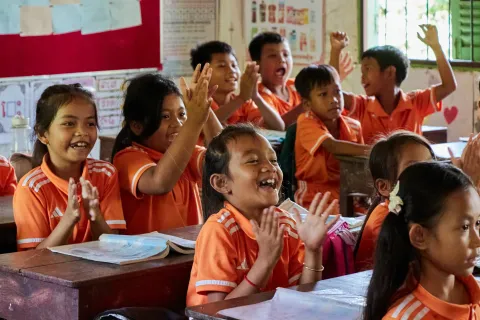
Peer support between students is just as important for the success of the programme. In local life skills classes, students learn individual responsibility and how to work together towards a common goal. In the process of learning about themselves, students become more confident and engaged with classmates, teachers, family, and the greater community.

“The biggest progress is students valuing themselves. Positive behavior starts with themselves and extends to others. They communicate among teams, show respect, and are polite. When they have questions or need help, they will ask.” said Vun Voeung, School Director of Prey Chrouk Lower Secondary School. Other school directors reflected the same thing saying that students can now bravely advocate for themselves.
Students from Aranhraingsei gladly shared that they were more confident through learning soft skills. “When I don’t understand something, I ask a teacher or friend.” said Koy Lisa, a Grade 9 student. “Before, I didn’t want to share my opinion. Now, I speak up and communicate nicely to my friends even when I’m not happy.” continued Non Sreynuch, a Grade 6 student. “I talk to people I don’t know and I always greet guests or relatives. I can also manage my anger very well.” said Sin Sony from Grade 8.

Mon, the mother of two students from Aranhraingsei school, described the difference she’s seen in her children since they began the Local Life Skills programme, especially in the context of COVID-driven school closures: “I have observed that my girls are more polite and do housework without being asked. They manage their own schedules: learning, chores, and relaxing. Mesa is doing great at distance learning: When she doesn’t understand a lesson, she tries to learn on her own. If she still does not understand, she will contact her teacher.”

Teacher Bunthang highlighted the change he’s seen in his students, “ After experiencing the different teaching style of Local Life Skills class, many students became more engaged in their studies and even in the community. For example, when we selected ‘trash’ as a topic to study, my students understood the impact and started to pick up trash. It became a new habit. Even on their way in today they picked up trash, without being asked.” Further “when students pick up new habits, family and neighbors begin to follow. They become role models. Then this problem decreases in the community.” said the school director of Prey Chrouk Lower Secondary School.

Students also said that Local Life Skills classes gradually made them more aware of others, and awakened an interest in helping in their communities. “Before, I was selfish and did not want to contribute. Now, I have this mindset that the school also belongs to me, not just my teachers, so I volunteer at school and in my community, like repairing damaged roads or bridges.”
Although Sreynou, Peth, Mesa and other students have been able to leverage their soft skills training to keep up with their studies during school closures, online learning can be a struggle for students and teachers alike. Both schools cited around a maximum of 50 percent of students having access to smart phones for online support, with even less having consistent and reliable internet. Teachers at Aranhraingsei offer mixed online and offline support for Local Life Skills and other classes. Teachers offer Zoom classes, answer questions via Telegram messages, and encourage students to send video presentations of their research. They also provide printed interview guides to practice communication and collect information by interviewing relatives on the current Local Life Skills subject. All students and teachers expressed an eagerness to return to in-person learning as soon as it’s safe to do so, saying that it’s easier to learn in person.
The Inquiry-Based Learning approach that young Cambodians are learning through Local Life Skills courses can grow students into self-starters who confidently communicate, collaborate with others, and who can learn well wherever they go. This kind of independent learning style is now more important than ever, with self-guided, distance learning becoming the new norm worldwide.
But beyond learning independently, the Life Skills Programme has changed the way teachers engage with students and it is creating empathetic Cambodian citizens who bravely ask for what they need, care for others, and take initiative for the greater good of their communities.
When we support each other, everyone wins. In a time when the future is uncertain globally, we need to be stronger than ever, together.
UNICEF together with MoEYS will continue working with provinces, districts and schools to strengthen and expand the local life skills education, through school-to-school and province-to-province partnerships. UNICEF Cambodia would like to thank SIDA, SDC and the Australian Government through the Australian NGO Cooperation Program (ANCP) for their generous support for this programme.