How MUAC tape changed how one mother sees her child’s health
A simple colour-coded tape helps a mother understand her child’s nutrition. Through UNICEF-supported outreach, families are learning to detect malnutrition and act before children fall ill.

- English
- Khmer
23 November 2025, Preah Vihear – Two-year-old Pheng Hong Ann stretched out his arm without knowing why.
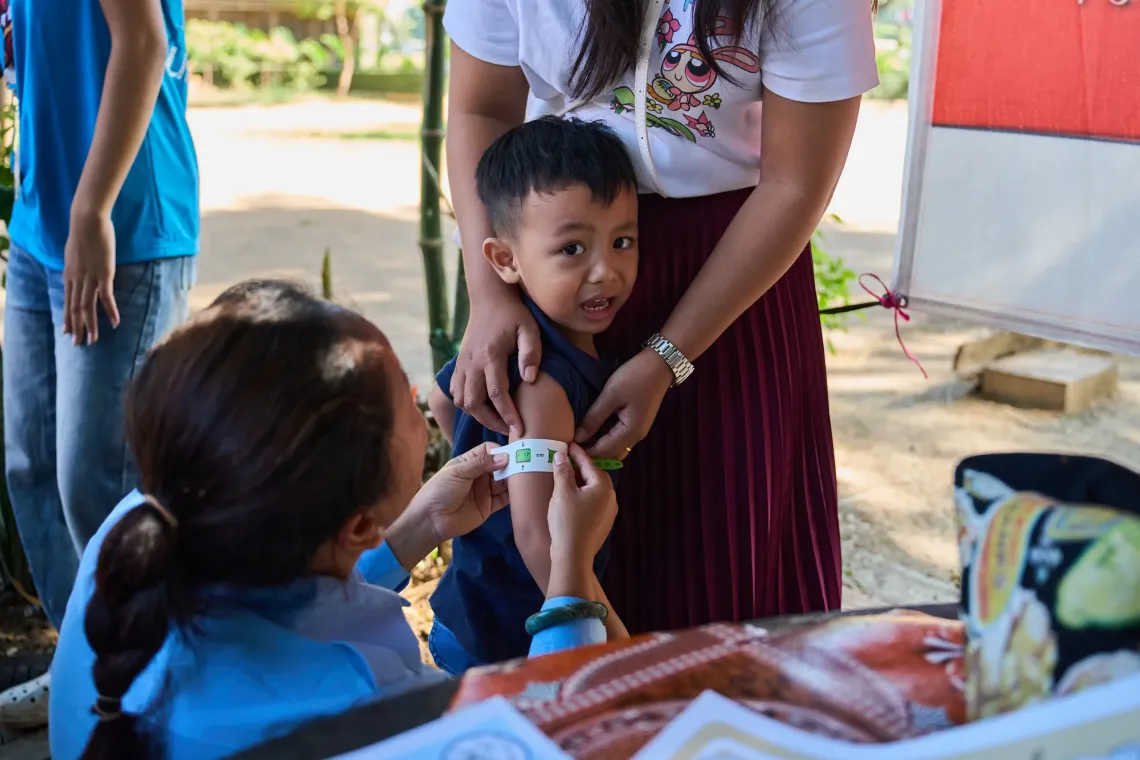
A health worker wrapped a thin plastic tape around it, paused, and smiled.
Green.
His mother, Som Sopheak, watched closely. In that moment, three small colours told her something she had never been able to see clearly before: her child’s nutrition status.
“I always looked at weight,” she said. “If he gained weight, I thought he was healthy. If he lost weight, I worried. This is different.”
She had come to the community health event expecting routine services. She did not expect a simple tape to change how she understands her child’s nutrition.
Seeing what was once invisible
The tape is called Mid-Upper Arm Circumference, or MUAC. It is a simple tool used to detect malnutrition— severe acute or moderate acute malnutrition— in young children. Green means a child is growing well, with no indication of wasting. Yellow signals a moderate case of wasting. Red indicates severe wasting and requires urgent care.
For Sopheak, MUAC was new.
“No one ever explained this to me before,” said the 30-year-old mother. “Now I can see risk early, not when it is already serious.”
In Preah Vihear, early detection matters. About one in four children under five is stunted, and child mortality remains among the highest in the country1.
Like many parents in the province, Sopheak works full time. A visit to the health centre often means lost wages and long queues. Growth monitoring does not always happen regularly.
“When services come closer to us, it makes a big difference,” she said.
Health services, brought closer
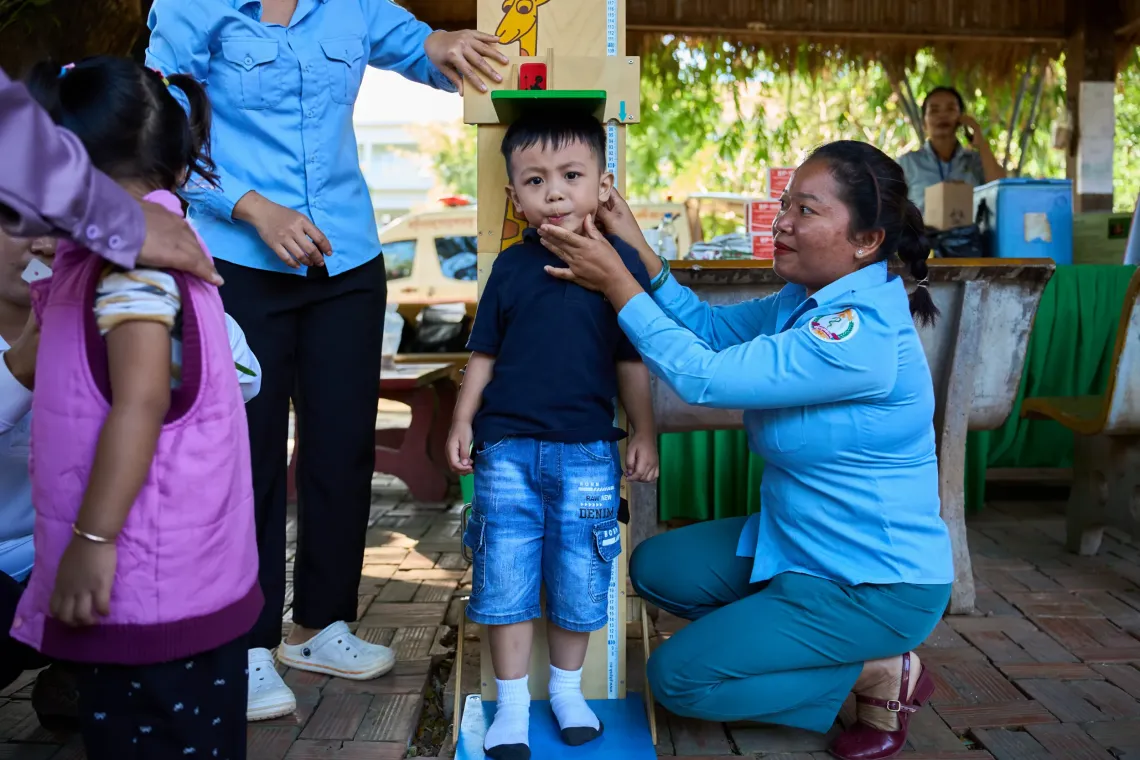
With engagement from Preah Vihear’s Provincial Health Department, Village Health Support Groups (VHSGs), and a health centre, the mobile health bus that day was part of a broader effort to bring essential services directly to families during UNICEF’s celebration of World Children’s Day. Children received growth monitoring, nutrition sensitization, vitamin A, deworming, and routine immunization checks.
Ann’s vaccination card was already complete. He ran between booths, drawn to books and games, stopping only when he saw the reading bus.
“He is scared of needles,” Sopheak said, smiling. “But he loves books.”
What stayed with her most was MUAC.
“The video showed how to use it. The posters were clear. The colours make it easy for any mother to understand,” she said.
Through national nutrition investments funded by the United Kingdom Children’s Investment Fund Foundation (CIFF) and the China International Development Cooperation Agency (CIDCA) and implemented with UNICEF support, the Family MUAC initiative has expanded to several provinces, including Kampong Thom, Siem Reap, Kampong Chhnang, Ratanakiri and Pursat. In 2025, 71,530 children were screened across 1,106 villages.
Knowledge that stays in the home
For Village Health Support Group volunteer Choup Sovandy, the day marked a shift.
“I had only seen MUAC used at health centres,” she said. “Today, mothers could touch it, learn it, and take that knowledge home.”
She helped weigh children and mobilise families to receive health and nutrition services. She knows the challenges well.
“Many children stay with grandparents while their parents migrate to work,” she said. “Growth monitoring doesn’t always happen. Tools don’t always stay in the home.”
Teaching caregivers to use MUAC themselves can change that.
“Health is everything,” Sovandy said. “If a child is not healthy, the whole family suffers.”
Why early detection saves lives
Dr. Vanh Noeum, from Preah Vihear’s PHD, sees the link clearly.
“Children need full support in one place—vaccination, nutrition, and growth monitoring,” he said. “Especially in the first 1,000 days of life.”
When undernutrition is not detected early, children are often lost to follow-up. Families may not recognise the signs until the condition becomes severe.
“Knowledge about nutrition and stunting is still limited,” Dr. Vanh Noeun said. “MUAC puts that knowledge directly in the hands of families.”
Early detection not only protects physical growth, but also cognitive development, household income, and long-term health.
As the afternoon ended, the World Children’s Day booths began to close. Ann clutched his small reward and waved goodbye to the reading bus.
Sopheak gathered her things and prepared to head home.
She had one message for other mothers.
“We are all tired,” she said. “But we all want our children to be healthy. Even if you are busy, make time to play with your child, give good food, and follow health advice.”
Then she paused.
“And MUAC,” she added. “This surprised me the most. Every mother should know where to get it.”
For Sopheak, three simple colours replaced months of uncertainty.
“For the first time,” she said, “I feel confident reading my child’s health with my own eyes.”