For every child, a chance to learn
In Cambodia, children with disabilities are three times less likely to attend school than their peers. Specialised training is equipping teachers to bring inclusive education to life for every child.
- English
- Khmer
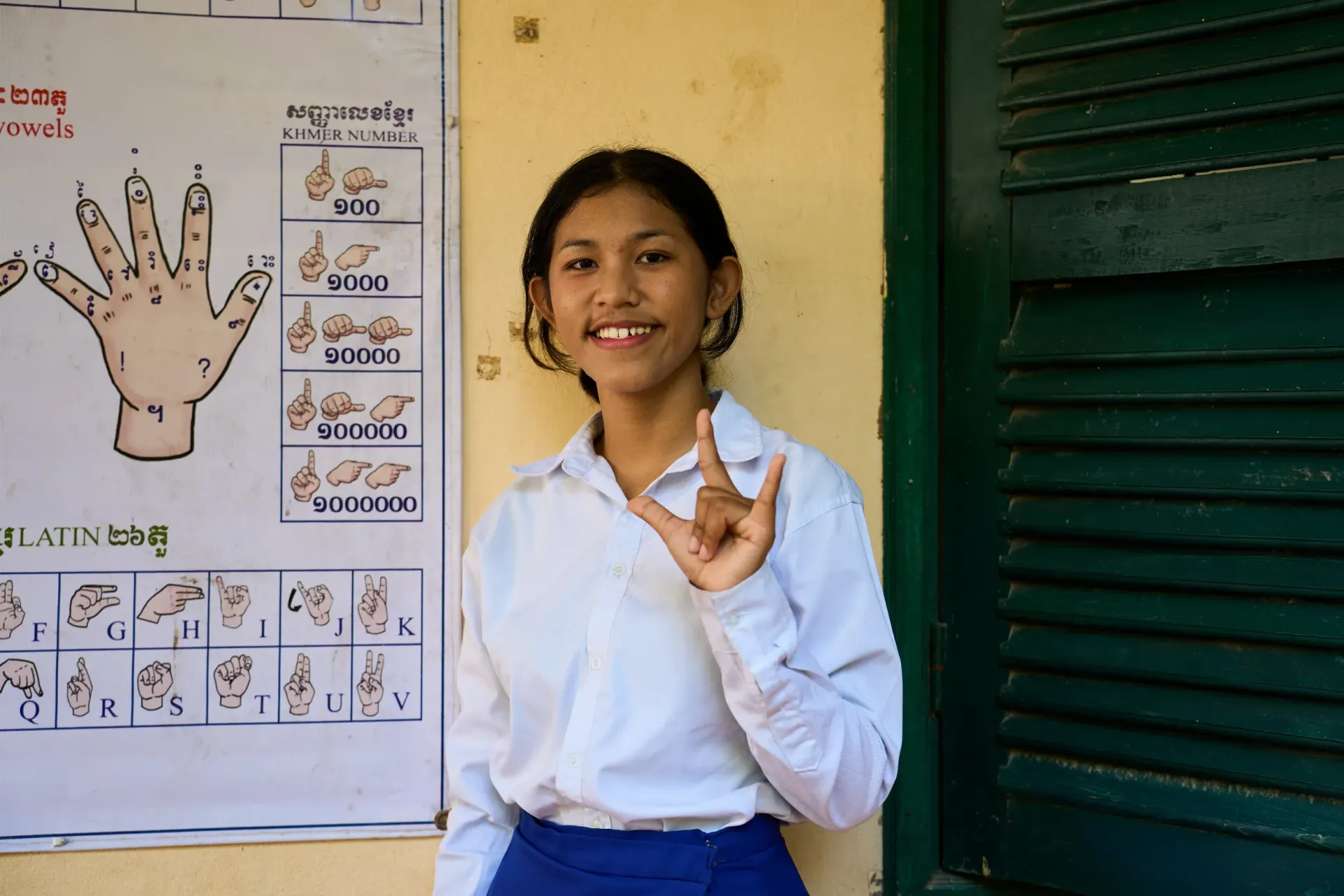
11 March 2026, Battambang – At Battambang’s Special Education High School, each lesson is shaped around how children see, hear, and understand the world. In some classrooms, children explore and learn through braille and sign language. In others, children with intellectual disabilities learn through pictures, repetition, and tailored support.
“I like English,” signs 18-year-old Neath to her English teacher, Chea Sreymao, with a signature grin that stays on her face for most of the class. “The words are difficult, but I try.”
Today, Neath and her classmate are having fun acting out the signs for different types of natural disasters. Sreymao, who specialises in teaching children with hearing impairments, teaches and signs with ease and confidence, despite only starting to learn sign language a couple of years ago.
“I’m confident because the students make me confident,” she says. “I stand with them, and they smile.”
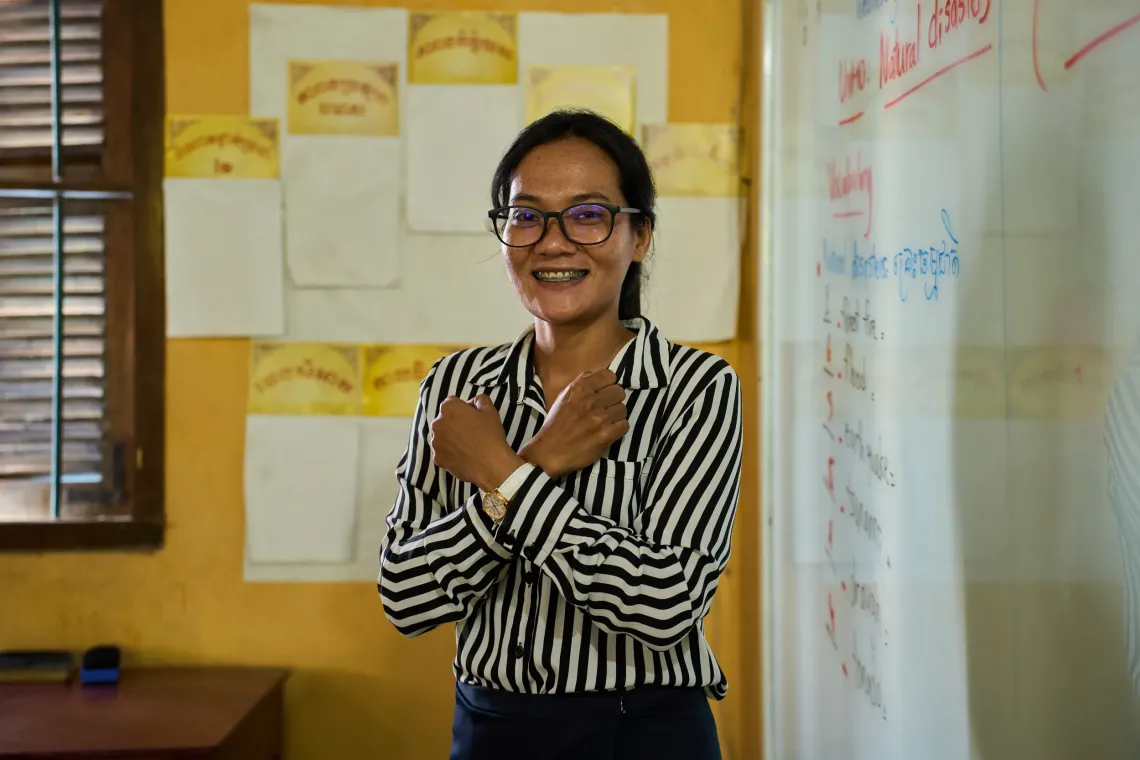
Sreymao’s start at the school followed a year-long diploma course with the Ministry of Education, Youth and Sport’s (MoEYS) National Institute of Special Education (NISE). With support from UNICEF through the Capacity Development Partnership Fund (CDPF), the course provides educators with the foundation for teaching children with disabilities, with options to specialise in students with hearing impairments, visual impairments, and intellectual disabilities and autism.
“If I didn’t attend that 10-month course, I would know nothing,” she says. She’d been teaching in the bordering province of Pursat for several years before making the transition to working with children with disabilities, which she knew would require a whole new set of skills. The decision felt natural, however, and a challenge that not many other teachers were willing to take on.
“Nobody volunteered or wanted to help much,” she says. “If we don’t, how can the children help themselves? How can they support themselves? When I took the diploma for teaching special education, I felt that this is the right thing for me.”
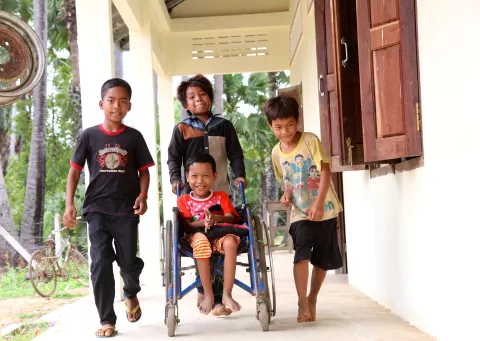
In Cambodia, children with disabilities face immense challenges in obtaining an education and fully participating in society. Children with disabilities are three times less likely to attend school than their peers, and globally, Cambodia has one of the largest gaps in school attendance and completion between children with and without disabilities. Many children continue to be held back by stigma, discrimination, and harmful norms—caregivers may not see the value in sending their children to school or may not know that education is available, while mainstream schools are not well equipped with inclusive facilities, students do not have access to appropriate adaptive learning materials, and teachers are not trained to support children with various types of functional difficulties.
UNICEF’s support to the National Institute for Special Education is part of comprehensive efforts to strengthen inclusive education in Cambodia, including by improving quality of teaching and increasing access to learning for children with disabilities.
With CDPF support, 146 teachers have graduated from the special education diploma course across three specialisations, which means they are qualified and deployed to the six schools that offer a curriculum for children with disabilities. Since 2018, another 5,000 teachers have received training in inclusive education, equipping them with skills to teach in mainstream schools where children with disabilities learn alongside their peers. UNICEF is stepping up its support to inclusive education, with one thousand teachers trained since 2024.
Sreychea says that sign language was the most practical and useful knowledge she picked up during her time studying, but even this by itself was not enough. She also learned that students may have intellectual disabilities as well as hearing impairments, so she needs to adjust her lessons for different abilities and provide tailored support to ensure no one falls behind.
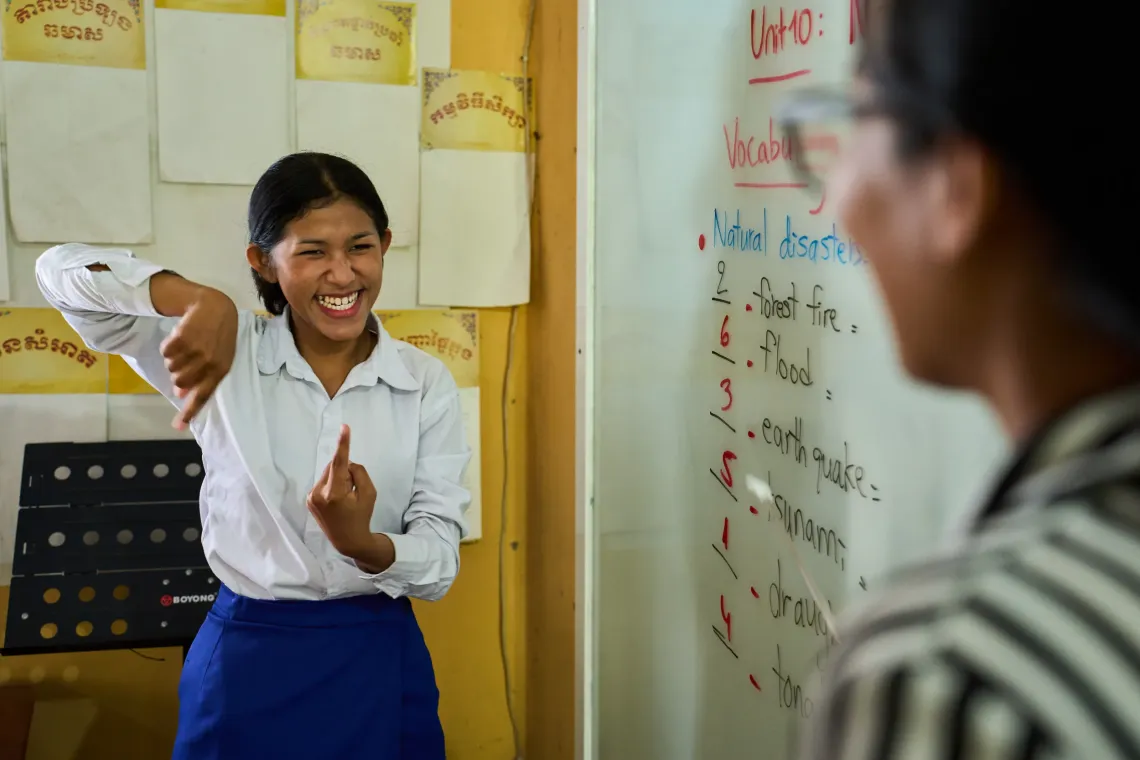
“We have to be flexible. If I only know sign language, I just teach sign language,” she says. “But I wouldn’t know that other students have difficulty writing, in movement. Or that they cannot memorise what I teach—just one or two words, just remember the sign, the picture, but later on, forget it. I’d feel very, very sad. But I learned everything that I know in advance so I can [support] them more.”
Battambang Special Education High School offers a curriculum from pre-school to Grade 12, with food and accommodation provided to students coming from neighbouring provinces.
“To come here and teach children with disabilities, a teacher must be hardworking and dedicated to preparing materials and lessons,” says Thlang Raky, the school’s deputy director. “They must be committed.”
Commitment means continuous learning, she says.
“There is no limit to knowledge,” says Raky.
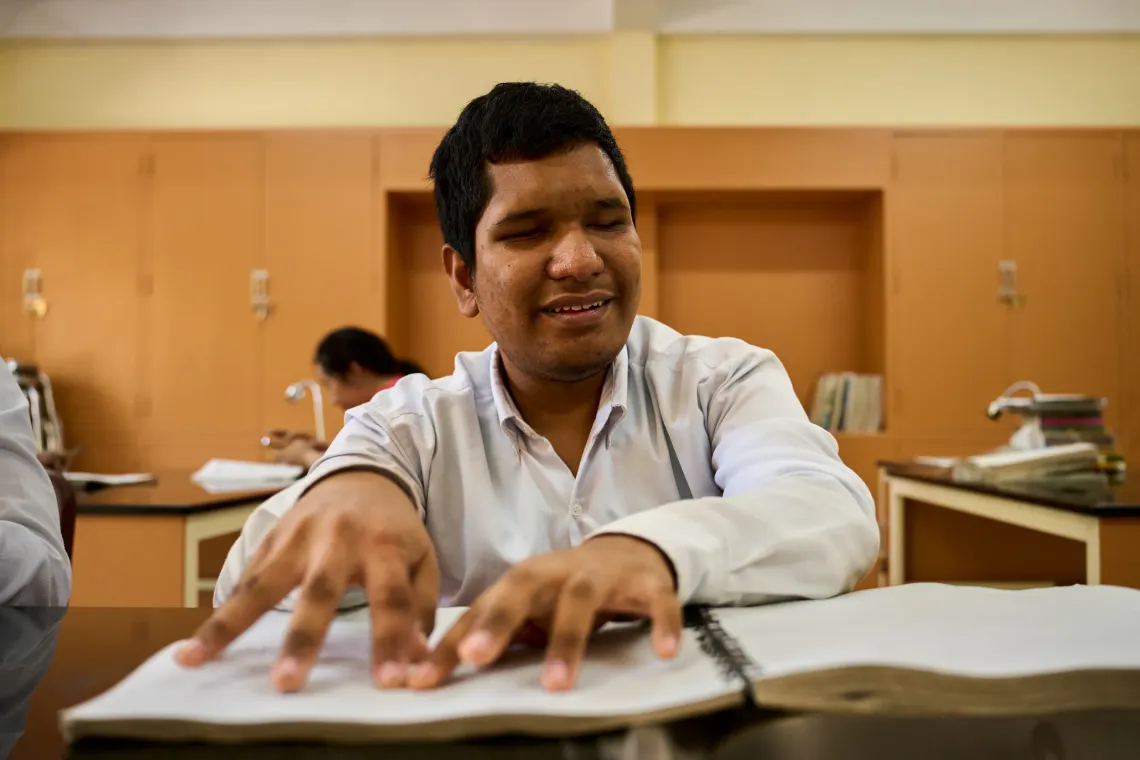
Sreymao says her job does not finish when class ends. Absenteeism is still a challenge, and she’s often had to call parents to remind them to send their children to school. Yet Raky says that mindsets are slowly changing, and that more parents are understanding that a disability does not have to be a barrier to prevent children from reaching their full potential.
“Most of them are very satisfied,” says Raky. “When children go home, their parents praise the school, saying they see a real difference and that the children know much more than before.”
Despite the challenges, this is what drives teachers like Sreymao.
“This is the reason that I can do this up until now,” she says. “It’s stressful sometimes, but this keeps me working here.”
Back in class, Neath continues practising new words, one sign at a time.
“She said that she likes my class because I make it short and simple,” she says. “It’s easy for her to learn.”
“I’m lazy,” Neath signs back with her cheeky smile. “I know I need to work hard.”
The CDPF is a longstanding partnership between Cambodia’s MoEYS and partners including the European Union (EU), the Global Partnership for Education (GPE), and UNICEF.