During crisis, a new beginning for Nuon Yat
With support from UNICEF, disability identification ensures that persons with disabilities can access essential social protection despite displacement.

- English
- Khmer
5 March 2026, Banteay Meanchey – At Wat Chansi displacement site in Banteay Meanchey province, 24-year-old Nuon Yat sits quietly next to a blue tent, her schoolbag tucked neatly behind her. Now studying in Grade 2, she lights up the moment she talks about school.
“I’m ranked first in my class,” she says, with a shy but proud smile. What she enjoys most, she adds, are “the many stories the teachers read from the books at school.”
Yat has lived with an intellectual disability and physical challenges since birth. Born with an extremely fragile bone structure and fluid in her brain, for years she struggled to walk, hold objects, or even comb her own hair. It was only after she turned 11 that her mobility and strength slowly began to improve.
Her early childhood was marked by instability. Her biological father—who was violent and battled alcohol and drug abuse—left when she was very young. She saw him only once afterward during a family funeral, where he handed her 5,000 riels (US$1.25), before vanishing again. For many years, she was raised by her grandparents in Siem Reap, whom she adored deeply. Their deaths, both within a span of just a few years, left her with a profound sense of loss. “I was with my grandfather in the hospital when he died,” she recalls quietly. “I remember everything.”
After her grandparents passed away, her mother brought her back into the household. Gradually, life regained a sense of structure. Her mother remarried, and although her stepfather works in Thailand, he embraced Yat as his own child. When work is stable, he sends home 300,000 riels (US$75) each month. Yat speaks warmly of him: “He plays traditional music and knows how to take pictures. He is very hardworking.” She has also built strong relationships with her stepsiblings.
When fighting along the Cambodia–Thailand border forced the family to flee, they left their home behind and sought safety at the Wat Chansi site. In the early days of displacement, the unfamiliar surroundings overwhelmed Yat. She struggled with orientation, so to prevent her from getting lost her mother would write her phone number on her hand. But she soon adapted. She made friends easily, settled into the rhythms of life at the site, and like many young people, enjoyed the small joys that came with receiving donated items.
“I like it here,” she admits. “People give things.”
Her mother, however, has noticed that donations have begun to decline. With no income this month and no remittances from Thailand due to the recent economic slowdown, the family’s situation has become increasingly precarious. It is only through accessing social protection that the family has seen a glimpse of hope. has offered a glimpse of hope. This month, the household received 240,000 riels (US$60) through the Government’s newly launched cash transfer to support the livelihood of displaced people who cannot return home.
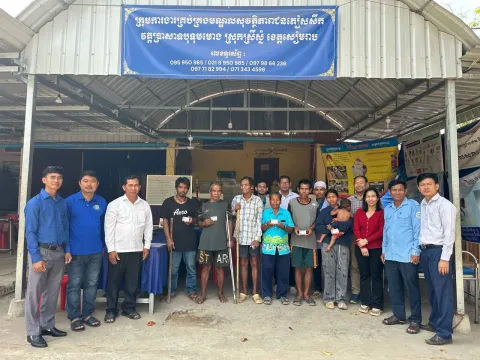
The family is also completing registration for Yat’s Disability Identification Card, following a visit from officials of the Ministry of Social Affairs, Veterans and Youth Rehabilitation (MoSVY) to the site. The family is in the process of renewing their IDPoor Card so they can continue to receive benefits through the National Social Assistance Family Package Programme. Supported by UNICEF, the Family Package provides cash assistance to vulnerable households, including pregnant women, children, elderly people, persons living with HIV/ADIS, and persons with disabilities.
Once ready, the family will receive 102,000 riels (US$25.50), of which 28,000 riels (US$7) per month comes from Yat’s disability specific benefits, and 20,000 riels (US$5) comes from her primary school student benefits.
With support from UNICEF and funding from the Australian Government through the ACCESS 2 project1, the disability identification process ensures that persons with disabilities, who often face the highest barriers during crises, can access Cambodia’s social protection system, including the Family Package. Nationwide, more than 360,000 persons with disabilities have been identified through this process.
During the crisis, Cambodia’s social protection programmes—including the Family Package and the national Disability Identification Programme—were rapidly adapted to ensure that displaced households could continue receiving essential support.
For Yat and her mother, this support could not have come at a more critical moment. “We will use the money mostly for food,” her mother explains. “Vegetables, eggs, pork, fish… after cashing out this month, I will cook her favourite dish—glazed pork, Chinese style. One good family good meal.” With no remittances arriving this month, the cash transfer will help sustain them for at least ten days, bridging a particularly difficult period of uncertainty.
Despite everything she has experienced—abandonment, loss, and displacement—Yat carries a deep sense of hope. She looks forward to moving into her new temporary home, which has been provided by the Government and will be ready soon. She dreams of becoming a medical professional—“the person who knows how to do the needle,” she explains—so she can help people the way hospital staff once helped her grandfather.