Disability identification brings hope to displaced families
Sannchhay has lived for years with a permanent physical impairment. Now caught by crisis, national social protection ensures the most vulnerable can access essential services and support.

- English
- Khmer

26 February 2026, Siem Reap – When renewed fighting along the Cambodia–Thailand border forced more than 640,000 people to flee their homes in late 2025, thousands of families arrived in displacement sites with little more than what they could carry. For many, including persons with disabilities, the sudden upheaval meant losing not only their homes but also access to the services they relied on.
In this emergency setting, Cambodia’s social protection programmes—including the Family Package and the national Disability Identification Programme—were rapidly adapted to ensure that displaced households could continue receiving essential support.
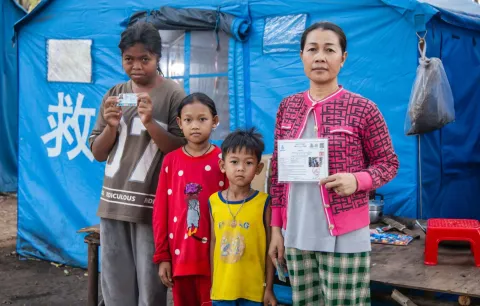
At the Srey Snom displacement site in Siem Reap, families gathered beneath makeshift tents as officials from the Ministry of Social Affairs, Veterans and Youth Rehabilitation (MoSVY) carried out disability identification and IDPoor verification. With support from UNICEF and funding from the Australian Government through the ACCESS 2 project1, the disability identification process ensures that persons with disabilities, who often face the highest barriers during crises, can access Cambodia’s social protection system, including benefits from the National Social Assistance Family Package Programme. The Family Package provides cash assistance to vulnerable households nationwide, including pregnant women, children, elderly people, and persons with disabilities.
Among those waiting patiently for disability screening was 23‑year‑old Sun Sannchhay, carrying her 10-month-old son, Samrith. Sannchhay had fled the border area in December and temporarily moved back to her mother’s home in Srey Snom. Born and raised in a rural village, she developed a severe weakness on the left side of her body following a serious childhood illness.
“I have lived like this since I was nine,” she says quietly. “My left hand and leg are weak. I can carry my baby, but I cannot lift anything heavy.”
But the hidden toll started long before displacement. As a child, she struggled with exclusion from her peers. Later, after marriage, stigma followed her into her husband’s family. The combination of disability and social isolation made it difficult for her to seek help, and even more difficult to know what support she was entitled to.
When fighting intensified near her village, her husband, who was stationed near the frontline, urged her to flee immediately. She gathered her baby, a few clothes, and her documents before escaping to Srey Snom. Once they arrived, uncertainty quickly set in. Their IDPoor card had already expired, and although Sannchhay had lived for years with a permanent functional limitation, she had never been registered for a Disability Identification Card.
“I didn’t know how to apply,” she explains. “My mother didn’t know either. We never heard that people like me could get support.”
With her husband at the frontline and no stable income, the family depended entirely on her mother’s occasional daily‑wage construction work. On many days, they struggled to afford food and basic necessities for the baby.
It was her grandmother who encouraged her to come for screening after hearing from neighbours that MoSVY officials would be conducting disability registration at the site. Sannchhay did not hesitate.
“My grandmother told me this is my chance that maybe life can get better,” she said.
Through the Disability Identification Programme, persons with disabilities are registered in the national Disability Identification Database, which enables them to access essential services and support.
In Siem Reap alone, as of January 2026, nearly 20,000 persons with disabilities have been identified, with the majority of cases validated, approved, and issued cards. More than 360,000 persons with disability have been identified nationwide. Receiving a Disability Identification Card is an entry point to essential government services, which is especially critical during crisis, ensuring individuals that their vulnerability is formally recognized and strengthening their access to health care, assistive devices, and Family Package benefits.
Once her IDPoor status is renewed, Sannchhay will become eligible for monthly Family Package benefits. For families like hers, this includes a base transfer of 34,000 riels (US$8.50) per month, along with additional support during pregnancy and after childbirth—for example, 80,000 riels (US$20) for each antenatal and postnatal visit, and a one‑time 400,000‑riel (US$100) delivery benefit. These payments provide vital stability, helping families buy food, transport to health facilities, and essential supplies for young children.
“I want to try therapy for my hand if possible,” says Sannchhay, her baby resting against her shoulder. “If I can get the disability card, maybe I can get help that I never knew existed.”
Despite the uncertainty of displacement, Sannchhay remains hopeful. Sitting among other families waiting their turn, she offers a small, shy smile.
“Today, I feel seen,” she says. “If this card helps me care for my child and stand a little stronger, that’s enough for me.”