Early grade learners succeed in and beyond the classroom
Through structured lessons, colourful materials, and teacher training, a UNICEF-supported initiative is helping instill a love of learning in Cambodia’s youngest students

- English
- Khmer
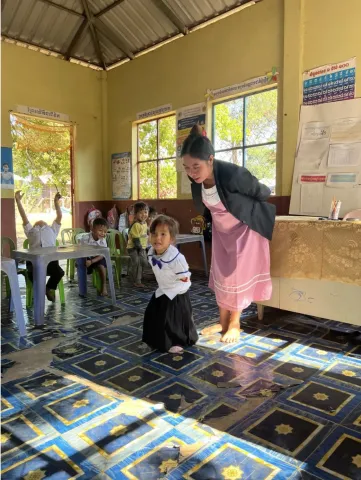
4 June 2025, Takeo – At a primary school in Takeo province’s Tram Kok District, Grade 1 students read aloud from their storybooks, mimicking the movements of animals in the story. With arms stretched wide like wings, they flap with excitement, their faces lit up with joy as they bring each sentence to life.
“I liked being able to say the sentences I made in front of my friends. Everyone clapped for me,” says five-year-old Phatreaksa, who started Grade 1 earlier than most children her age.
Although she’s only been in school for several months, she already creates her own words and confidently shares them with her classmates.
This colourful scene is possible thanks to an Early Grade Learning (EGL) initiative introduced by the Ministry of Education, Youth and Sport (MoEYS), with support from UNICEF, to tackle persistent learning challenges among early grade learners of primary education. In Cambodia, despite significant progress in education, most students fail to meet the minimum proficiency levels in essential skills like reading and mathematics. National learning assessments for Grade 6 in 2021 revealed 45 per cent of students were below basic proficiency in Khmer and 75 per cent were below basic proficiency in mathematics.1
Through improving the quality of teaching and learning at the beginning of primary education, the programme aims to establish strong foundational literacy and numeracy skills for students in Grades 1 to 3, which can then benefit them for their entire educational journey.
With funding support from COOP Sapporo through the Japan Committee for UNICEF (JCU), the programme, with a particular focus on Early Grade Reading (EGR), has been expanded to 65 primary schools in Tram Kok District, Takeo province, reaching 115 Grade 1 teachers and approximately 4,800 students. Nationally, 365,000 Grade 1 students are benefiting from the EGR programme and 155,000 from the EGM programme, with support from UNICEF and partners including the European Union (EU), Swedish International Development Cooperation Agency (SIDA), and the Global Partnership for Education (GPE).

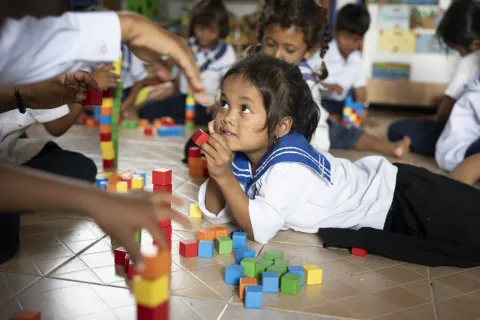
Now, instead of relying solely on traditional textbooks and rote learning, teachers use structured and engaging learning tools that make learning both more fun and more effective. New student books, writing practice books, storybooks, flashcards, and colourful classroom visuals help students master Khmer letters and sounds in a step-by-step way.
Teachers use these materials in combination with the teacher’s guide to deliver more structured and effective reading lessons.
Nop Chankev, a Grade 1 teacher at the school, recalls that the old textbooks combined letters, sounds, and sentence structures in a way that “confused the children and made it difficult for me to manage the lessons.”
The mix of complex consonant systems made it challenging to teach students to understand how sounds and letters work clearly, she says.
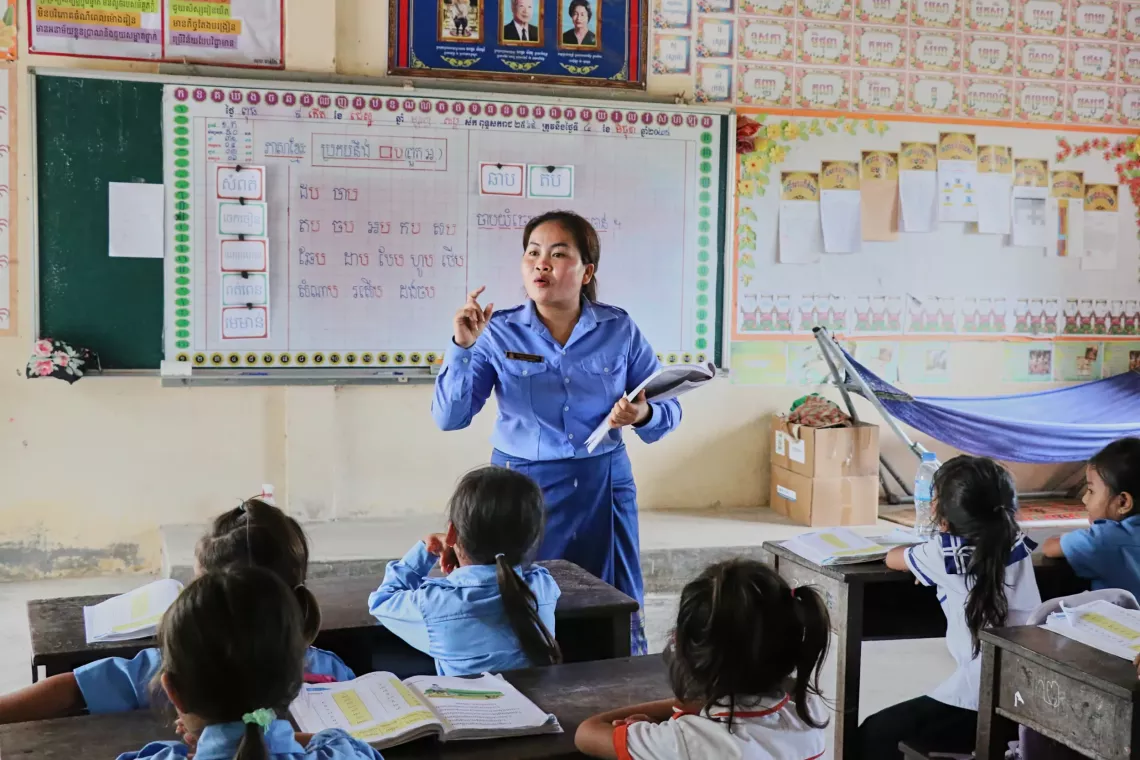
“In the past textbook, the phonics distinctions weren’t clear, so the students often got confused, and honestly, I was never sure which consonants or vowels to teach first,” she says. “But the new textbooks clearly separate phonemes into consonants and vowels, and they’re structured step-by-step, from simple sounds to more complex words, which makes everything more systematic. The lesson flow is much more natural now, and students actively participate in activities like using hand gestures to sound out and build words.”
Alongside the introduction of the new teaching materials, all Grade 1 teachers, primary school directors, and school mentors from Tram Kok District participated in training on EGR instruction methods, facilitation skills, classroom management, and gender-responsive pedagogy.
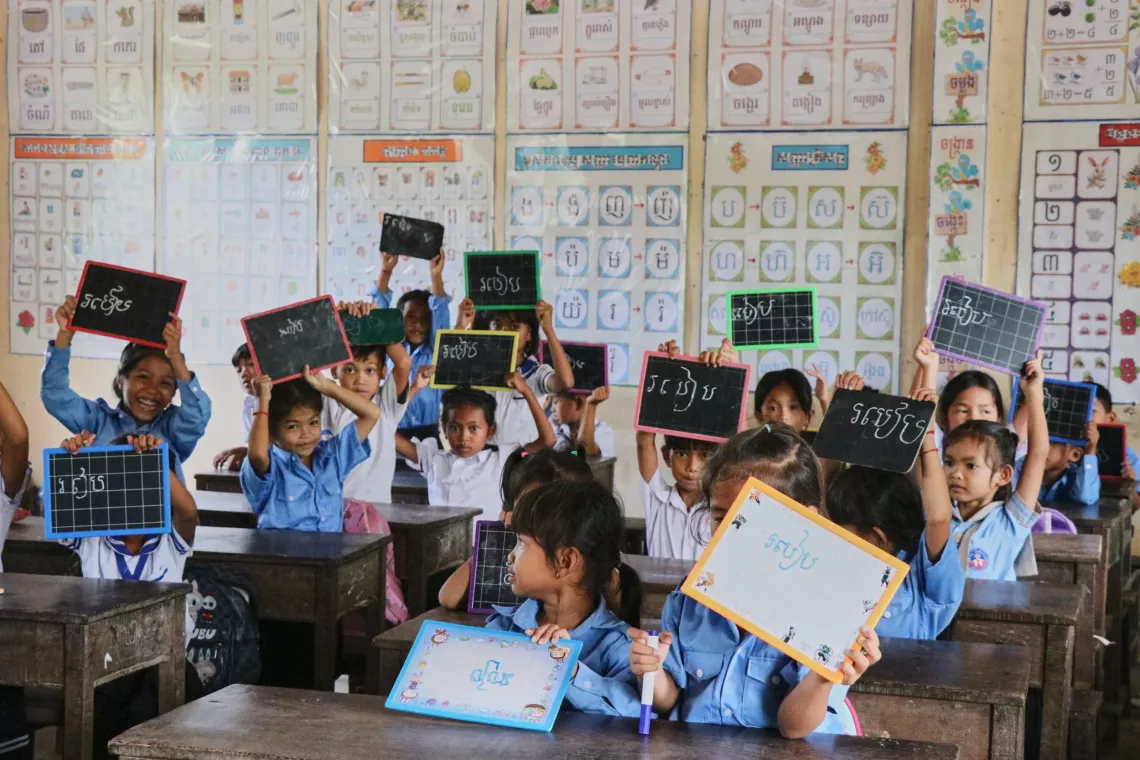
Teacher Nop Chankev shares that the EGR teaching training taught her how to engage students and structure the flow of her lessons, moving beyond simply delivering information and asking children to copy notes.
Now, through a variety of interactive activities, she’s noticed students participating much more actively, that they’ve begun to enjoy class more, and, above all, that their concentration has improved dramatically.
“There were times when I felt confused about what and how to teach, and I was never sure if my pronunciation or explanations were correct,” she says. “But now, with systematic lesson plans and well-designed materials, my lessons have a much clearer flow, and the students are able to follow along much more naturally. After completing the teacher training, I feel much more confident in both preparing and delivering my classes.”
This positive feedback from teachers reflects the results of an assessment of the EGR programme in 2024, which reveals encouraging improvements in the reading skills of students. After only one year, reading fluency has increased from 18.2 words per minute (wpm) to 38.7 wpm among Grade 2 students, and from 30.6 wpm to 50.3 wpm among Grade 3 students.
To ensure these changes are sustained, MoEYS has also established a comprehensive mentoring system to help teachers fully understand and effectively implement EGR in the classroom. This shift is transforming the overall atmosphere of schools.
Say Nak, a school director and master mentor overseeing several schools in Tram Kok District, sees these changes as a positive turning point.
“In the past, when external support ended, the programmes often stopped as well,” he says. “But now, with ongoing training, mentoring, materials, and teaching methods in place, support continues at the school level.”
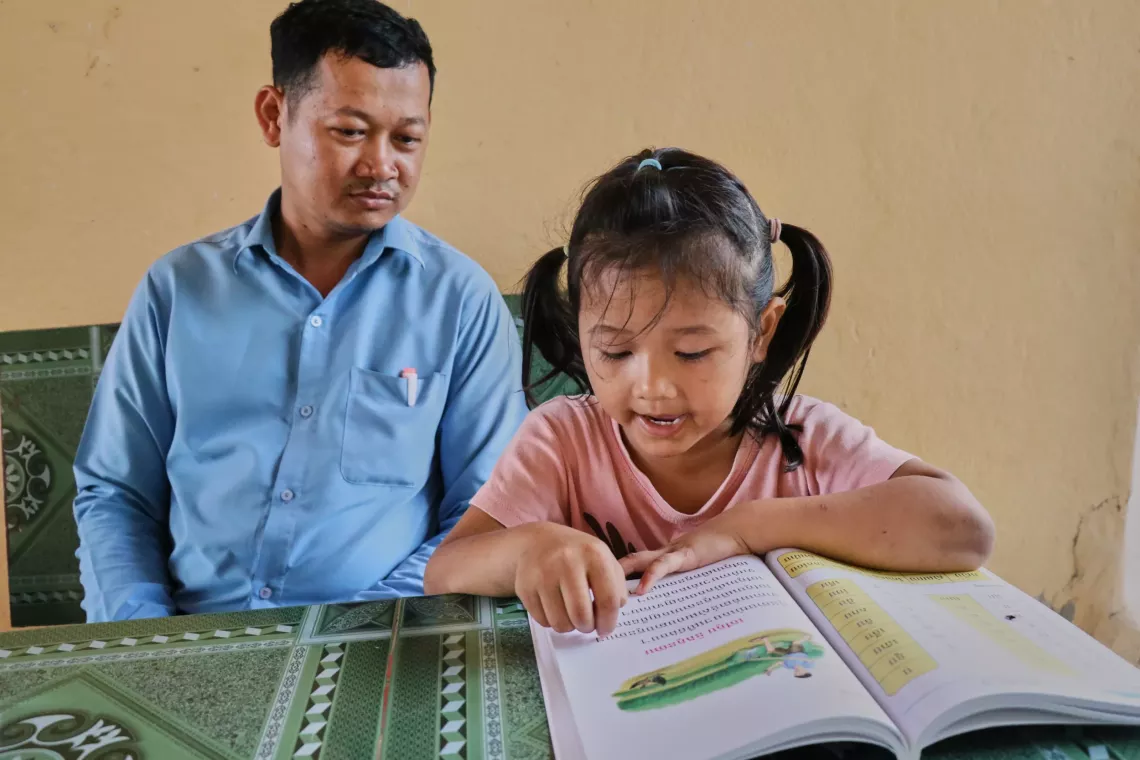
The new EGR approach has been well received by the parents of Grade 1 students as well. One such parent is Phau Sambath, whose daughter, Phatreaksa, started Grade 1 earlier than most students her age. Despite being only five years old, she quickly adapted to school life and is now one of the best students in her class. Sambath is deeply involved in her education and actively supports her learning at home to reinforce what she learns at school.
“She didn’t used to be interested in letters, but these days she opens a book on her own and reads aloud at home,” he says. “The old books had such small, cramped text that it was hard for children to read on their own. But now, books are easy to look at and fun. The lessons are clear, and she wants to try things by herself, which makes us happy, too.”