Digital Lifelines: How Technology Helps One Social Worker Reach Cambodia's Most Remote Children
In Cambodia's floating villages, social worker Pov Vanny uses digital tools to track vulnerable children across districts.
- English
- Khmer
29 May 2025, Ek Phnom, Battambang--- The fan overhead barely stirs the humid air in Pou Vanny's cramped office in Battambang province. The 47-year-old social worker's brown uniform looks freshly pressed, but his tired eyes tell a different story. He sits with his hands folded on his neat wooden desk, recalling a challenging week.
"Last week, I had to sleep three nights in a floating village just to check on one family," he says. "The boat people move constantly. By the time I arrive, sometimes they're already gone."
"I was once that hungry child," he reflects. "When I help others, I sleep better. In Buddhism, we call it earning good karma."
He didn't plan to become a social worker. He moved to the Ministry of Social Affairs, Veterans and Youth Rehabilitation in 2018.
Now, seven years in, some memories haunt him. Vanny's voice drops when he recalls two siblings in a floating village, their bodies swollen from malnutrition because their parents couldn't afford food to eat.
"They were dying from hunger," he says, pausing. "As a father myself, I couldn't just file a report and leave."
He reached out to a partner NGO. The rescue succeeded—the children who were once dying from hunger now have regular meals and attend the floating school while their father earns income as the village announcer, riding his motorbike to share news of weddings, government campaigns, and community announcements. Still, Vanny knows how close this family came to tragedy.
Vanny's experience reflects the enormous challenge facing Cambodia. In this country of 17.8 million people, children under 15 make up one-third of the population—about 6 million young lives.
Vanny is one of just over 200 para-social workers trying to protect children across Cambodia. He was trained and mentored by Toem Aun, the dedicated provincial social worker leading efforts to build a stronger child protection network.
The numbers are staggering. Cambodia has only 37 professional social workers to protect 6 million children. Para-social workers like Vanny help bridge this gap, but even with over 200 para-workers added in, that's still roughly 25,000 children for every worker.
Vanny's district includes 10 floating villages along the Tonle Sap River, where hundreds of families live on boats, following fish to survive. Children in these communities face many challenges: family violence, risk of injury by drowning,and limited access to schools and health services.
"The road ends at the water," Vanny explains. "To help these children, I need a boat. But there's no budget for boats."
Sexual abuse cases keep him awake at night, especially during the crucial 72 hours when police investigate, and children need safe shelter.
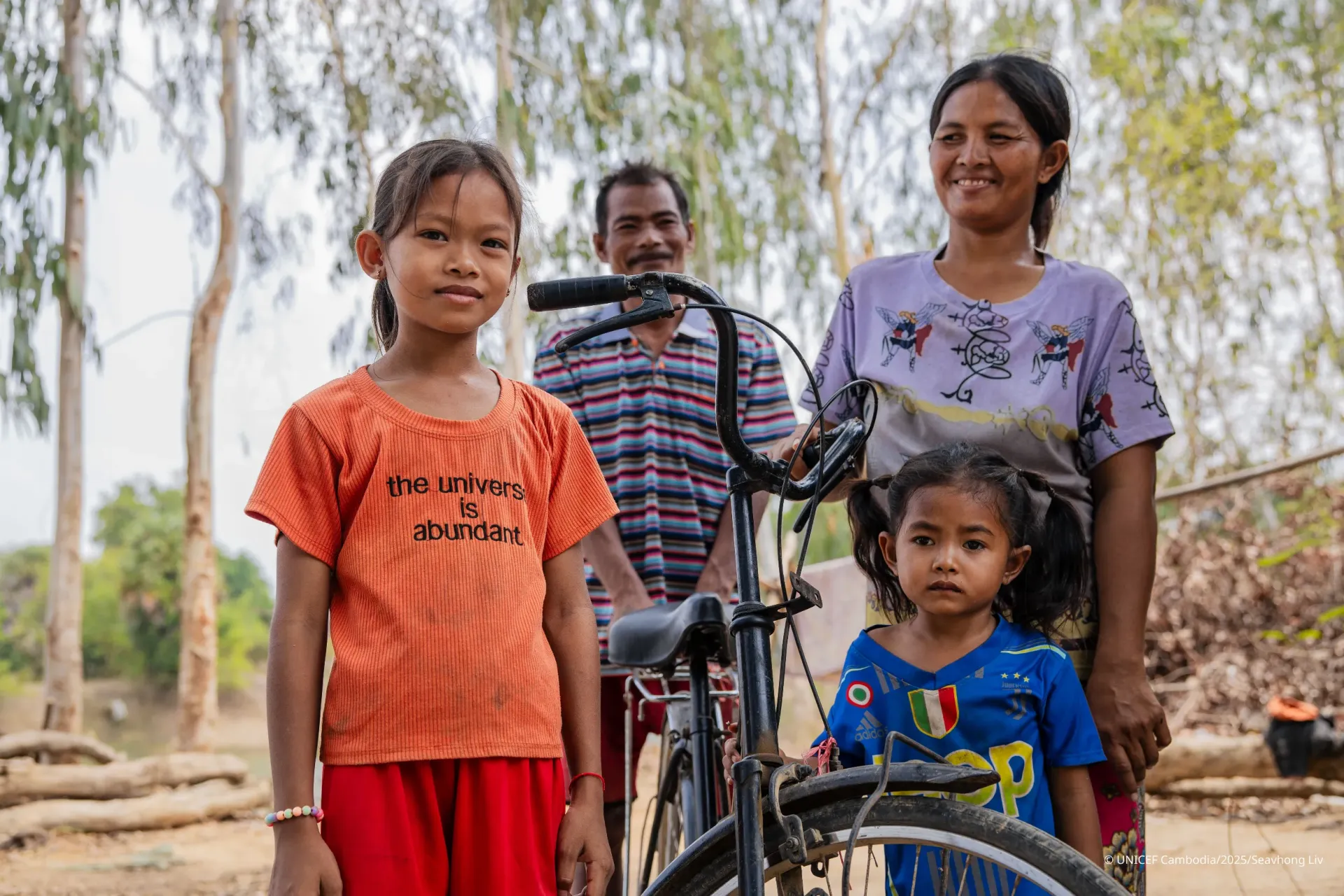
Vanny has learned to work around the gaps. On a scorching afternoon, he visits Oeub Poy's family. The 44-year-old construction worker has struggled with poverty and unemployment. His real challenge has been finding steady work to support his wife and two children, now 7 and 8.
"The hardest part was feeling helpless when I couldn't provide for them," Poy explains quietly.
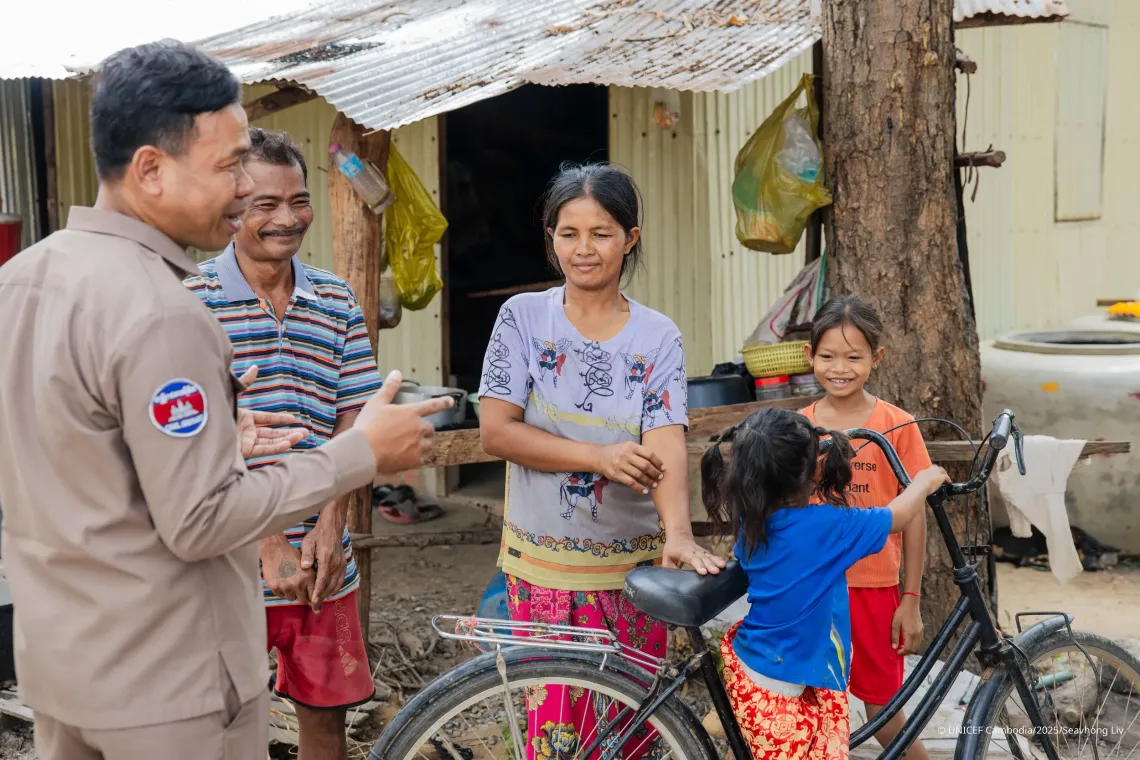
Vanny connected him with a CCI partner NGO for job training and financial support. Through the programme, Poy learned new skills and gained access to resources. Now he runs a small poultry farm at home instead of chasing uncertain construction jobs far away, providing steady income while staying close to his family.
The family is poor, so they receive government help called the "family package", a UNICEF supported financial assistance of $13.50 per month provided by the Government.
"The monthly support seems tiny," his wife says, feeding their ducks. "But it changed everything. Our kids can buy lunch at school."
Success stories like Poy's increasingly rely on new technology that's changing how social workers operate. In his sunlit office, Vanny opens an app called Primero—a digital system that UNICEF helped bring to Cambodia's social services. Before this, everything was on paper. Reports got lost. Cases fell through cracks. Children who moved between areas vanished from the system.
"This app saved job," Vanny admits with a rare smile. Several months ago, his supervisor pointed out issues with his handwritten reports: they were often incomplete and sometimes late. Vanny struggled with paperwork, spending hours trying to remember all the details from his visits. Now, Primero guides him through each case with automatic reminders. His supervisor recently noted that his reports have become much more thorough and timely. him for poor report writing. The system walks him through each case—from first assessment to final closure.
"I can track children even when families move between districts," he says. "It's like having eyes everywhere."
The changes are noticeable. Before Primero, Vanny managed several cases at a time—beyond that, he’d lose track of important details. Now he comfortably handles more cases because the system keeps everything organized. Writing reports used to take up most of his afternoon. With Primero, he completes reports in under an hour, since the system organizes all the information he’s already entered.
The app connects him instantly to other helpers, sends alerts when deadlines approach, and keeps private information secure. Most importantly, it coordinates between government workers like him and NGOs that provide specialized services.
The Primero app is part of broader reforms happening across Cambodia. In October 2024, the Ministry of Social Affairs, Veterans, and Youth Rehabilitation and the National Institute of Social Affairs launched the first comprehensive training curriculum for the social service workforce, developed with support from UNICEF, the United States Government, and UNICEF Australia. The curriculum offers competency-based training tailored to address Cambodia's child protection challenges and establishes formal standards for social workers within the nation's child protection system.
The workload remains overwhelming. With each social worker serving thousands of families, putting out fires' beats preventing them.
"People see us delivering rice and think that's our job," Vanny says. "They don't see us teaching parents how to discipline without violence or helping children testify safely in court."
But for workers like Vanny, each rescued child reminds him of dozens more out of reach. "Sometimes I dream about those floating villages," he admits. "All those children I can't get to because I don't have a boat."
His phone buzzes. Another case, another crisis. He opens Primero, reviews the basic information, and can see immediately what support this family has received before. The digital system helps him track families across districts and coordinate services more efficiently. In a country where 200 para-social workers serve 6 million children, every tool that helps them work smarter makes the impossible feel manageable. Vanny closes the app and prepares for tomorrow's visits, knowing that technology has given him something invaluable: the ability to make every intervention count.