UNICEF supports health and well-being education for adolescents and youth in Muyinga.
Supported by UNICEF and UNFPA with the Kingdom of the Netherlands’ funds, a project for health and well-being education for adolescents and youth (ESBEAJ) contributes to reducing cases of school-related pregnancies in five provinces of Burundi.

- English
- Français
No sooner had we arrived at a school on the hill of Kigoboye, in the commune and province of Muyinga, the telephone rang just as we got out of the vehicle. On the other end of the line, a man's voice ordered us to turn right: it was Moussa, the headmaster of the school, who guided us to his office where we met Léocadie, a teacher involved in coordinating the school's health club. ‘Welcome to Muyinga Islamic School’, he says as he ushers us into his office. After the introductions, the headmaster invited us to follow him into a classroom.
As we entered the classroom, more than forty pupils stood up at the same time and sang a song for at least four minutes. ‘It's an awareness-raising song that helps these children pass on messages to their peers. The lyrics are made up of advice and good practices for responsible teenage behaviour’, explains Léocadie.
Léocadie and Moussa are among the teachers and school principals in charge of health clubs who have received training in the use of the module « Le monde évolue avec moi ("The world evolves with me") as part of the Health and well-being education for adolescents and young people (ESBEAJ) project. This module provides important concepts relating to the sexual and reproductive health of adolescents and young people, and is used to reduce the number of cases of pregnancy among girls in primary and post-primary schools. As part of this project, school health clubs have been set up in all schools in the project area.
Under the facilitation of club supervisors, pupils meet twice a month to discuss the subjects covered in the module. During these sessions, club members meet to discuss the practical application of what they have learned. "Some of the subjects in the module were considered taboo in Burundi, but with the module and the discussion sessions developed by theme on a quarterly program, the children are very receptive ", a teacher found on site told us. With the help of the "Rwaruka twese tumenyeshe" and "Ihinduka ry'inyifato y'abantu rihera kuri jewe" booklets, the children are developing their knowledge of several themes and how to pass them on to those around them.


As well as the ECOFO Islamique, this school also hosts the Lycée Comibu. Both schools are beneficiaries of this project. The proximity of the schools means that awareness-raising goes much further.
Principals of the schools are very appreciative of this good initiative, which has transformed the children. ‘We produce our own drawings on sheets of paper and put them up in all the classrooms. That way, other children who are not in the club get the message,’ explains Najibu Tuyizere, a member of the Health Club at the ECOFO Islamique in Muyinga.
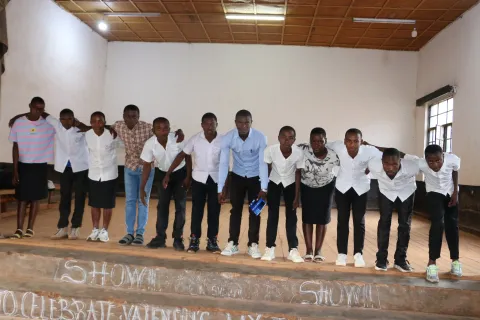
Thanks to the technical support of local NGOs IRIVUGA and Spring Communities, which are UNICEF implementing partners, awareness-raising is also taking place outside the classroom through games and sketches performed by members of the health clubs for their peers during break time.
On the second day, our journey took us to the Lycée communal of Muyinga. A group of young post-basic teenagers were performing a sketch for their peers at the school. Vincent, the headmaster of the school, was happy to see his pupils perform. ‘The project has helped to reduce the drop-out rate among girls. Pupils are less distracted, and the lessons and concepts they learn help them to succeed, because they give up other preoccupations that prevent them from studying. Last school year, 83 of the 84 candidates who took part in the grade 9 national certification and orientation exam passed,’ said the school headmaster.


Many results have been achieved through this project, and the statistics are clear to see: 3,400 teachers trained to supervise health clubs and the ‘Le monde évolue avec moi ’ module; 212 teachers trained in drama techniques; 67,417 pupils made aware of the fight against pregnancy in schools through sketches; 34,010 pupils made aware of the issue through educational games; 247 sports teachers trained in the fight against pregnancy in schools; 30 additional trainers trained in health education and the well-being of adolescents and young people; 36,000 copies of the module printed and distributed.
In light of the encouraging results, many school officials are advocating for the integration of the module " Le monde évolue avec moi " into the official curriculum. Such an approach would allow all children, beyond the project area, to access vital knowledge about reproductive health and well-being, and to become change makers in their community in turn.