UNICEF committed to supporting Burundi Government in mobilizing resources to finance health care
During a National Dialogue on Health Financing in Burundi, organized by the government, UNICEF drew attention to the importance of investing in children's health and nutrition, particularly in the first thousand days of life.

- English
- Français

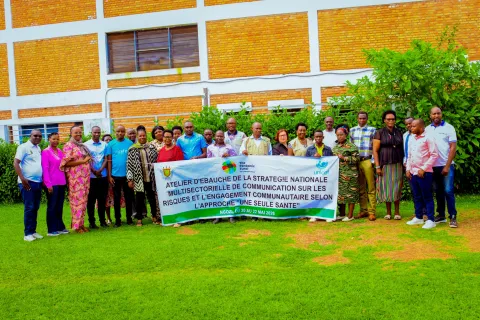
Mobilizing national and international stakeholders to evaluate and review Burundi's health financing strategies was the aim of the high-level national dialogue on health financing, which took place in Bujumbura from 12 to 14 February 2024.
Under the high patronage of the Vice-President of the Republic of Burundi, HE Prosper Bazombanza, this dialogue was organized by the Ministry of Public Health and the Fight against AIDS, in collaboration with the Ministries of Finance, National Solidarity, and East African Community Affairs. It provided an ideal forum for key stakeholders from the health sector, government, the private sector, development partners and civil society to discuss key issues, progress, challenges, and priority actions in mobilizing health financing resources to achieve universal health coverage by 2030.

At the opening of the dialogue, the Vice-President of the Republic, Prosper Bazombanza, pointed out that, despite the many efforts already made by the government to improve the health of the population, Burundi still faces many challenges in providing adequate healthcare for its people, and that it remains heavily dependent on donor support.
Among the main challenges that need to be tackled, the Vice-President of the Republic mentioned the importance of direct payments for healthcare by the population, the difficulties in absorbing external and internal budgets, geographical inequalities, and the low level of social protection coverage. ‘’ The key to overcoming these challenges (...) will be to expand the budgetary space for health by mobilizing more national resources; promoting and aligning public-private partnerships with the priorities of the Government of Burundi and development partners; and investing in preventive healthcare", he stressed. He therefore called on all the health stakeholders present to use this forum to discuss and identify the best ways of encouraging and increasing national health funding.
During a panel discussion that brought together development partners to discuss their experiences in mobilizing resources to finance health, UNICEF's representative in Burundi, France Bégin, emphasised the importance of investing in health, particularly in the first years of life, with a focus on vaccination and nutrition. ‘’ It is estimated that every dollar invested in immunization brings a return of 16 dollars in terms of healthcare savings and increased productivity (...) 10 dollars invested in nutrition per child worldwide saves 3.7 million lives, 65 million stunted children and 265 million women with anaemia", she explained.
She therefore reaffirmed UNICEF's commitment to working hand in hand with the Government of Burundi, development support partners, civil society and all stakeholders to mobilize the necessary resources and implement the proposed reforms. ‘’Together, we can overcome the challenges of health financing and make the vision of universal health coverage a reality for all Burundi's children," she declared.
At the end of the three-day discussions, the government of Burundi undertook to finalize and adopt the national health financing strategy, incorporating the recommendations made during the dialogue.
The government's other commitments include enacting a law instituting compulsory health insurance to accelerate progress towards universal health coverage in Burundi; increasing the proportion of the national budget allocated to health with a view to reaching at least the 15% set by the Abuja Declaration by 2030; and increasing private sector involvement in health financing with a view to creating more favorable conditions.
The government of Burundi is also committed to improving the allocation of resources according to the population's priority health needs; to strengthening community participation and involvement in the provision of health services and to promoting health risk cover. In addition, the government will introduce a hospital law to improve the motivation and retention of healthcare staff. Existing mechanisms for inter-ministerial and multi-sectoral coordination and decision-making, for monitoring the implementation of funding and for control will also be strengthened.
This dialogue, which is part of the implementation of the recommendations of the African leadership meeting held in Addis Ababa in 2019, has been organized in collaboration with the African Union, AUDA-NEPAD, the East African Community (EAC) and with the support of the Global Fund, UNICEF, the European Union, the World Health Organization, UNAIDS, the World Bank and CURDES.