Strengthening health system in Muyinga with funding from the Global Alliance for Vaccines (GAVI)
With GAVI funds,UNICEF helps strengthen the health system in Burundi in order to contribute to the reduction of morbidity and mortality related to vaccine-preventable diseases among children and mothers

- English
- Français
‘’The construction of this health district office was a great relief for us’’! Nicaise Ndizeye, a supervisor at the Giteranyi health district office, says with a smile. Nicaise recalls the ordeal he endured when the Giteranyi health district office was still housed in buildings borrowed from Muyinga Hospital, in the capital of Muyinga province. ‘’We had to travel at least 45 km to reach the nearest health centre during our supervision missions. The same goes for the health centres in our area that had to come and get supplies, with the risk that the vaccines or other inputs transported would be damaged on the way; not to mention the storage space for vaccines and other inputs, which was neither sufficient nor suitable’’, he recalls.
Today, the new district office, built by UNICEF under Gavi funding, has been erected in a location closer to the health centres under its responsibility, and has spacious offices for staff, space for the cold chain and storage of pharmaceutical products, a room for meetings, toilets including for people living with disabilities, etc.
The Giteranyi district office is the third office, after those of Cibitoke and Rumonge, built by UNICEF as part of the third project to strengthen the health system in Burundi, implemented since May 2018, under the tripartite agreement between the Government of Burundi, GAVI and UNICEF.
As part of this project, 18 health districts, which constitute the project's immunisation intensification zones, have also been provided with vehicles; this makes their supervision missions in the health facilities under their responsibility less arduous, and facilitates the supply of medicines, vaccines and nutrition products. ‘’Our old vehicle was too old, it often broke down and could stay in the garage for weeks on end, which made it difficult for us to meet our supervision schedule", says Nicaise Ndizeye, supervisor at the Giteranyi district health office, relieved.


GAVI funds have also enabled UNICEF to strengthen the capacity of health centres in the project's intervention zone in terms of the cold chain through the provision of WHO-approved solar refrigerators, as well as 3.8KW solar energy kits for lighting in some health centres. ‘’Before we used to use the Sibir petrol refrigerator, and the temperature was often outside the norm (+2 to +8°C); not to mention the lack of petrol on the market and the time we had to spend monitoring the temperature. Now we don't have any problems with the conservation of vaccines and other inputs'', says Rogatien Macumi, head of the Masaka health centre in the Giteranyi district.
The health centres in the project area have also been provided with other equipment to facilitate their work. These include motorbikes that now allow them to requisition vaccines from the district pharmacy and to better carry out their mobilisation mission at the community level. It also includes computers to facilitate the collection, analysis and transmission of immunisation and other health data.
The community health workers, for their part, benefited from a kit consisting of mackintoshes, megaphones with accessories, backpacks, telephones, solar lamps for charging telephones, bicycles, pairs of boots, flowcharts and equipment for rapid malaria screening. This has strengthened the capacity of the 5,341 agents in the intervention zone out of the 12,000 existing in the country. ‘’Thanks to the bicycles, we can reach some places that were difficult to reach when we had to walk,'' says Marie Goretti Ndabarushimana, head of the grouping of community health workers at CDS Masaka.
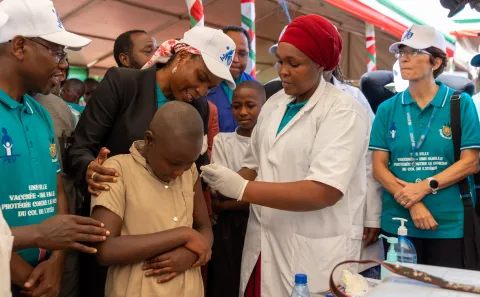
At the government's request, UNICEF has also provided mother and child health cards for two annual cohorts of more than one million pregnant women, taking into account the expectations of health care providers, community health workers and parents. ‘’This booklet allows me to remember all my medical appointments and gives me a lot of information about my health and that of my baby," says Vyizigiro Speciose, a young mother who met at the Masaka health centre for her baby's first vaccination.

In order to improve the storage conditions of the Expanded Programme on Immunisation (EPI) vaccines, a shed was built within the framework of the project, and two new generators, one of 100 KVA and another of 50 KVA, were installed to ensure the permanent availability of the energy necessary for the conservation of vaccines.