Renovated sanitary facilities for resilient education in Bujumbura
In Bujumbura, four schools have benefited from the renovation of their sanitation facilities as part of the response to the Mpox epidemic

- English
- Français
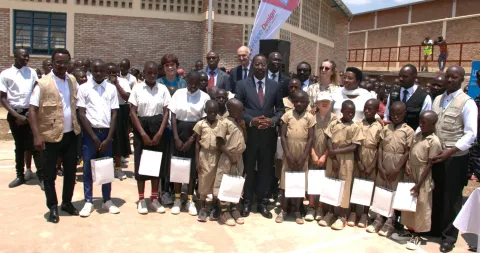
On July 7, 2025, an official ceremony marked a major milestone for four schools in the Burundian capital. The Reine de la Paix high school in Ngagara, the Gasenyi I and II basic schools, and the Don Bosco high school in Buterere now have renovated, modern sanitary facilities that meet current hygiene standards. These facilities include latrines, showers, washing stations, septic tanks, and water tanks.
These achievements were made possible thanks to technical and financial support from UNICEF and the Mastercard Foundation and implemented by the Global Development Community Burundi (GDCB) organization. The project is part of a humanitarian-development “nexus” approach in response to the Mpox epidemic that has affected Burundi. It aims to ensure continuity of learning while guaranteeing the health and safety of students and educational staff.
The ceremony was co-chaired by Ms. Mame Selbee Diouf, Deputy Representative of UNICEF Burundi, and Mr. Herménégilde Burikukiye, Permanent Secretary at the Ministry of National Education and Scientific Research. Also in attendance were the country director of GDCB, school principals, and members of parent-teacher associations.
At Reine de la Paix high school in Ngagara, the principal praised the transformation of the school's sanitation facilities. “Thanks to UNICEF's support, the school now has two sanitation blocks, one with ten latrines and a shower, the other with six toilets and six showers, as well as washing stations, a functional septic tank, and two water tanks, each with a capacity of 5,000 liters,” she said. She emphasized that these improvements have a direct impact on the lives of the 630 students, including 420 boarders, and on the quality of education.


Ms. Mame Selbee Diouf, for her part, emphasized the importance of the school environment in disease prevention, stressing that these facilities will not only strengthen hygiene and sanitation services but also prevent the spread of diseases such as Mpox. She also called on the beneficiary schools to ensure rigorous management of these facilities to guarantee their sustainability.
Mr. Herménégilde Burikukiye, Permanent Secretary at the Ministry of National Education and Scientific Research, praised the joint efforts between UNICEF Burundi and the government: "By supporting the WASH project, UNICEF is once again demonstrating its faith in Burundian youth and the importance of education as a lever for social transformation. " He emphasized the need for responsible management and urged school officials and students to maintain these facilities so that they can benefit current and future generations.
At Gasenyi II Primary School, the renovations were also welcomed. The principal expressed his gratitude, explaining that the lack of adequate sanitation facilities had been a constant source of concern for teachers, students, and their families.


These interventions, carried out in four facilities in Bujumbura and implemented by Global Development Community Burundi (GDCB) with support from UNICEF and funding from the Mastercard Foundation, are part of an integrated response to the Mpox epidemic in Burundi.