New school and health facilities give hope to pupils in the communes of Nyanza-Lac and Kayogoro
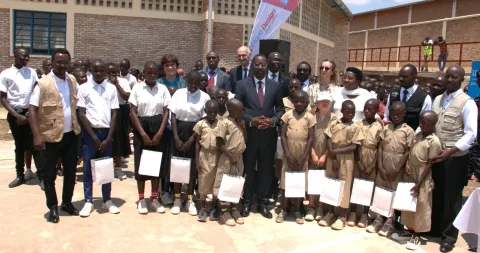
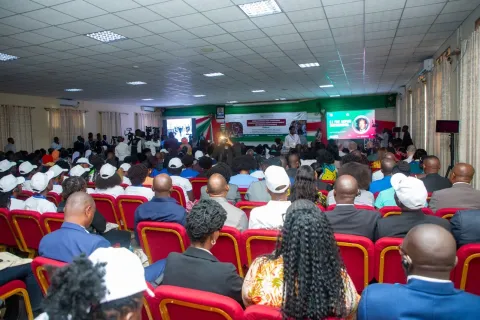
On June 25 and 26, UNICEF in partnership with the Ministry of Education, Jesuit Refugee Service (JRS) and with support from Education Cannot Wait (ECW), took provisional delivery of new school and health facilities in Nyanza-Lac and Kayogoro communes

- English
- Français
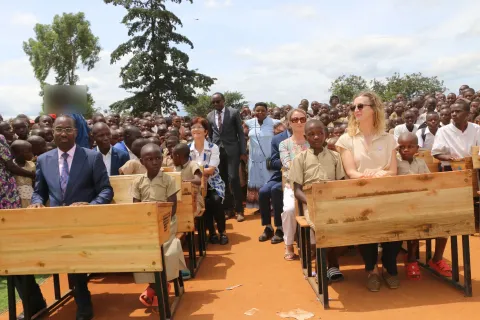
From Bujumbura, it took us over three hours to drive across the warm, flat land bordering Lake Tanganyika to reach the Mukungu I, Mukungu III and Rubindi II basic schools in the Nyanza-Lac commune. On site, the delegation was able to observe the concrete transformations brought about by the school infrastructure improvement program.
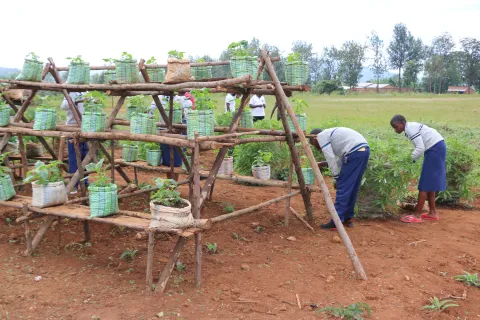
When we arrived, the beaming faces of the pupils and the pride of the teachers were living testimony to the positive impact of the new buildings on everyday school life. On-site achievements include new classrooms, modern sanitary blocks and the installation of rainwater collection systems.
At Mukungu I and III, the overflowing Lake Tanganyika had rendered the kindergarten rooms unusable. Some classrooms had been abandoned, and the children had to share the space alternately with other groups. Today, thanks to the new buildings, we have been able to see the installation of two rooms dedicated to pre-school education, as well as the installation of a rainwater supply system.
"Before, pre-school children were moved to other classrooms every day, and sometimes we even had to seek shelter outside the school. Today, they finally have a stable space in which to learn", explains André Rurihafi, principal of the school.
The students, visibly happy, expressed their enthusiasm and eagerness to resume classes in these new facilities. "Before, it was really difficult to study. We often had to move to another room to let the kindergarten children follow their lessons, and that threw me off. Now I can finally learn without being moved. I hope these new classrooms will help us to study better," confides Christmas Akimana, an 8th grader

At ECOFO Rubindi II, the transformations are also noteworthy. Two new classrooms have been built, as well as a rainwater storage point. Pupils shared their delight at these improvements and stressed the importance of the new infrastructure for their education. "Before, there wasn't enough space, we were overcrowded and lacked water. Now we'll be able to learn in better conditions", enthuses Richebe Nimpaye, a 6th grader who dreams of becoming a teacher.
The next day, our journey takes us to Kayogoro. A journey of over two hours through green hills, before reaching the other two basic schools: Gashonge and Rutenderi.
Arriving at ECOFO Gashonge, we discovered a school that had had to be relocated due to extreme conditions, particularly during the rainy season. Run-off water from the locality regularly flooded the courtyard and classrooms, sometimes up to a metre high. “The children studied with their feet in the water; some suffered from illnesses linked to the unsanitary water and lack of hygiene, and we feared that the aging walls would collapse on our children”, says Salvator Ndorere, representing the school's parents.
Four classrooms and sanitary infrastructures were built to solve these problems. Today, pupils can study in good conditions. The school principal sums up: “Thanks to these new classrooms, we no longer need to seek shelter for our pupils to study with dignity.”


We ended our visit at ECOFO Rutenderi. A pre-school classroom, a latrine block and a water storage point have been built. However, the school's principal stresses that there are still major needs to be met: “The sanitary infrastructure is still inadequate for the number of pupils we cater for.” He also expressed his gratitude to UNICEF and its partners for this initiative, which he is convinced will have a real impact on children's education.
The multi-year “KOMEZA ZIGE” education resilience program in Burundi, led by UNICEF with funding from Education Cannot Wait (ECW), embodies a tangible response to educational obstacles in emergency situations in Burundi. In this region known as a zone of great return, where climatic challenges, isolation and poverty hamper education, each classroom built is a step towards a more stable and equitable future.