Gateri: rebuilding dignity with water, latrines and hygiene
Thanks to the support of USAID, through its Office of Humanitarian Assistance, hundreds of repatriated and displaced families are regaining their health, dignity and hope through access to clean water, family latrines and hygiene kits

- English
- Français
The Gateri site, located about 5 kilometers from Buganda in the current commune of Bukinanyana, Bujumbura province, stretches along the Rusizi River, which forms the natural border with the Democratic Republic of Congo. In July, at the height of the dry season, the heat is oppressive; the red earth rises in dust at the slightest movement.
Gateri is not an ordinary site. Since 2015, it has become a refuge for repatriated families from the Democratic Republic of Congo, Tanzania and Rwanda; and more recently, for more than 1,000 internally displaced families who were relocated following the devastating floods in Gatumba.
It is in this context that UNICEF, in collaboration with its implementing partners, AIDE, Civil Protection and the Burundian Agency for Water and Sanitation in Rural Areas (AHAMR), is intervening as part of the project ‘’Emergency assistance to people affected by the impact of El Niño in Burundi’’, funded by USAID through its Bureau for Humanitarian Assistance. Objective: to restore the dignity of affected populations through improved access to drinking water, hygiene and sanitation.
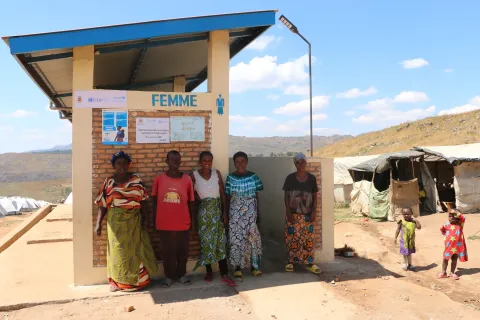
Our visit begins with Maskini and Jeannette, a couple who are among the 163 families who have benefited from the construction of family latrines. Maskini, who has had one leg amputated, describes with emotion the difficulties he experienced in the past: “Before the aid arrived, we had no toilets. Like many families living here in Gateri, we were forced to defecate in the open air in the forest by the Rusizi River. It was shameful, especially during the day, so we waited until nightfall to go there discreetly. With my disability, it was even more difficult and humiliating. Today, thanks to the family latrine we received, I can finally use the toilet with dignity, like everyone else,” says Maskini, relieved.


According to Anne Marie, another resident of the site, before the family latrines were built, diseases linked to poor hygiene, such as cholera and dysentery, were common. ‘’Since we have had our own latrine, we live much better because we live in a cleaner environment and my children get sick less often,’ says Anne Marie, who is also happy to have received WASH kits consisting of buckets, jerry cans, multipurpose cloths and sanitary towels.
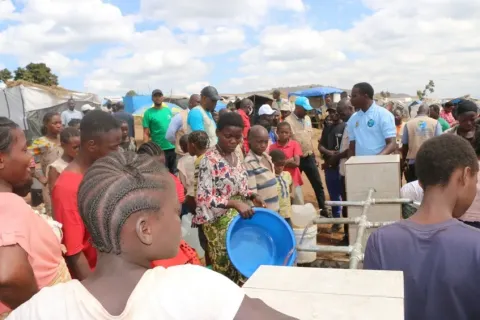
In the area of the site reserved for displaced persons from Gatumba, the first thing you notice is the permanent availability of drinking water. For the 1,025 households relocated from Mubimbi, this is a real breath of hope. Bella, a young mother, talks about how happy she is now that she has access to water: “We have enough water to drink, wash ourselves, do laundry, and even water our crops. It's a blessing.”
Not far away, Marie, who lives in the same area, sums up the importance of this progress in one sentence: “Even if I don't have enough food, I'm happy to have water. Water is worth more than gold.”
Their words, simple but profound, illustrate the relief shared by many displaced people we met at the Gateri site, all of whom are aware of the vital impact of access to reliable drinking water.

In the same vein, the Gateri clinic, located on the same site, is now connected to the drinking water network, significantly improving sanitary conditions and access to water for patients and healthcare staff.
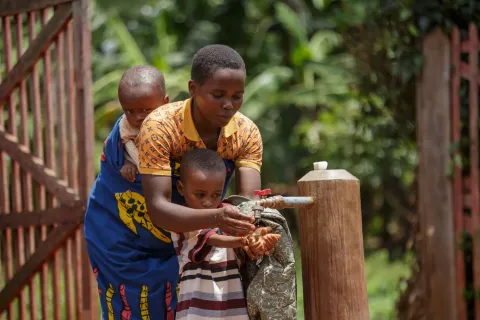
To ensure that these gains are sustained, 14 volunteers, supervised by the NGO AIDE, work every day to raise awareness among households about good hygiene practices. They go door to door, offering advice, reminding people of essential hygiene measures and helping families to use the facilities responsibly. “We go from house to house, showing people how to maintain the latrines and keep the water clean. If we notice any shortcomings, we give appropriate advice,” says one of the volunteers.

These interventions are part of the project “Emergency assistance to people affected by the impact of El Niño in Burundi”, funded by USAID through its Bureau for Humanitarian Assistance and implemented by UNICEF and IOM. The project aims to provide integrated emergency assistance to internally displaced families and other affected communities so that they can rebuild and recover with dignity. The project covers the provinces most affected by El Niño, such as Rumonge, Bujumbura Rural and Cibitoke, addressing essential needs such as shelter, non-food items, access to drinking water, hygiene and sanitation services.
UNICEF's interventions focus in particular on the construction of family latrines, the extension of the drinking water network with the installation of standpipes at the Mutambara site, and the co-financing of the installation of a drinking water supply network at the Gateri site. The latter includes the laying of pipes, the installation of bladders, polytanks and tap ramps. In addition, there are hygiene promotion activities within the communities and the distribution of WASH kits to meet the immediate needs of families.
In Gateri, every drop of clean water, every latrine built, every family educated represents more than a technical gesture. It is an important step towards resilience; a hand extended towards regained dignity, a silent reconquest of life.