UNICEF supports health and school facilities to improve hygiene conditions
To reduce the risk of spreading disease & infection, 5 health centers and 5 schools have been equipped with water, sanitation and hygiene infrastructure, as well as hygiene materials, with the support of The Church of Jesus Christ of Latter-day Saints.

- English
- Français
Surrounded by the hustle and bustle of children, accompanied by their mothers, we enter the inner courtyard of the Gashoho Health Center (CDS). This center, linked to the Gashoho Hospital, serves more than 27,000 people living across seven hills, including nineteen sub-hills. On average, more than 100 people visit the center each day, particularly during immunization periods.
That day was a routine vaccination day, as explained by a nurse in a white coat who came to greet us.
After the introductions, we headed toward the vaccination room. There, a nurse was checking the list of children to be immunized while holding a register in hand. On a table, syringes, vials, and compresses were carefully arranged.
After each immunization, nurses ensured that all waste was properly disposed of in the designated garbage bins located in a designated area. This was not the case before UNICEF provided support by supplying different-coloured garbage bins to facilitate the sorting of biomedical waste. The center was also able to acquire hygiene equipment, which helps prevent diseases related to poor sanitation. The center is now equipped with various hygiene materials and products, including boots, aprons, medical gowns, soap, chlorine, cleaning products, and garbage bins.


“Before getting these bins, there was no waste collection system. We just used old cardboard boxes as trash bins,” says a nurse just after vaccinating a child. The Gashoho CDS had to use its own funds to buy cleaning products, which created an additional financial burden.
The Gashoho hospital and health center offer numerous healthcare services that generate a large amount of waste. Thanks to the new materials, daily management has improved significantly.
“The spread of infectious diseases is now better under control thanks to the protective equipment provided to hygienists. Waste is sorted and removed in appropriate bins according to its category. Our staff and patients are now protected,” says Dr. Sylvestre Bayaga, senior physician at the Gashoho CDS.
With a high number of patients and additional staff, the Gashoho CDS also needs sanitation facilities such as latrines. The latrines were destroyed two years ago and are unusable. Patients defecated openly around the fence of the health center, while others used the facilities of the hospital located right next to the health center.
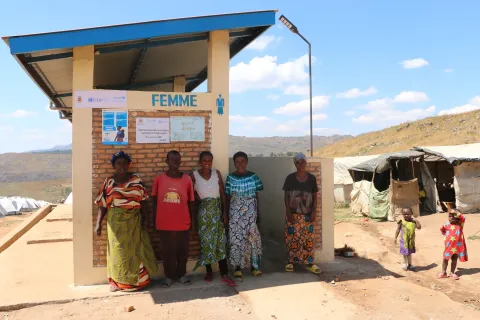
Fortunately, with support from UNICEF, new latrines are being built: two blocks, one for women and one for men. “These new latrines will help reduce environmental pollution and limit the transmission of diseases such as diarrhea. People will no longer have to defecate in the open,” said one of the Gashoho health center managers.


At the Kagari Fundamental School (Ecofo) in the commune of Muyinga, in the same province of Buhumuza, we met Jeannette, a 13-year-old girl. She is one of the students involved in the hygiene club.
Thanks to the support of teachers who were trained with technical assistance from the NGO SOJPAE (Solidarité de la Jeunesse Chrétienne pour la Paix et l’Enfance au Burundi) on hygiene issues, Jeannette received regular coaching at this club and a pack of sanitary pads. “Before, I used to miss school during my period because my parents didn’t have the money to buy disposable pads. However, with the reusable sanitary pads I’ve received, I no longer miss classes because I can use them for at least two years. What’s more, I’m better able to manage my menstrual hygiene thanks to the knowledge I’ve gained in my hygiene club and the availability of sanitary pads,” she told us. A total of 1,800 sanitary pads were distributed to this school.
Kagari School includes both secondary and fundamental sections. In total, there are 1,257 students, including 670 girls and 587 boys, supported by a team of 32 teachers (13 women and 19 men).
For all these students, mixed-gender toilets were available. Two latrine blocks were in use: one had two doors, and the other had six. Thanks to UNICEF’s support, new latrines are being built to provide students and teachers with safer sanitation facilities.
Four separate blocks of latrines, one for girls and one for boys, will improve hygiene in our school. It will also reduce the risk of sexual abuse,” said Gaudence, a teacher at Ecofo Kagari who is one of the teachers trained in hygiene issues. Twice a month, she gathers the club members to discuss hygiene at their school and within their families.


This initiative, funded by The Church of Jesus Christ of Latter-day Saints, also raises awareness in the community about good hygiene practices. As part of this effort, nineteen community health workers received training sessions to strengthen their hygiene skills.
Additionally, seven teachers from Ecofo Kagari received specific training on hygiene.
To improve infrastructure, two latrine blocks, each with three doors, were built at CDS Gashoho. As for Ecofo Kagari, it will be equipped with twelve new latrines: five for girls and five for boys, as well as a two-door block for teachers.