In Cishemere, a precarious refuge where UNICEF is strengthening protection for refugee children.
Feeding, protecting, educating, UNICEF is stepping up its efforts in Cishemere to give displaced children a dignified daily life. This story takes you inside that work, carried out in an extremely fragile context.

- English
- Français
Perched on the Murambi hill in Buganda commune, a narrow path cuts through short grass to connect National Road No. 5 with the leading transit site in Cibitoke province: the Cishemere transit site. Here, hundreds of Congolese families fleeing violence in eastern Democratic Republic of Congo find temporary refuge. According to the National Office for the Protection of Refugees and Stateless Persons (ONPRA), 1,072 people currently live at the site, around 60% of them children, considered particularly vulnerable.
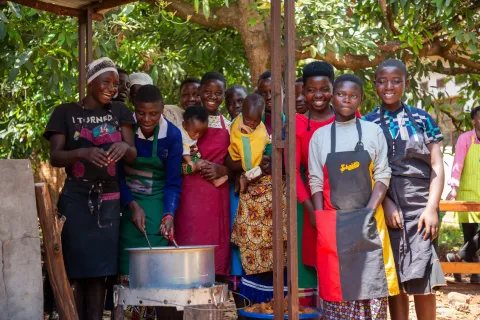
At the entrance, activity is intense. A small improvised market selling charcoal stands near the communal kitchen, where thin streams of smoke rise into the air. Children run between the shelters while women wash clothes at water points. On 19 November, UNICEF’s Child Protection team visited the site to assess living conditions and monitor the activities it supports within the camp.
Since 10 September 2025, UNICEF, in partnership with the NGO Spring Communities and with support from FONAREV and UNICEF thematic funds, has been implementing a programme to strengthen child protection and psychosocial support. The initiative aims to provide a learning environment, a safe space, and tailored support for children.

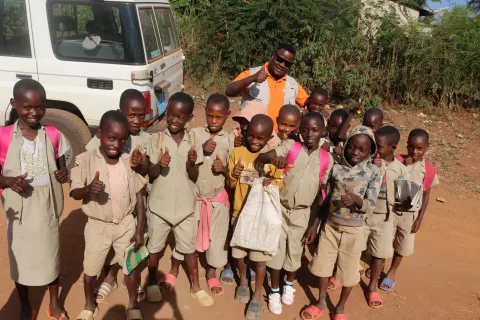
In the centre of the camp, a large tent stands out. It houses one of the Child-Friendly Spaces, where dozens of children take part in educational and recreational activities. Sitting slightly apart, 13-year-old Moïse Bindanda taps proudly on a table: “I’ve already finished the exercise I was given. Here, we learn the alphabet, numbers, and also respect for our parents. I love coming here.”
Not far from him, 11-year-old Chanceline Matata adds, “I like the games and the songs. I really enjoy being with my friends.”
Activities are organised by age group: 3–5 years, 6–11 years, and 12–17 years.
Joëlle Tuliya, one of the supervisors, explains: “We teach from Monday to Friday, from 8 a.m. to 2 p.m. The aim is to maintain the children’s academic skills and protect them by keeping them busy, so they don’t fall into bad company.”
Each child also receives a ration of porridge, which is critical for allowing them to participate in activities and ensuring they receive essential nutritional support.
But the initiative goes beyond learning. It includes a comprehensive package of protection services: mental health and psychosocial support, case management, and specialized assistance for unaccompanied or separated children.

AA has a total of 2,500 children receiving psychosocial support through socio-recreational activities, individual or group therapy, and personalised follow-up. At the same time, 7,500 people have been sensitised on preventing abuse, exploitation, and gender-based violence, and on how to use safe reporting mechanisms. Data from October 2025 further illustrate the reach of these interventions: 45 children who survived violence, abuse, or neglect received comprehensive assistance covering health, justice, and social services; 10 children were supported through individual case management; and 226 children, parents, and caregivers benefited from mental health and psychosocial support. In addition, 446 women, girls, and boys took part in sessions on gender-based violence prevention, while 541 people are now equipped to report any form of sexual exploitation or abuse safely.
In Cishemere, where daily life remains extremely precarious, these combined efforts are helping children regain not only a safe space but also a semblance of childhood. Thanks to the commitment of UNICEF, Spring Communities, and FONAREV, the transit site is gradually becoming a more protective and resilient environment for the families who have sought refuge there.