Japan helps build school infrastructure to strengthen education in Burkina Faso.
school infrastructure to strengthen education

- Français
- English
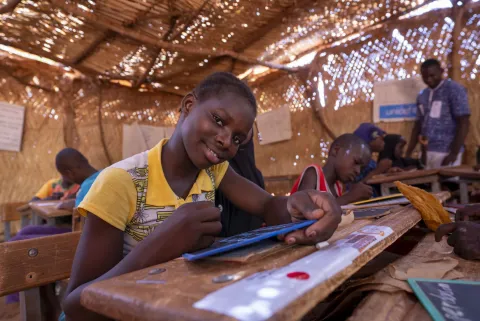
The Government of Japan and the Government of Burkina Faso have a long history of friendship. It is therefore in this long-standing partnership that the Government of Japan, in partnership with UNICEF and MENAPLN, through JICA, is providing support for the construction of new classrooms in the Centre and Centre-Sud regions of Burkina Faso. These new classrooms will not only help children in these regions the country but also internally displaced children from other regions of Burkina Faso who have found refuge in these areas.
Since 2019, displacement to urban areas is rapidly increasing due to insecurity. Armed violence has had a considerable negative impact on the continuity of children’s education. It has forced more than 6,136 schools to close, including 704 post-primary and secondary schools. More than 1,043,490 children are deprived of a normal education, including approximately 154,622 children of post-primary and secondary school age.
The project "Strengthening Education through Secondary School Construction" aims to improve access and quality of post-primary education in the targeted areas (Ouagadougou, Manga, Saponé) and to provide access to post-primary education for 5,200 children, 50 per cent of whom are girls, by providing safe and child-friendly learning spaces.
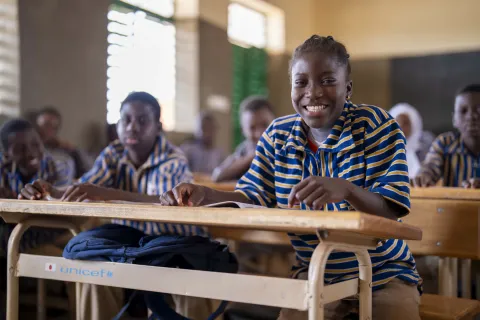
So far, 18 new schools have been built with the installation of WASH infrastructure (latrines, water points), the provision of basic school furniture and science laboratory equipment, the training of 162 teachers and school directors in the "Safe School" approach, etc.
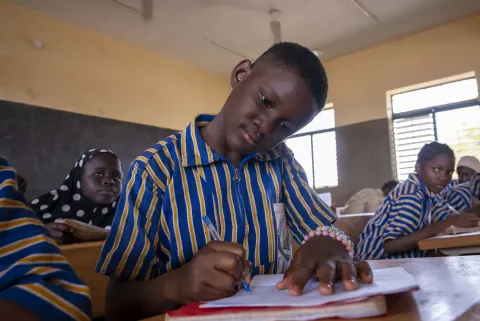
"I am very happy to have these new classrooms. It is good and it gives us the opportunity to study well. We are at ease, and no one comes to disturb us" said Zalissa Dabone. Indeed, before the students of Wend Kouni Secondary School started using the new classrooms in January, they were forced to share the classrooms of a private school not far from their new CEG.
Yési Kabore is the interim director of the school. According to him, the new premises have motivated the children: "We have very good results with the children, and I can tell you that it is the prospect of working in these rooms provided by JICA and UNICEF that has motivated the children. Our highest average is 17.33”.
The CEG of Wend Kouni is composed of 183 students of which 110 are girls and 73 are boys. Out of the eight classrooms built, only two are currently being used. These are the 6th grade classes. As the year goes by, new classrooms will be opened. The CEG of Wend Kouni is the only public school in the district. In addition to the classrooms, the toilets built under the project will allow the students and especially the girls to come to school even during their menstrual period as Asséta Ouedraogo says: "I am really proud of my new school, it is really beautiful. There are nice toilets and everything is functional. I can come to school and be comfortable even when I have my period".
Similarly, new classrooms and sanitary facilities have also been built at the CEG of Polesgo. Mamounata Doussa, Acting Director of the CEG is delighted with the result: "It's really great! At the beginning of the year, the children had to share classrooms with the students of the CEG of Toukin. They were cramped and worked on the floor. Now, things are better. The children are more comfortable". The CEG of Polesgo is near the industrial zone of Kossodo. Similar to the school in Wend Kouni, two 6th grade classes were opened first. The other classes will open over the next few years. The CEG of POLESGO is composed of 135 students of which 87 are girls and 48 are boys. Among them there are nine displaced boarders and two girls with disabilities. Toilets have also been built to help these vulnerable children.
Awareness of proper hygiene and sanitation practices and WASH kits will be provided to ensure a healthy learning environment and prevent the spread of COVID-19 and other preventable waterborne diseases in schools. For UNICEF and the Government of Japan, this project will strengthen the resilience of post-primary education in a context of insecurity and massive displacement.
Since 2019, displacement to urban areas has been increasing rapidly and this has created a huge demand for school infrastructure. Currently, the target regions of this project host only 0.8 per cent of the country's IDPs6, however if the situation continues to deteriorate, displacement to urban and peri-urban areas around Ouagadougou, the capital of Burkina Faso, is possible.