Access to justice for mobile and other vulnerable children
UNICEF and its partners are hard at work helping mobile and other vulnerable children in West Africa.

- Français
- English
"I come from Koumbia, a rural commune in the province of Tuy, in the Hauts-Bassins region. I lived there with my father. I never knew my mother because she abandoned me when I was two. To continue my studies, my father sent me to the city, here in Bobo Dioulasso, to live with his little sister. He told me it was for my own good".
Adjaratou Sangaré will soon be 15. She had clung to the hope of continuing her studies, as her father had promised her, but her story would be quite different.
“When I came to live with my aunt, I was the victim of a lot of physical abuse. When I went to school, I slept all the time. They didn't give me any food, and sometimes I felt so tired I'd even miss classes to rest under a tree,” she recounts.
It was under that tree, where she usually rested, that her life was to change. Like many other children, she now lives at the Bobo Dioulasso reception and transit center.
“One day when I couldn't go to school and I was under the tree, an old lady came up to me to find out what I was doing there. I told her my story, and that's how she put me in contact with social workers. When my aunt saw this, she abandoned me on the street. But as I knew the way back to the transit center, I came back here so as not to live in the street. Since I've been here, I've been eating well, sleeping well and being looked after,” she adds.
In Bobo Dioulasso, Burkina Faso, a project to improve access to justice for mobile and other vulnerable children has been implemented since 2022 by the NGO Terre des Hommes with funding from the European Union. It aims to improve children's access to child-friendly justice through age- and gender-sensitive juvenile justice mechanisms, while offering alternatives to detention for mobile and vulnerable children in West Africa. As part of this project, the government of Burkina Faso and UNICEF have opened a foster and transit center in Bobo Dioulasso, where many of the children have found refuge, with the help of social workers.

Mrs Amina Sanou is a Family and Child Department’s agent. She is in charge of welcoming children at the Bobo Dioulasso foster and transit centre. “When children arrive, we first welcome them at the Guichet Unique InterSectoriel (GUIS), a room where we receive children on the move and vulnerable children. We register them and direct them to the case managers. On average, we can receive five mobile children and six vulnerable children at the same time. At the moment, we have 15 children, including 9 girls, plus two adults. Generally, a child should not spend more than seven days at the centre, but sometimes, due to some situations, we keep them longer, in order to reunite them with their parents or place them within foster families,” she explains.
At the foster centre with the help of social workers, children try to rebuild their lives until they find a more welcoming home. The majority of these children are victims of physical abuse, female genital mutilation or child marriage. Others are lost children who can no longer find their way home. Social workers’mobile teams have been deployed to find children in need.
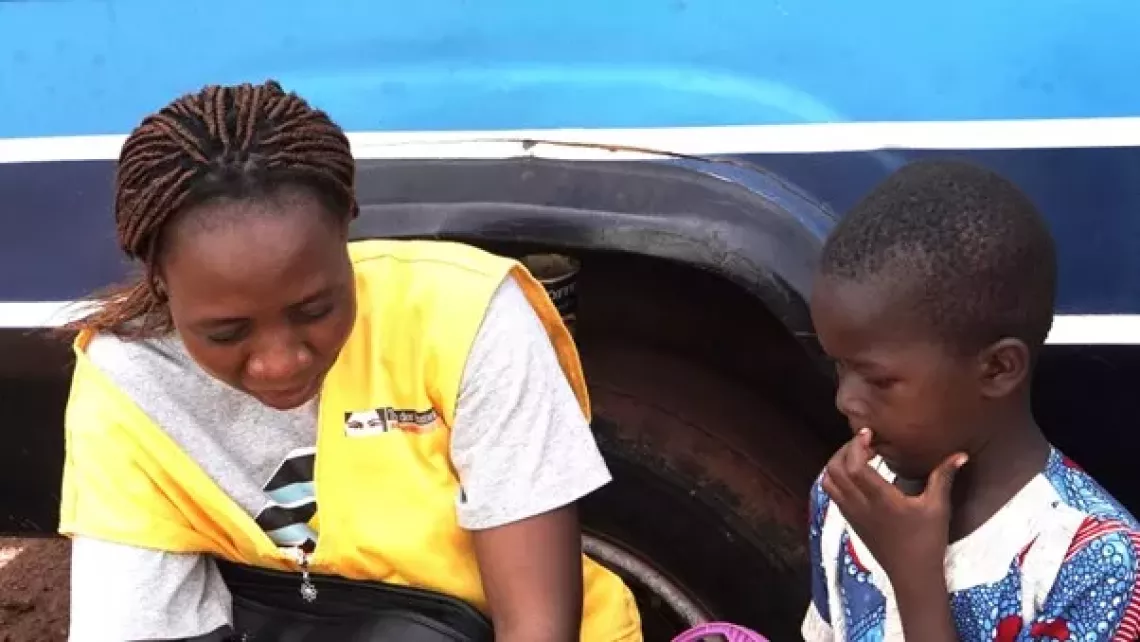
At Bobo Dioulasso's Lafiabougou bus station, a child is walking around with a bucket of peanuts on his head. It's Guelilou Ouedraogo. Aged 6 and originally from Dandé, he fled his village because of insecurity. He now lives with his grandmother in Bobo Dioulasso. When he was in Dandé, he went to school and was in CP1. Today, he sells peanuts in town and does no longer study. He found himself by chance at the Lafiabougou bus station, and a social worker from a mobile team approached him to understand his situation. She wanted the little boy to show her his home, so that she can talk to his grandmother and bring them assistance. Many children like Guelilou are in need of assistance, hence the importance of the project.
Apart from these children, there are others who are just as vulnerable or in conflict with the law, and the project takes care of them too. They benefit from what we call "criminal mediation", which enables us to find an amicable solution to these children's legal problems, with the intervention of religious leaders. When an agreement is reached, the child is followed by social workers.
This is the case of 15-year-old Abdoulramane Sanou, who had a run-in with the law following a theft. Today, he assures he's learned the lesson and won't do it again. He is currently training to become a welder and would like to open his own workshop in two years' time, to give himself a better life.
In Burkina Faso, children face many challenges in accessing the justice system, such as lengthy procedures and lack of free legal aid.
UNICEF is supporting the authorities' efforts to improve compliance with international standards.
In 2023, 3,150 mobile children, including 1,259 girls, were supported in the 7 intersectoral one-stop shops set up as part of the project. Also, 684 children in conflict with the law or on the move and other vulnerable children, including 108 girls, benefited from alternative measures to criminal prosecution or prison sentence, or from specialized social support including professional reintegration or legal assistance. A total of 52 foster families were trained on the care of children in conflict with the law and children on the move and 27 community child protection units were set up and trained.
To help displaced children gain access to services, the Ministry of Women, National Solidarity and the Family and UNICEF have set up innovative care strategies, such as mobile teams and the one-stop social protection service, to offer multi-sectoral services. Families also take care of children on the move, in conflict with the law or children victims of violence, placed by judges for temporary protection.