“Turning a Blind Eye Is a Form of Abuse”
A conversation with Professor Gordana Buljan Flander PhD, clinical psychologist and psychotherapist for children, on how to recognise and respond to child abuse
- Bosanski/Hrvatski/Srpski
- English
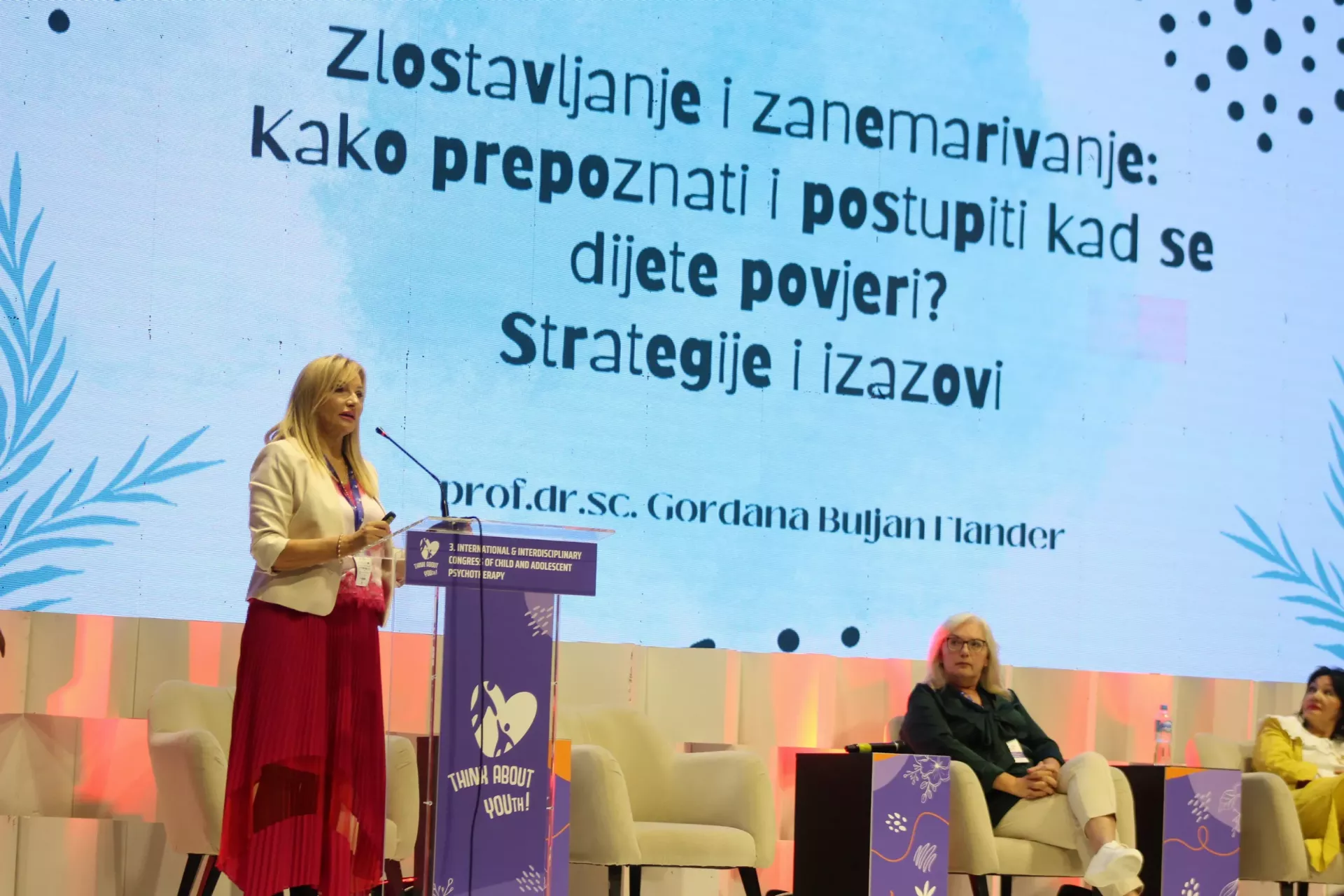
At the Third International and Interdisciplinary Congress of Child and Adolescent Psychotherapy “THINK ABOUT YOUth”, recently held in Sarajevo, Professor Gordana Buljan Flander PhD addressed the topic of “Abuse and neglect: How to recognise and approach when a child confides?”. A clinical psychologist, integrative psychotherapist for children, adolescents and adults, as well as a permanent expert witness for abused and traumatised children, she spoke in an interview for UNICEF about recognising signs of child abuse, key things to watch for, the role of preschools and schools in preventing and detecting abuse and when professional help is essential. Professor Flander draws attention to the prevalence of child abuse and the alarming statistic that 90 percent of sexual abusers are individuals well known to the children. She shares insights from her extensive experience in child protection, mental health and rights advocacy. As the founder of the “Hrabri telefon” helpline for abused and neglected children in Croatia, she underscores the crucial role of helplines, such as the “Plavi telefon” 080 05 03 05 in Bosnia and Herzegovina, in safeguarding children in our society.
While your lecture addresses a professional audience, what advice can you give to parents?
It’s crucial for parents to understand that abuse occurs. Furthermore, they should be aware that physical abuse or corporal punishment is ineffective in teaching children the difference between right and wrong, as it only exemplifies what is wrong. Also, parents often mistakenly believe that sexual abuse occurs outside the family. They teach children not to talk to strangers and to mistrust them, but they should understand, and this is indeed quite widely communicated, that abusers are usually within the family circle, among close relatives and friends. About 90 percent of sexual abusers are individuals well known to the children: one third are immediate family members, up to 50 percent are part of the extended family and the remainder up to these 90 percent are close family friends. Thus, only 10 percent of children are abused by strangers.
How should we approach children in such situations? What should we teach them?
It’s essential to educate children from preschool age about the intimate parts of their body, which should only be touched by their mother during bathing or by the doctor during medical examinations. We must instil the rules of sexual behaviour in children from preschool age. Furthermore, we need to teach them that hitting others is unacceptable, and it’s certainly not appropriate to hit a child to convey this message, as children learn by observing our behaviour. I believe that parents today are often confused and unsure of how to set boundaries, leading them to resort to beatings, which can escalate into physical abuse. Another important point for parents to understand is to avoid embarrassing their child, even if well-intentioned. They say things like “Shame on you, how can you behave like that?” or “You embarrassed me”, and I think it’s really crucial for parents to realise that such words can leave a lasting impact on a child’s heart and soul, carrying into adulthood and significantly shaping the kind of person they become.
You mentioned in your lecture that it takes 10 to 16 years for a child-victim of sexual abuse to talk about it and confide. Why do children remain silent?
Sexually and physically abused children often feel stigmatised, withdraw further into themselves, keep silent about it even more and do not want to speak up. They do so because they fear that speaking up will destroy their family, and this fear is reinforced when their mother, if the father is the abuser, says things like “Bring daddy back from prison, you destroyed my family”. Children remain silent out of fear of revenge, afraid that something may happen to them or one of their close friends. They also keep quiet because they don’t know how to talk about the abuse and believe that adults will be trusted more than they will. This is why it typically takes 10 to 16 years from the time of abuse to when the victim confides. Often, they are asked “Why didn’t you say something sooner?”, and here I explained why.
How can we then encourage adults to break their silence about abuse, and who should an abused child turn to, especially if the abusers are often people from the child’s closest environment, whom the child would expect to protect them?
The worst situation is when a child is abused by someone who is also their guardian, someone who is supposed to care for them, which creates a terrible feeling of betrayal. That’s why it’s essential to work with children and tell them “You don’t need to suffer, you don’t need to be silent, confide in a trusted adult”. This trusted adult doesn’t have to be a preschool teacher, a teacher or a psychologist; it could be a godmother or an aunt. That’s why it’s important to help children identify their trusted people and understand what to do and how to react if something like that happens. As for the parents, it is important for them to be aware. We should also work with them to increase public awareness of how frequent abuse is and how often it occurs within families. Parents need to observe their children closely. If they notice the child behaving strangely, refusing to kiss someone goodnight or not wanting to stay with someone, they should look into what is happening to see if there’s an issue. The issue that parents most often overlook is sexual abuse, as it is difficult for us to believe children suffer in this way. We protect ourselves by turning a blind eye and not wanting to see children suffer, because once we acknowledge their suffering, we’re obligated to take action.
What is the role of preschools, schools and other educational institutions in preventing and detecting of abuse?
The role of schools and preschools is vital. In preschool, it is particularly important, in a manner appropriate to their understanding and developmental level, to inform children about which touches are inappropriate and which are acceptable, which are healthy and which are unhealthy, and the difference between a good secret and a bad one, without startling them. In primary school, I believe that lessons on self-protection and empathy should be incorporated into the curriculum so as to help prevent violence and peer violence, as well as teach children how to protect themselves from all forms of abuse. I think these topics are far more important to discuss in homeroom lessons than merely counting justified and unjustified absences.
You also pointed out in your lecture that professionals often hesitate to report cases of abuse. How long does it take for everyone, from professionals to schools to the community, to become aware of the importance of reporting abuse?
Professionals often fear that they will be responsible for removing the child from the family, whereas by then, a significant amount of time and investigation will have passed. It’s important for professionals to understand that we’re not the ones conducting the investigation or providing proof. That is the role of institutions. Our duty is to report what we see and hear. If we fail to do this, we miss that essential first step of conveying what the child has shared with us. Of course, we must never promise the child that it will remain a secret that we won’t tell anyone. If we fail to disclose, then we are complicit in the crime. I believe all professionals should understand this, which is why I concluded today’s lecture with the sentence “Turning a blind eye is a form of abuse”. Because if we, as adults who are supposed to be the voice of these children, merely observe, we become participants in the crime. Therefore, it’s crucial to raise public awareness, especially among professionals, about their responsibility for the protection of children.
Considering that it’s often challenging for children to choose someone they can confide in if they experience abuse, how important are helplines such as “Plavi telefon” in Bosnia and Herzegovina, where they can receive help and support by calling 080 05 03 05?
I think helplines for children are extremely valuable and effective. These anonymous lines provide a safe space where children can seek advice without fear of being identified. Often, people view them merely as reporting lines, but they also act as counselling lines. The “Hrabri telefon” helpline in Croatia, which I founded back in 1997, was initially for abused and neglected children, allowing them to speak anonymously with counsellors who would then direct them to the nearest trusted person. The counsellors can call the child again if needed, arranging as many follow-up calls as necessary until we can agree with the child that we will inform the authorities if they lack a person to confide in. In such cases, we become that person, informing the child about the next steps. Helplines play a very significant role in protecting children in our society.
How important is it that a case of abuse is discovered as soon as possible?
In my practice, I once received a call from an elderly woman in Sweden, over 80 years old, who wanted to share what had happened to her before she died. When she was a child, her grandfather sexually abused her. She escaped from her family who didn’t believe her, moved abroad, never married and had no children, feeling emotionally scarred all her life. She needed to confide in someone. So, the child feels the urge to confide in us; they just need to have confidence in us adults. Research and my practice reveal that a child tries to tell someone about the abuse five or six times before they are actually heard. Often, the adult’s face shows they’re not ready to listen or handle it. We must be prepared to deal with what the child tells us because we’re adults and know what to do and how to protect them.
How can we shorten that 10-to-16-year period and encourage victims to speak up sooner?
Sadly, in my experience, when a child confides in their mother about being sexually abused by their father, older brothers or grandfather, the mother often sides with the perpetrator. This immediate display of distrust causes the child to shut down. It’s essential to continuously raise public awareness by writing about abuse regularly, not just when incidents occur. Unfortunately, it’s only brought up when something happens; this lasts for a few days and then the story fades until the next incident. We need to educate both professionals and parents on the symptoms, what to look for and how to respond – rather than turn a blind eye. A non-abusing parent often pretends not to see anything, which is understandable. It is difficult to accept that the person you chose as your marital partner is sexually abusing your child and that in such situations you have to choose between your partner and the child – where, clearly, you must choose to protect the child over your partner.
What are the key signs that we can recognise in a child if they’re abused, and what should we pay attention to?
Physical abuse often presents with physical signs, such as inexplicable bruises. I’ve encountered cases where children had burn scars from cigarettes being put out on them. In the case of sexual abuse, physical signs are rare, so we look for behavioural and emotional indicators. If a child starts behaving in a sexualised manner, drawing pictures with sexual details, using vulgar words or excessively touching themselves beyond the age of two or three, these are all signs that something may be happening. Additionally, if the child begins to withdraw or exhibits any change in behaviour, it’s important to pay attention and consult a specialist. If the child is anxious, depressed, unwilling to talk or avoids certain people, parents should try to talk to the child. If there’s no response and the symptoms persist, it’s imperative to seek help from a professional who is better equipped to recognise these symptoms and determine if something is amiss. It’s also important to ask the child directly, which is something people, including professionals, often avoid. Questions like “Has anyone called you stupid or silly?”, “Has anyone touched your private parts?” or “Has anyone asked to see your private parts? Or asked you to see his private parts?” can be asked. This does not mean you will expose the child to something unpleasant, but you will give them the opportunity to speak up if something like that has happened.