It's OK to Seek Help – Blue Phone in Mental Health Protection
Online and telephone counselling for children and families in Bosnia and Herzegovina
- Bosanski/Hrvatski/Srpski
- English
Blue Phone is a counselling line providing anonymous and free help to young people and children in Bosnia and Herzegovina. The most common reasons why children turn to them are related to mental health, violence or abuse. Year after year, the number of calls concerning mental health is constantly increasing. For the sake of comparison, every year since the beginning of the pandemic, there have been up to 5 times more conversations on this topic compared to the period before the pandemic, with the largest number of calls coming from girls aged 10 to 19.
The phone lines are always hot. The counsellor answers one of the calls and hears a female voice:
"Good afternoon! I need help, I have no one to talk to about the situations I'm going through right now, not even my parents and brothers. I hope I can confide in you."
After the counsellor encourages her to continue, fourteen-year-old Hana* states that her problems started a few months ago when her father became seriously ill and was fired from his job, which economically endangered the whole family. In addition to caring for her father, her mother had to work, just so that Hana and her brothers could have at least basic things. However, she also caved in after some time. Until recently a stable and functional family found itself in crisis and poverty. Hana was badly stricken by this.
Unfortunately, problems in the family are only one of the many difficulties Hana faces.
She has been exposed to violence since the first grade of primary school. The girl describes her peers beating her, calling her names, and making fun of her appearance. She also described the situation that happened a few days before calling the Blue Phone: "Two girls spilled ink on my backpack and jacket, because I was sitting in front of them, nothing could be washed off. In addition, they threw trash and crumbs on my things and around the desk, blaming me for it. I reported to the class teacher, but no one was reacting. Nobody cares about me, they know I'm there, but they don't pay attention, if I died in the middle of the classroom, nobody would notice."
In the further conversation with the counsellor, Hana also reveals something very worrying:
"I started self-harming a few months ago, and I still do. My only way out of those problems is to injure myself, and so after some problem I waited until I got home and cut myself, on my arms, legs, thighs. It's easier when my body hurts."
However, after a while, the situation became even more serious because in the school she attends they found out that Hana was self-harming.
Because of self-harm, Hana often went to a psychologist and school counsellor, but it was stressful for her, because she was excluded from classes, and the situation would only worsen when she returned to the classroom: "The school counsellor and the psychologist often take me out of class and take me to a conversation, which is stressful for me because of everything that awaits me when I return to class, namely hurling insults and provoking. When they found out in my class that I was self-harming, one of them betrayed me to the whole generation, so when everyone found out, they stopped hanging out with me, the worst stories started and it's still going around the school."
In addition to not being understood at school, Hana says that she did not receive the support and understanding she needed from her parents either. "Nobody supports me in the family. If I complain that I need new clothes, they say they have bills to pay. When they found out that I was self-harming, they threatened me that I must not do it again or they would punish me. They conclude every conversation by saying that they survived the war and remained normal, and that nothing will happen to me and that I do not need professional help."


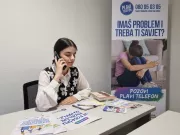
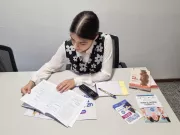
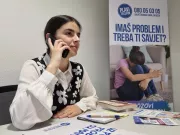
During the conversation, the Blue Phone counsellor supported the girl and tried to come up with the most appropriate solution together with her. One of the options is to report suspected violence. Hana did not immediately agree to report it because she was afraid that the situation at school and in the family would worsen, and that she would be exposed even more. But the counsellor explained how the report works and what could happen if the competent institutions are notified. After several hours of talking with the counsellor, Hana decided to report the violence that was happening to her after all.
After the conversation with the girl, the report of suspected violence against the child, with all the information obtained, was sent to the competent institutions, the Police Administration and the Centre for Social Work.
In addition, the counsellor talked with the girl about different techniques that could help her deal more easily with the unpleasant emotions she feels, as well as with self-harm. Through the conversation, the girl learned the technique of drawing on the parts of the body where she cuts herself in order to delay self-harm, and the technique of self-harm on paper, in which she draws her silhouette on paper and when she feels the urge to self-harm, she does it on paper instead of on her body.
A day later, Hana called again and said that representatives of the police had visited her and interviewed her and her mother: "I have to say that I was positively shocked when they came. They asked if everything was okay, that they wanted to see if I was okay, if there were any problems at school, so they made a list of everything I talked about with you and said they would contact the school. They told me that I could contact them and the Centre for Social Work if I had any problems."
After that, Hana spoke to the Blue Phone several times, and in one of the conversations she stated that she had started seeing a psychologist at the Healthcare Centre, and that she was already feeling a little better. In one of the conversations, she also shared how she feels when she talks to Blue Phone counsellors: "For the first time in my life, I felt true support and actually true love, even though it wasn't live, you somehow changed my view of life, it's easier when you have a person to whom you can tell anything and who will help you and not turn it against you. I feel safe and I'm surprised that after a couple of hours of conversation you can have such a positive influence and turn my story around."
For several years, UNICEF in Bosnia and Herzegovina has been a partner of the "Nova Generacija" association, which runs the Blue Phone. Counselling lines such as the Blue Phone are important in the promotion and realization of children's rights, as they provide a safe and accessible platform for children and young people to get the support they need. They offer an efficient way to provide children and young people with accurate information, psychological counselling and to refer them to appropriate services or resources in their communities, thus enabling them to receive professional help and support. Bearing in mind the needs of children and young people in Bosnia and Herzegovina, as well as the recommendations of the Committee for Children's Rights in BiH, and the recommendations of children and young people from 20 municipalities, it would be necessary to ensure institutional recognition and long-term systemic support and sustainability of the services of the Counselling Line for Children. This requires establishing technical and formal legal conditions for assigning a European harmonised number for lines of special social value - call centre for children 111 116. Advocacy will continue so that the sustainability of the service is promoted, and all children in BiH can access this important service.