What makes a USpace empowering?
Four guiding principles for child-friendly engagement

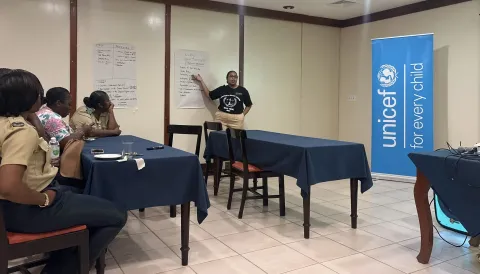
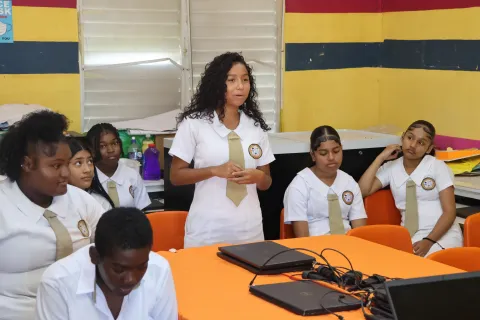
A USpace is a physical space/place where children can talk to an adult in a non-judgmental environment, receive support, and get connected to the resources they need to succeed. A USpace is a community initiative to develop our digital skills, and experiment with technology + culture with the purpose of developing new ideas for today + tomorrow.
The USpaces in Belize will be set up at Houses of Culture and Libraries around the country. The main feature of the USpace is that it is a supervised and protected environment where children can participate in organized activities to play, socialize, learn and express themselves. The main principles of USpaces iinclude:
USpaces are secure and "safe" environments for children.

Children require immediate support and a safe environment in challenging circumstances. All involved actors should commit to ensuring that children are safe and secure at all times in an emergency USpaces and provide a safe and supportive system for children and families during a time of crisis. A safe environment should also be a focus of USpaces.
USpaces provide a stimulating and supporting environment for children.

It is important to provide an environment that supports children. A supportive environment entails three key elements: i) a wide range of appropriate activities and programmes ii) a physical environment to facilitate those activities and programmes iii) encouraging, supportive and sensitive staff.
USpaces are inclusive and non-discriminatory.

An inclusive process and a non-discriminatory approach ensures that all children regardless of their class, gender, abilities, language, ethnicity, sexual orientation, religion, nationality have access to USpaces. The best interests of a child should be the primary consideration.
USpaces provide for support integrated services and programmes.

Activities and programming should be integrated as much as possible. The three most involved sectors are education, protection, and health. Activities that are integrated into wider systems (i.e. existing community support mechanisms) tend to reach more people, are often sustainable, and tend to carry less stigma.
Launch of USpace at the Banquitas House of Culture