Young children’s diets show no improvement in last decade, ‘could get much worse’ under COVID-19 - UNICEF
During crucial period when children begin to transition to solid foods, just 1 in 3 are fed a diet diverse enough to grow well

- বাংলা
- English
NEW YORK/DHAKA, 22 September 2021 – Children under the age of 2 are not getting the food or nutrients they need to thrive and grow well, leading to irreversible developmental harm, according to a new report released by UNICEF today.
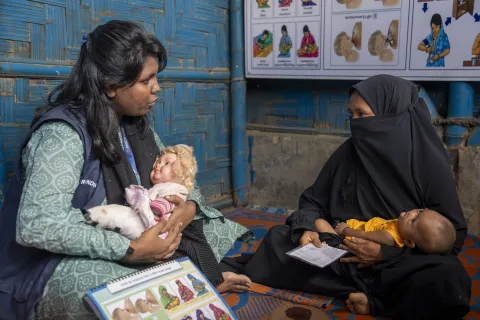
In Bangladesh, for example, only one in three children aged 6-23 months are being fed the minimum number of recommended food groups. There has been progress in the last decade, but gaps in equity persist. Only 22 per cent of children in poorer households have a diet that meets minimum diversity, compared with 48 per cent of children in wealthier households. And despite some progress, 36 per cent of children under five years of age in Bangladesh continue to be affected by different forms of malnutrition such as stunting, wasting and overweight.
Fed to Fail? The crisis of children’s diets in early life – released ahead of the UN Food Systems Summit this week – warns that rising poverty, inequality, conflict, climate-related disasters, and health emergencies such as the COVID-19 pandemic, are contributing to an ongoing nutrition crisis among the world’s youngest that has shown little sign of improvement in the last ten years.
“The report’s findings are clear: When the stakes are highest, millions of young children are being fed to fail,” said UNICEF Executive Director Henrietta Fore. “Poor nutritional intake in the first two years of life can irreversibly harm children’s rapidly growing bodies and brains, impacting their schooling, job prospects and futures. While we have known this for years, there has been little progress on providing the right kind of nutritious and safe foods for the young. In fact, the ongoing COVID-19 disruptions could make the situation much worse.”
In an analysis of 91 countries, the report finds that only half of children aged 6-23 months are being fed the minimum recommended number of meals a day, while just a third consume the minimum number of food groups they need to thrive. Further analysis of 50 countries with available trend data reveals these poor feeding patterns have persisted throughout the last decade.
As COVID-19 continues to disrupt essential services and drives more families into poverty, the report finds that the pandemic is affecting how families feed their children.
Children carry the scars of poor diets and feeding practices for life. An insufficient intake of nutrients found in vegetables, fruits, eggs, fish and meat needed to support growth at an early age puts children at risk of poor brain development, weak learning, low immunity, increased infections and, potentially, death.
Children under the age of two are most vulnerable to all forms of malnutrition – stunting, wasting, micronutrient deficiencies, and overweight and obesity – as a result of poor diets, due to their greater need for essential nutrients per kilogram of body weight than at any other time in life.
Globally, UNICEF estimates that more than half of children under the age of 5 with wasting – around 23 million children – are younger than 2 years of age, while the prevalence of stunting increases rapidly between 6 months and two years, as children’s diets fail to keep pace with their growing nutritional needs.
According to the report, children aged 6-23 months living in rural areas or from poorer households are significantly more likely to be fed poor diets compared to their urban or wealthier peers. In 2020, for example, the proportion of children fed the minimum number of recommended food groups was twice as high in urban areas (39 per cent) than in rural areas (23 per cent).
“We must continue to strengthen our efforts so that all children can benefit from the diverse diets they require to grow, develop and learn to their full potential. Food systems are critical for ensuring nutritious, safe, age-appropriate and affordable food for children,” said Tomoo Hozumi, UNICEF Representative in Bangladesh.”
“The UN Food Systems Summit and the Nutrition for Growth Summit are great opportunities for Bangladesh to reaffirm its commitment towards improving children’s nutrition and build on the progress it has made in the past decades”, he added.
To deliver nutritious, safe, and affordable diets to every child, the report calls for governments, donors, civil society organizations and development actors to work hand-in-hand to transform food, health and social protection systems by leading key actions, including:
- Increasing the availability and affordability of nutritious foods – including fruits, vegetables, eggs, fish meat and fortified foods – by incentivizing their production, distribution and retailing.
- Implementing national standards and legislation to protect young children from unhealthy processed and ultra-processed foods and beverages, and to end harmful marketing practices targeting children and families.
- Increasing the desirability of nutritious and safe foods through multiple communication channels including digital media to reach parents and children with easy to understand, coherent information.
The report notes that progress is possible with investment. In all regions, investments are needed to ensure that all children benefit from the diverse diets they need to prevent all forms of malnutrition, and grow, develop and learn to their full potential.
“Children cannot survive or thrive on calories alone,” said Fore. “Only by joining forces with governments, the private sector, civil society, development and humanitarian partners, and families can we transform food systems and unlock nutritious, safe and affordable diets for every child. The upcoming UN Food Systems Summit is an important opportunity to set the stage for global food systems that meet the needs of all children.”
#####
Notes to editors:
Quantitative data on current status, trends and inequities of young children’s diets presented in this report are derived from UNICEF’s global databases, which include only data that are internationally comparable and statistically sound. UNICEF global databases comprise data from 607 nationally representative surveys conducted in 135 countries and territories, representing more than 90 per cent of all children under the age of 2 globally.
Download the high-res image here.
More multimedia content available to download here.
Media contacts
About UNICEF
UNICEF promotes the rights and wellbeing of every child, in everything we do. Together with our partners, we work in 190 countries and territories to translate that commitment into practical action, focusing special effort on reaching the most vulnerable and excluded children, to the benefit of all children, everywhere.
For more information about UNICEF and its work for children, visit www.unicef.org.bd
Follow UNICEF on Facebook and Twitter
About the 2021 UN Food Systems Summit
The UN Food Systems Summit was announced by the UN Secretary-General, Antonio Guterres, on World Food Day in October 2020 as a part of the Decade of Action for delivery on the SDGs by 2030. The aim of the Summit is to deliver progress on all 17 of the SDGs through a food systems approach, leveraging the interconnectedness of food systems to global challenges such as hunger, climate change, poverty and inequality. More information about the 2021 UN Food Systems Summit can be found at https://www.un.org/food-systems-summit