Validation Workshop on Education Sector Analysis 2026 Advances Evidence-Based Education Reform in Bangladesh
- বাংলা
- English
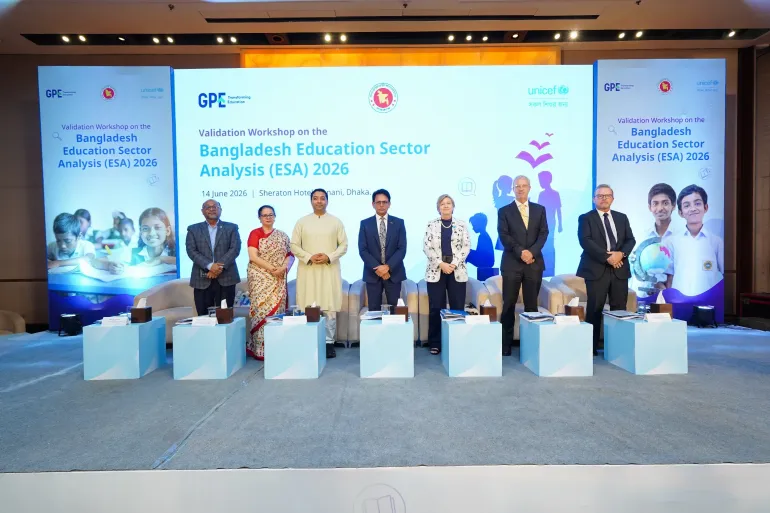
Dhaka, June 14, 2026 – The Government of Bangladesh, in collaboration with UNICEF and development partners under the Global Partnership for Education (GPE), held a high-level validation workshop on the Bangladesh Education Sector Analysis (ESA) 2026 at Hotel Sheraton, Banani, Dhaka. The workshop brought together over 100 participants, including senior government officials, development partners, education experts, academics, researchers, civil society representatives, and media.
The ESA 2026 is a comprehensive, evidence-based review of Bangladesh’s education sector, covering all levels from pre-primary to higher education, as well as cross-cutting areas such as teacher development, governance, financing, inclusion, and the use of technology.
Now in draft form, the ESA presents key findings and recommendations drawn from extensive data analysis and nationwide consultations. The validation workshop provided a platform for stakeholders to review the evidence, offer feedback, and strengthen consensus on priorities for education sector reform.
The ESA is a critical tool for guiding education policy, planning, and investment in Bangladesh. It is expected to support efforts to improve learning outcomes, strengthen equity, and inform longer-term system reforms in response to evolving national priorities and emerging development challenges.
Key trends highlighted in the ESA
- Steady progress in access with persistent gaps: Gains in access and gender parity, yet “last mile” challenges persist in primary access; high dropout rates at all stages of education mean many children do not complete secondary education.
- Learning crisis persists, with half of the children do not have foundational literacy and one in every three children not having foundational numeracy, requiring critical attention: Strong emphasis on foundational skills, such as reading, writing, and math skills, teaching quality, and relevant competencies is required.
- Equity concerns: Continued disparities affecting children from low-income households, remote areas and vulnerable areas, and marginalized groups, including children with disabilities.
- System coordination needs: A complex landscape of providers requiring stronger governance and alignment.
- Financing constraints: Investment levels remain below international benchmarks, with efficiency improvements needed. The burden falls on households who spend considerable amounts out of pocket for children’s education
- Shifting context: Climate change, demographic shifts, digital transformation, and labour market demands are reshaping education priorities.
The workshop was graced by Dr. A N M Ehsanul Hoque Milon, MP, Honourable Minister of Education and Ministry of Primary and Mass Education, as Chief Guest. Special Guests included Mr. Bobby Hajjaj, MP, State Minister, Ministry of Primary and Mass Education; Mr. Md. Daud Miah, Secretary, Technical and Madrasah Education Division; Ms. Rasheda K Chowdhury, Executive Director of CAMPE and Member of the GPE Board; Ms. Rana Flowers, Representative of UNICEF Bangladesh; Mr. Martin Dawson, Deputy Development Director, Foreign, Commonwealth & Development Office; and Mr. Michal Krejza, Head of Development Cooperation, Delegation of the European Union to Bangladesh.
The workshop strengthened shared ownership of the ESA findings and set the stage for finalization of the report. Once completed and validated, the ESA 2026 will inform strategic education reforms, planning, and investments to support a more inclusive and quality education system in Bangladesh.
###
Media contacts
About UNICEF
UNICEF works in some of the world’s toughest places, to reach the world’s most disadvantaged children. Across 190 countries and territories, we work for every child, everywhere, to build a better world for everyone. For more information about UNICEF and its work for children, visit www.unicef.org/bangladesh/